Why You Can’t Scale If You Need To Be The Star
May 05, 2026
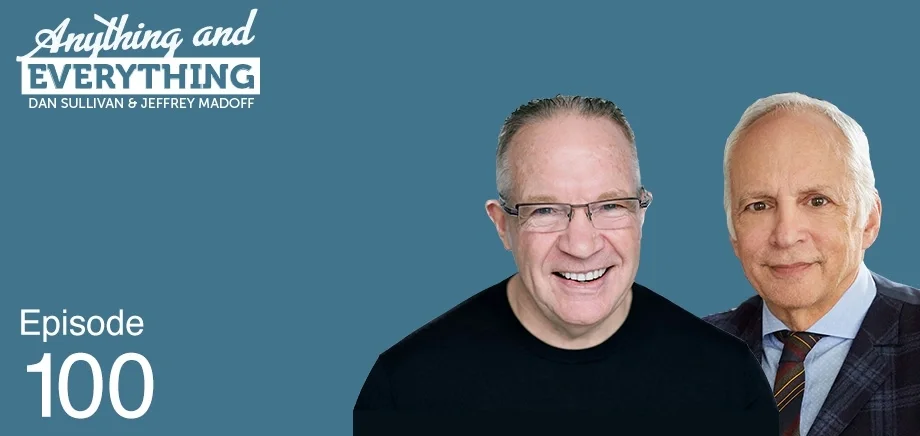
Hosted By
 Dan Sullivan
 Jeffrey Madoff
Plenty of entrepreneurs secretly chase celebrity, but fame can become a trap that limits growth. Dan Sullivan and Jeffrey Madoff explain the dangers of building a personality-based business, and how to design a company where your ideas matter more than your image so your success can scale.
Show Notes:
The strongest businesses are designed so team members can deliver transformative value without the founder in the room.
Great entrepreneurial structures protect the founder from distractions and side projects that don’t support the company’s main future.
Entrepreneurs get into trouble when their excitement about new ideas is interpreted as a commitment to future projects.
Asking thoughtful questions about someone’s idea lets you stay curious without overcommitting your time, brand, or resources.
People project their own fantasies of happiness onto celebrities and assume fame automatically creates a better life.
Dan intentionally shifted from a personality-driven model to building thinking tools and a coaching system so Strategic Coach® could grow beyond him.
Entire industries now manufacture celebrity through events, PR, seating charts, and carefully curated rooms, but security comes from a solid business model and ongoing production.
Relationships are one of the best safeguards against the distortions of celebrity, because true friends will tell you when you’re off track.
In a great company, people are cast into roles that match their unique talents instead of being dropped into generic jobs.
Resources:
Who Not How by Dan Sullivan with Dr. Benjamin Hardy
Casting Not Hiring by Dan Sullivan and Jeffrey Madoff
Learn more about Jeffrey Madoff
Dan Sullivan and Strategic Coach
Episode Transcript
Jeffrey Madoff: This is Jeffrey Madoff and welcome to our podcast called Anything And Everything with my partner, Dan Sullivan. As is often the case, we discover in that world of anything and everything as we stroll around mentally what our topic's going to be. And we've been talking about, and we're gonna continue talking about, celebrity and just what that is and why does celebrity have the power that it does. When Dan, you were talking about in your world, there's a lot of people who know you. You've been around now for 45 years in terms of Strategic Coach. How do you feel being on the receiving end of people being so curious as to who you are?
Dan Sullivan: Well, first of all, I think that celebrity is a force. Either that you went to the right top and you're well known for a particular act or a particular kind of performance, or you've been around for a long time and the word just goes out. I've been fairly consistent. So I've done 52 years just as a coach, and then the actual company, we started getting workshops, so you have not just a person, one person talking to another person, but you have hundreds of people, and we have other coaches, and we have other workshops. Books have come out, so a lot of people know it, podcasts, and the thing is that people get to know you, and something you've done has been especially meaningful to them, an idea, but they don't actually have a relationship with you. You're an authority in their mind on something. So they build you up. They take one experience of you and they make it into a 360 degree, this is how you are. And I'm aware of it, so I don't disrespect it, because it's part of how the word goes out. It doesn't communicate. But, you know, I just try to be normal day in when I actually meet them, you know, ask them questions about why the idea that they made their own. And I like meeting people and I like finding out what their experience is. So I don't find it an onerous thing at all, but I'm aware celebrity is a thing. We live in a very intense communication culture and celebrity is one of the forces in that culture.
Jeffrey Madoff: Which I think it's always been. Yeah, in popular culture, you know, that's always been the case. So that opens up some interesting questions to me. How much of a gap is there between Dan Sullivan on stage and Dan Sullivan, when he bumps into somebody outside of an event, but who might be a member of Strategic Coach, but they bump into you at a restaurant and have never met you before, but, you know, never met you one-on-one before when they did. What's the gap between who Dan is on stage and who Dan is in his regular life?
Dan Sullivan: My approach to it is that it's the same person. One of the ways I do that, I'm never scripted on stage. It's all improv. One way I approach it is that, you know, I have some riffs, you know, like a performer does. I have some stories. And I just did an event this past week. Half the audience had never really encountered me before. So I just go out. I know what the theme is for the day, but the words I'm going to use or the stories come to me as I'm, you know, I was there nine hours I was on front stage. I have sort of a triangle that I try to stick to. One is that whoever I'm on stage with, I'm paying attention to what they're doing, and I try to support whatever they're doing. And the second thing is questions are always great. You know, we're asking the person a question, and you're not picking on something that you know they know the answer. You try to say, well, you know, what you just said there, I remember we were having a conversation three years ago, and you told me this story. Could you tell that story? And they tell the story, and then I ask questions about the story. Well, that's being created in the moment. So I try to do improv as much as I can. And secondly, questions are always really terrific, especially when they have not thought about this before. You know they'll give a good answer, but you don't know what the answer is that they're going to give. It's based on their experience. And the third thing is humor. You try to keep it really light.
Jeffrey Madoff: Is there anybody who you considered to be a celebrity who you wanted to meet or met? And, you know, who do you consider to be a celebrity? If you could have lunch with anybody, who would that be?
Dan Sullivan: I mean, some of them are dead, so that's not possible. I mean, even you recognize your limits. I mean, if speech was okay, I think Shakespeare would be the number one thing. Just spend an evening with Shakespeare. That would be terrific. But I've got like sports heroes. One of my favorite sports heroes, Larry Bird, who's still alive. There's so much about how he conducted himself and performed. I really admire him an enormous amount. And I think that probably of popular things, I just think Roy Orbison created his own genre. He was just such an amazing performer and apparently a very nice person. Everything I've heard about him, he was—he just went out and did his five octaves every night. I try not to look behind the magic of people's performance. In other words, if they're magical at a front stage, I try to let them have their magic, and I don't know what's going on in the back stage. And I do that with people generally. However the best that they want to present who they are, I accept that. I'm not interested in their inner turmoils.
Jeffrey Madoff: Has anybody ever asked you a question or approached you because, of course, they knew who you were? And have you ever wondered, why are they asking me that?
Dan Sullivan: Since I operate in the entrepreneurial world, we have kind of an endless series of people who want to do something with us. You know, they would like to attach what they're doing to what we're doing. And I've got instructions from Babs and my team members how to answer something like that. I used to say, well, that's a really interesting idea. And then immediately there would be a communication with Dan is really interested in this idea. So I can't even say it's an interesting idea. I said, you know, this is where I really resort to questions. Well, how did you get on this path? You know, can you give me the background to this idea? And that way they have to talk about it, but I'm not making any commitment to them. I mean, I'm a sucker for new ideas. So yeah, I've gotten into a lot of trouble because I was excited about their idea. They thought that that was a commitment on my part that we're going to do some future project together. And I've just had to learn how to do that.
Jeffrey Madoff: So why do you think celebrity carries such currency in our popular culture?
Dan Sullivan: I think people have certain ideals. You know, they've read literature, they've read about heroes, and they've read about famous people, and they would like to be attached to that. I think people would like to be attached to what they perceive the other person's life is like. I remember there was … remember the cartoon, it was an old cartoon series, it was called Animal Crackers?
Jeffrey Madoff: No.
Dan Sullivan: Yeah, it was, you know, where you had eight boxes, you know, you tell a little story. Pogo was like that, Pogo Walt Kelly. And there's these two people talking, and he says, I'm reading about this famous movie star, and apparently, you know, he's got five different houses, he's got boats, he's got cars, and it's a sequence, and he's talking about what he does this. Any beautiful woman he wants to go out at night, he can do that, and you've gotten through about six boxes now. And the other person isn't saying anything, and he says, yeah, but does it say that he's happy? And he says, yeah, it says he's very happy, and the other person says, nuts. But we don't know. I mean, we had three podcasts in a row on happiness. You perceive that if you were in their position, you'd be very happy, you know? So I think there's a projection on the part of someone who's not famous, who's not a celebrity. They're projecting what their life would be like if they were famous and they were a celebrity. I think there's a jump in thinking about that.
Jeffrey Madoff: You know, when we were growing up, there weren't nearly as many celebrities as there are. And I think another term for celebrity at this point is also influencer. So I remember Zsa Zsa Gabor. Her primary talent was getting people to know who she was, you know.
Dan Sullivan: She was famous for being famous.
Jeffrey Madoff: That's right. That's right. Because the thing with celebrity is that there is not …
She was married five or six times, wasn’t she?
Jeffrey Madoff: Yeah.
Dan Sullivan: But Johnny Carson would have her on. I remember Jack Parr would have her on. You know, and she was always enjoyable. I mean, she had that, she was Austrian or she was. You know, and she had that very sexy voice and she had big eyelashes, big wig.
Jeffrey Madoff: Yeah. But, you know, she was famous for being famous, as you said. And I always found that kind of fascinating. And I think that social media has allowed many more people to become celebrities. And then if you have enough eyeballs on you, you can sell yourself as an influencer if you can impact the people following you. And it becomes another transactional enterprise. And with the different events that you've attended, at Joe's and others, have you ever ended up with someone who you knew of them, but didn't really know them? And then when you met them, you wonder what's the big deal about this person? I don't get it.
Dan Sullivan: I think that probably the most famous Joe, a year ago, actually, I think it was 2024, on the same stage for an afternoon, he had Robert Kennedy Jr., he had Jordan Peterson, and he had Tucker Carlson. All famous, you know, in their own worlds, you know. I talked a little bit with Jordan Peterson because at that time he lived about three blocks from us in Toronto. He's Canadian. And we just chatted. And I mentioned to him, I said, you know, I've been in Canada since 1971. And I said, I think that you're probably worldwide, you're the most influential Canadian. I said, Marshall McLuhan was kind of that way, but not like you, because the internet has made a huge difference in how well-known someone can be, you know, and he does, you know, lots of videos that go out on YouTube and everything else. And he said, well, that's kind of a sad fact, isn't it, that I'm the most famous Canadian?
And we just chatted, and I mean, he really engages with you when you approach him. He's not looking over your shoulder or saying, it was enjoyable. We talked for about five or 10 minutes, but not really much. He asked what I did, and I told him what I did. And he said, that was really fascinating, the kinds of businesses people can have these days. Yeah, so that was it. There was no, well, we got to get together or anything like that, you know. But my sense is that that I was in an opposite position, that he's very famous. And in that particular setting, you know, I was just a member of the audience. And, you know, so I'm kind of respectful of people's personal life, you know, like this person has a personal life and I'm encountering them in their public life. But that's as far as it goes.
Jeffrey Madoff: Well, and I also, I mean, one of the things that I learned is someone can be quite engaging, which is nice, but they're not your friend.
Dan Sullivan: No. People can be very friendly who are not your friend.
Jeffrey Madoff: That's right. That's right.
Dan Sullivan: And I have my own world that I live in, and they have their own world that they live in.
Jeffrey Madoff: And I think that one can often mistake that kind of behavior for friendship, or also misunderstand the other thing when you say to somebody that's interesting about some idea that you could care less about, but they think, oh, Dan really thought this was interesting. And they have a relationship that they don't necessarily have.
Dan Sullivan: I'm not saying that. I'm interested in a lot of ideas. You know, I'm just interested in different ideas. But that doesn't mean I'm going to bet on them or that doesn't mean I'm going to commit to them. I'm just really, I'm interested in the way people think about things differently. I'm just very interested. I'll tell you one thing, and it answers your question. I knew in the 1980s that we had a much bigger future with Strategic Coach. I could tell that what we were offering and the kind of people who were going to find it very useful was going to grow and grow and grow, and that's still true. That's still true 40 years later. And I was starting to get sort of a celebrity status because I was doing a lot of speeches at conferences back then as part of our marketing. And I said, you know, there's a fork in the road here and we've got to make a decision. And I said, what I'm noticing that everybody in this business is basing it on their personality, you know, that they're a motivational speaker and they get big crowds. And I said, I don't want the company based on a personality model. So that's when I started creating the thinking tools, that we would create a system of thinking for entrepreneurs and that we could have many coaches. If you're a personality, you can't have many knockoffs.
And what I was noticing, and I was hearing stories of the big speakers, that they all attempted to create a program, you know, where, for example, Tony Robbins, who's probably been the most famous of the motivational speakers over the last half century, is that he's made several attempts to have sub coaches, and nobody wants to go to his sub coaches because they want to be in touch with the personality. I meet people who have been in Strategic Coach for 25 years, and this is the first time they've ever met me. They had their own coaches. I want to create a real system here. It can't be based on a personality. It has to be based on other coaches who can coach and have an impact that people find very, very meaningful, and it doesn't require my presence.
Jeffrey Madoff: Yeah, which to me is the ideal business setup. Plus, if you're in demand and there's only one of you, but also you can create something like Free Zone or a premium priced presence within your organization because you've created the scarcity.
Dan Sullivan: Well, there's a progression too. You have to go through layers of growth before you get to Dan. You know, you have to, I mean, trial and error, you know, we've made mistakes and, you know, but that's just, you know, that's life. You just have to make lots of mistakes. I think the best entrepreneurs are just the entrepreneurs who made the most mistakes and corrected them.
Jeffrey Madoff: So what's your biggest mistake?
Dan Sullivan: Yeah, we tried to have licensed coaches in the 1990s where they would virtually have a little Strategic Coach business. And what we found with intellectual property as opposed to meat patties like McDonald's, is that once they know your ideas, they want to know why they're still paying you since they have the ideas now. They say, well, I'd like to have a Strategic Coach company, but I'm going to have some of my ideas, too. And, you know, it just doesn't work. But they had to market. They had to have an administration. It lasted about two years. And they had each acquired about 50 or 60 clients. And we brought them into it and we paid them for any of the clients who were progressing. It just didn't work. And then we hit on the fact that the coaches are our clients who are in the Program. They have their own business, but they like 20, 40 times a year to actually coach Strategic Coach as they learned it. And that's been hugely successful. But it cost us a couple million dollars to get out of the mistake. And it was confusing for our team, and it was confusing for our clients, and it was a major misstep.
Jeffrey Madoff: Well, and sometimes you don't know it's a misstep until you've misstepped.
Dan Sullivan: Yep, yep, yep. But Dan isn't allowed to do that sort of thing anymore. There are strict rules. Dan has to be tightly supervised. I mean, you're good at some things, you're not good at others. In every entrepreneurial business, the originator and the founder is good at certain things, but they're not good at a lot of the things that are required to have a successful business.
Jeffrey Madoff: Right. Well, I think, you know, especially when you're starting out, it's very hard to take on additional overhead. Plus you think that, well, in the time I could explain this to somebody else, I could already have done it myself. And so there's a lot of people that create their own prison because they don't know how to delegate. I mean, I'm thrilled with the play that I have such good business support. In my business, my executive producer did the stuff that I didn't wanna do. And that's not where I brought the greatest value to the business anyhow. I think the best thing in terms of what I know about your structure is that you are kept away from the things that aren't going to develop into the important parts of the business. That the things that you do is where you're creating your tools, that sort of thing, you're doing things that help the entire business go. And so you're not distracted onto little sidebars every place. And I think that takes a real discipline or somebody like Babs to say, no, no, we should not go there or whoever says that. But I think that is a temptation, especially when you're starting off, is to try to control everything. And there's nothing like focus if you're trying to get something done. And there's nothing like distraction to keep you from doing it. And I've experienced both firsthand.
Dan Sullivan: I wanted to ask you a question about Personality as a total company, because it's not only a play on the stage, but it's an entire company of back stage and front stage and everything else. How does this compare with your production companies or big projects that you have had in the past? Is this much more of a well-developed model? Does it have much more working parts than things that you've done in the past? It's very different.
Jeffrey Madoff: And what makes it different is the things that I've done in the past. I had ongoing production. And so, you know, I knew that I'd be in France for those 10 days, you know, and I could book up my calendar and it was an ongoing business. With a play, there's a lot of starts and stops and it's not a source of revenue until you get further along. And going back to the guesses and bets, there's the possibility that it can be very lucrative. There's a possibility that it's not. So an ongoing business and the profitability of that, because I had a very good company with very good clients, that was an adjustment, but that was also, I was willing to take that bet because my mantra became, if not now, when? And I have no regrets for making that decision, even though it's tough. It's a very heavy lift to mount a musical, to mount a play, period, but especially a musical that size.
So I think the main difference is an ongoing business allows you to plan, to anticipate cash flow, all of those things, and the play, you're waiting for that piece of flint that ignites the fire that really goes, and your phrase, which I love, which is making your future bigger than your past. It certainly has that potential, and it's taken on a lot, and it's been an extraordinary experience and continues to be. But, you know, there are those down times that are frustrating and so it's very different from an ongoing business until it becomes an ongoing business. Then you've got the steady overhead and you've got all of those things going on. But one of the first questions I get asked after we do a performance, be it in Chicago or in Pennsylvania or in London, I say, so do you keep the actors on payroll? No, we don't, you know, which means we may have to hire somebody else to replace somebody we really like because they're not available.
Dan Sullivan: Cast, cast.
Jeffrey Madoff: That's right. Sorry, that's right. I should know better. I should know better than this. I want to quote your words back to you there. Yeah, it's a very interesting process. And I mean, that's where Casting Not Hiring came in, because it was, you know, I think it's because I am very much about relationships. And, you know, you don't have a relationship for just one thing. A relationship is, there's a versatility to it. With my closest relationships, there is nothing that's out of bounds, and the strength and encouragement and support that I get is incredibly important. And the fact that I can say to somebody, because it's not a problem to me, when somebody says, oh, this is so great, you must love every second of all this. I say, no, it's hard. And I love what I'm doing. And when we are in process, and when we're auditioning, and rehearsing, and doing previews and performances, it's the most satisfying thing that I have done. And I've done a lot of stuff, but, you know, getting there is a heavy lift.
And I think that a lot of people are unwilling to share that truth about whatever it is they're doing. You're not. I mean, you talk about going bankrupt and the difficulties you had, and it's, of course, a lot better when you're looking back and that bankruptcy was 40-some years earlier, but, you know, it wasn't a straight shot to the stars when you started out. I had as good of clients as you can get in the fashion world and in the academic world. And it was fantastic, but the other parts of it, I think people are often reluctant to talk about, and I'm not reluctant to talk about the hard work it takes, because I think so many people have unreal expectations about what it takes to build—and particularly starting a business is easy. It's sustaining it.
Dan Sullivan: Yeah. Yeah. Well, this is one of the, what I would say the misconceptions about celebrity, you know, that you see the person at their, or they're way up there, but you don't know what it took on their part to get to where they are. And you don't appreciate the single-mindedness oftentimes and the persistence of the person just to stick with something when they had no guarantee whatsoever.
Jeffrey Madoff: Absolutely, that's right, that's right. And it's also, I was talking to a friend earlier today and we were actually talking about celebrity and how people obtain it, how people keep it, and that sort of thing. And I remember one time I was at a big deal party at the Metropolitan Museum of Art in New York, and I was with Liza Minnelli and Caroline Rome. Of course, you know who Liza is, and Caroline was in her time a very famous designer, plus she wrote 12 books and all that. Anyhow, New York Times photographer, and he wanted to get a picture, and Caroline said, stand in the middle. She whispered to me, stand in the middle. I said, what? She said, they can't edit you out of the picture then. I didn't think that way at all, you know? And it was interesting that she said that, and of course, the next day there I was in The New York Times at this event, you know, with them, and the logistics involved when you want to be known and what that takes. And I think there are certain soul-killing parts of it too. It's kind of fascinating. And when you are trying to obtain celebrity, the various strategies that you need to employ.
I mean, there are people, my friend and I were talking about it this morning, this woman who was at the top of the heap in terms of being a publicist and PR person. And she could orchestrate and curate parties. And in your field, she could bring top movie star talent. And, you know, as the lyric in Hampton goes, I want to be in a room where it happens, this person creates that room. And, you know, and you pay a fortune for it. And they monitor all your moves and suggest all your moves and yes, go to this, don't go to that, we'll go to this if I can get you at that table. And it's actually quite fascinating. But in and of itself, it's also, God, I gotta think about all that. It's like the scene in Personality when Louis Armstrong says to Lloyd, you know, you can't ignore a white woman like that. You're lucky she wasn't with some man, all hell could break loose. I said, what do you mean? And he said, she would feel insulted. And you just gotta smile big and act like them asking for your autograph is the greatest gift they could give you. And when you smile a lot and laugh a lot, then you aren't as threatening to them. And Lloyd said, you mean I gotta think about that every time I'm gonna sign an autograph? He said, every time you're gonna sign an autograph and every time in between.
And this woman I'm talking about, I forget who the person was, but her fee was five million a month for several months to place this person in that jet stream that she wanted to be in. And the person who moves those chess pieces around, I mean, I've seen at Ralph Lauren, the seating plans, well, where are we gonna put Anna Wintour? You know, Vogue Magazine, most important. Where are we gonna put this person? Well, we've got these two actors, but one of them's with ICM and the other's with CAA, and you can't put them next to each other, and it's like, an incredible mosaic that has to be arranged to have the right people sitting right next to the right people, because the first thing they will hear is, why did you place me there?
Dan Sullivan: Yep, yep. Everything that takes place on the planet, there's a science and craft on how it happens at the highest levels. Well, you know, it's just the way things work, you know. And if you're willing to take the extra time to get where you want to go, where you can have your own sense of standards about how you want to do it, you can do it. But there are some professions and there are some industries where you got to do it really fast or you miss the window. Both of us are in professions and industries where you can take a great deal of time to get it. I mean, you've been with the play now going on a decade. One of the reasons why it's got still an integrity to the whole thing is that you're willing to take the time to get it right. I don't know how else to do it. Well, there are other ways to do it.
Jeffrey Madoff: Oh, I'm sure there are. I'm sure there are. But when I say that I don't know how else to do it, to me, it's not a small decision to devote myself to something like the play. That's a big, big decision. You know, our book together, that was a big decision. Do I want to spend that amount of time writing this book? And the answer was, yes, because I think there's topics to explore and learn from that several months ago, I couldn't even told you what those were. And so I love the exposure to be able to learn about these things and look at it in a very fresh way. So, you know, I love that. To me, the most precious thing is my time. And as I've gotten older, it's even more precious.
Dan Sullivan: Yeah, yeah.
Jeffrey Madoff: You know, I said to my kids, Jake and Audrey, when they were in high school, if you show up ready, with some questions and on time and polite, you're gonna beat out 85 percent of the people just by showing up. And like Audrey just landed Forbes Magazine and the United Arab Emirates hired her again. And it's like, you know, she's dealing with major clients in interesting ways. And I'm so proud of her. Likewise, with my son, who one of the things he's doing now is also coming out with a new protein bar, but he's got these things he's doing with trading algorithms and stocks, which is very interesting. And both Margaret and I always figured they're gonna find their way. Margaret found her way with the modeling, leaving home, doing that against all odds, me coming to New York and doing what I wanted to do. And so we always wanted Jake and Audrey to do what they wanted to do. You know, they gotta figure out their own life if it's gonna be a satisfying life.
And the funny thing is, and all these things we're talking about in terms of business and ideas, and you're curious about that and all that sort of thing, none of the things that you and I have talked about in terms of how we approach what we do have anything to do with celebrity. It's how do you do and refine and keep growing through the stuff that you're doing. Yeah, because there was always something, and I think I learned this from my parents, is that ultimately people are just people. They got, no matter how accomplished they are, they've got their insecurities and their other stuff going on, and it's the quality and integrity of the person that ultimately matters. So I think that I want to be known for the good work that I do. And believe me, there have been plenty of people, because of what I do, thought that that would be cool to know me, and that was the surest way to repel me. That's not what I was looking for. Yeah, I think having people around you that keep you grounded and know who you are I think is critical.
I was talking to a dear friend of mine, we grew up across the street from each other, and we were just talking yesterday. And she said she was with a group of people, and they're saying, oh yeah, this person and I have been friends for 20 years, this person and I have been friends for 25 years, that sort of thing. And Betsy said, well, and I've got two dear friends that we knew each other before we could walk, you know, and we're still friends and in regular contact. And I think the quality and integrity of the relationships, not only that you have but that you maintain, is incredibly important, because I've got a good group of people that, if I ever strayed from that path, let's say, what the fuck are you doing? That's not you. Of course it’s never come to that, because it's not me. But it is interesting.
Dan Sullivan: Yeah. Yeah, I think the big thing is there's a real craft that has developed out of what we do, and the continual deepening and expanding of the craft is what really interests me. Coaching, you know, I mean, I started coaching when you had to explain what that was, you know; it didn't really exist. I had a notion that this would be a constantly bigger thing in the future with entrepreneurs, just the way the world was going with technology. I said, there's going to be a real market for this. And, you know, I'm as excited about it now as when I got my first client back in 1974.
Jeffrey Madoff: No, I totally get that. That's never routine.
Dan Sullivan: There's something very nourishing about the activity that keeps me fascinated, and the world is changing. But it's interesting, the model that we established in 1989 for the workshops, I just had a podcast where somebody said, you know, there's no industry, there's no company that's going to stay the same now that AI is here. And I said, ours has gone through enormous number of changes. In the economy, in the culture, and it's still the same. It's still the same model. And I said, AI is really interesting, but it's just, there's always been technology that you had to adjust to. There's always new things that you had to look to. And I don't see that this is going to be any different, you know. There's a lot of hype and there's a lot of pitching. The train's leaving if you're not on the train, you know. And I said, you know, this is not technology. This is marketing. We're not dealing with technology here. It's just this is the way people market. You know, it wasn't any different with if you don't learn coding, you know, if you don't learn computer language, you're just going to be left behind. And then Steve Jobs stole graphic user interface from Xerox and off we were running. All you have to do is click. So my sense is that it's not people's job to adjust to AI. I think it's AI's job to adjust to people. And my sense is that people have a way of not adjusting in such a way that your enterprise is going to be a failure unless you start adjusting to them. So I think it has become incredibly user-friendly.
Jeffrey Madoff: Yeah, I think some of the uses are certainly way beyond my comprehension. And those are the things that I think are going to be instituted sooner rather than later in terms of like, machines that can rebuild themselves and stuff like that. But all of those things aren't happening tomorrow.
Dan Sullivan: No.
Jeffrey Madoff: You know, and oftentimes I think that that's a misconception people have on how on the doorstep it is.
Dan Sullivan: Yeah. But this is actually another topic.
Jeffrey Madoff: Yeah. Yeah. Yeah.
Dan Sullivan: But, you know, you have the big celebrities in the world now. And I said, you know, you've always had big celebrities who seem to represent the forces of change, you know, and their problem is that they get ahead of their skis and they start making, you know, they're technology people, but they're making political statements. They're making cultural statements. Some of them are actually making what I would call religious statements about what they've done. They've got a new capability and it's going to be really interesting, but they're not experts on human existence. They're just experts on a piece of technology that does certain things that right now people find fascinating, but might not be that way two years from now.
Jeffrey Madoff: That's right. You know, how it ultimately plays out. I mean, the example I'm going to give isn't the same thing, but I remember when we were changing to millennium, and all hell was gonna break loose with computers all over the world. Y2K. And all these doomsday scenarios, how nothing was gonna work and all that kind of stuff, which ended up being a big nothing. And although I do think there are real questions in terms of AI, even in eliminating entry-level jobs, which there's potential that it can do that in a lot of instances, but then what is the pipeline that people hire trained people through? So there's a lot of knock-on effects that need to be looked at, and that's what I would love us to look into next time, and how to AI-proof your business.
Dan Sullivan: Yeah, yeah. Well, and how to have a partnership with AI that you do what you do and AI does what it does and you bring the two of them together, you know. In the book that we have, Who Not How, is where you, as an individual, just focus on what you're doing and then you have Who's who do other things. If AI is human-like, then AI is the Who that you go to for other things. You know, you just have to adjust to it. But one of the things I find with this prediction about everybody's going to lose their job, you know, there are some human beings who just don't like people. They just really don't like people, and they don't like dealing with people, and they would like to see all the people gone. But I said, you got to love your customers. I was on a podcast and it was talking about robots, and robots are just going to eliminate all the jobs. And I bet, well, who's going to do the buying? Who's going to buy the stuff that the robots create? And the other thing is, if you put somebody out of a job, they're still a voter. I said, you know, politics still matters. You know, you got to pay attention to the things can be voted into. You know, it's like supersonic aircraft, you know, and they find that if you break my windows, I'm not voting for supersonic planes. You know, they've established that 600 miles an hour is about what you can do with an airline over land because you're going to break everybody's windows. We haven't had a faster airline in 70 years.
Jeffrey Madoff: Yeah, well, I had a number of times flew on the Concorde. And the interesting thing is, in spite of the speed, where they thought that all the wealthy business people would take that all the time, because you can get to France in three hours, instead of five and a half hours, or whatever it was, they couldn't sustain the business it went under.
Dan Sullivan: Yeah, so my sense is that we haven't seen this exact thing before, but we've seen things like it.
Jeffrey Madoff: Yeah, and I think it's important to understand what are the unique aspects of it, what is like what was. And, you know, I think that for me, I look at it, but I'm using it in a very small way.
Dan Sullivan: Yeah, me too. But it's a tool. Yep. And it's useful.
Jeffrey Madoff: Yes.
Dan Sullivan: Yes. And I get better at it. I've noticed that I've gotten a lot better at it over the last year. And there's a way of thinking about it that I didn't have a year ago. And now I have the way of thinking about it.
Jeffrey Madoff: Yes, and I think like anything, a hammer, you can build a house or you can beat somebody to death with it. How are you gonna use the tool? And there are people that will use it in ways that enhance their creativity and efficiency and everything else. But when the cell, and I see this so much in all these crap emails I get, is how these companies were able to lay off this many people because now with AI, they didn't need this group. And to me, that's not a selling point. Now, how's this going to make things better? And as you said, you know, it doesn't make it better because you're able to let go of a bunch of people.
Dan Sullivan: Yeah.
Jeffrey Madoff: What makes it better? It's what's, how can this tool be used to enhance what it is we're doing? And I think, show me that, show me what's going to excite me about using it. Not just that I can lay off a bunch of people.
Dan Sullivan: Yep. It's never come up as a conversation. Actually, we have plans for down the road hiring 30 more people than we have right now, you know. It's great. Actually, the book we're writing is part of the vehicle we're going to use to do it. They have to be cast. They can't be hired. They have to be.
Jeffrey Madoff: That's right.
Dan Sullivan: They have to have roles, not jobs.
Jeffrey Madoff: That's right. Yeah.
Dan Sullivan: I think we've done a pretty good job. I think that we stayed within visual distance from the main highway of celebrity. But we could still see the landing strips. We could still see it. But I think the way I approach celebrity is that, you know, in other countries, more European countries, aristocracy and royalty was sort of the celebrity item. In our century, it's become more sports and entertainment. We like our magical heroes. People like magical heroes. And that probably was true 10,000 years ago, and it's still true today. It just takes on different communication forms.
Jeffrey Madoff: Well, I think liking our superheroes is a good way to end. We'll imply that we're superheroes.
Dan Sullivan: Yep.
Jeffrey Madoff: Why not? Yes, you've become a much bigger celebrity in my life than you were before I knew you.
Dan Sullivan: Yep. Yep. Same goes.
Jeffrey Madoff: Thanks for joining us today on our show, Anything And Everything. If you enjoyed it, please share it with a friend. For more about me and my work, visit acreativecareer.com and madoffproductions.com. To learn more about Dan and Strategic Coach, visit strategiccoach.com.
Related Content


The Impact Filter®
Dan Sullivan’s #1 Thinking Tool
Are you tired of feeling overwhelmed by your goals? The Impact Filter is a powerful planning tool that can help you find clarity and focus. It’s a thinking process that filters out everything except the impact you want to have, and it’s the same tool that Dan Sullivan uses in every meeting.