When Technology Becomes Politics And Opportunity
May 13, 2026
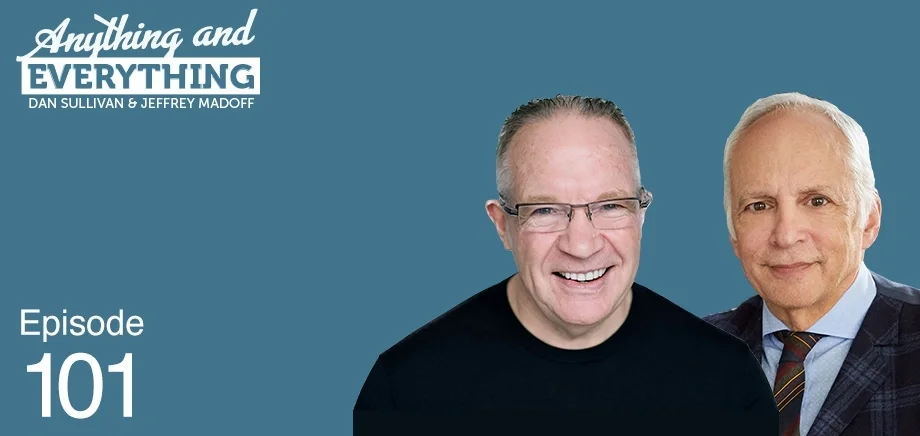
Hosted By
 Dan Sullivan
 Jeffrey Madoff
AI is about to move from a tech debate to a political battleground in the U.S., shaping regulation, jobs, and public opinion. Dan Sullivan and Jeffrey Madoff discuss how parties, voters, and leading tech companies are likely to respond—and why this friction is setting up a new golden age for entrepreneurs.
Show Notes:
There’s always a pause before politics fully catches up to a breakthrough technology like AI, but once it does, the debate quickly becomes intense and adversarial.
Around AI, three early camps are emerging: build as fast as possible, emphasize safety and oversight, and resist on populist grounds that cut across party lines.
We’ve seen this pattern before with industrialization—massive change first, political sorting later.
Big institutions are still trying to figure out AI while individual entrepreneurs are already running hands-on experiments.
A smart move is to keep a sharp human brain between you and the technology so your judgment stays in charge.
Wherever big organizations are slow, confused, or scared to move, entrepreneurs can step in and create new value.
Many business owners are using AI to automate repetitive, low-value activities so their teams can focus on higher-value thinking.
Even when jobs change or disappear, every person is still a buyer and a voter, so backlash is guaranteed.
Entrepreneurs who help clients think clearly about AI and their real problems will become the most important partners in their lives.
When services aren’t being delivered and problems aren’t being solved, that’s where entrepreneurs can build new kinds of value.
Resources:
Who Not How by Dan Sullivan with Dr. Benjamin Hardy
The Great Meltdown by Dan Sullivan
Learn more about Jeffrey Madoff
Dan Sullivan and Strategic Coach®
Episode Transcript
Jeffrey Madoff: This is Jeffrey Madoff, and welcome to our podcast called Anything And Everything with my partner, Dan Sullivan. Hello, everybody. This is Jeff Madoff, and I'm here with my friend and conversationalist, Dan Sullivan. Dan wrote something. I guess I'm telling the audience that because you already know you wrote something, don't you? And so that's it. Thank you for tuning in. Dan wrote an interesting article about AI and the political lens that things are viewed through. And I want to open up, Dan, when we go into that article, what inspired you to write it in the first place?
Dan Sullivan: First thing, there's two subjects which I'm very interested in, and this goes back a long way, and one of them is technology and the other one is politics. So I've always, from an early age, been very interested in both topics, and I consider both of them as realities, that there's a political reality and there's a technological reality. But for the most part, when you have a brand-new technology, like AI is, there's a little pause in the action before the political dimension gets really, really involved in a technology. It has a lot to do in the United States because the United States by design is an adversarial system. And that is that when one party is in the ascendant or they have been more successful, then the other party becomes the opposition party. And generally on any issue, if the one political party takes a particular stand or begins pushing certain programs and policies regarding a new thing, the other side will take the oppositional side. And that's just the way the system is designed.
I think there's only been two elections in U.S. history when there weren't two major parties contesting, and it's largely been our present two parties before the Civil War. The only time since the Civil War—no third-party candidate has ever won—but only once has a third party been the second in the election. That was Teddy Roosevelt in 1912, who had been a Republican, but then he created his own party and ran against both the Republican and Wilson, who was Taft, who was the president, and Wilson, who was the challenger. And Teddy Roosevelt, very popular, got second. But that's the only time it's ever happened in U.S. history. The only other one was George Washington when there were no parties. So he became president. But outside of that, there's always been two contesting major parties, and it has to do with the Electoral College. For example, Ross Perot.
Jeffrey Madoff: Oh, the chicken man.
Dan Sullivan: That great sound you hear, sucking sound. And he had charts. I always remember he had charts and he would always do his charts. And in the first election, he took 26% of the popular vote, but no electoral votes. So the system is really geared to have the two parties contesting. So in my article, I just projected what might be on a series of 10 different issues, what the democratic approach would be on it. and what the Republican approach would be on it. And I said, these things are going to be contested politically.
Jeffrey Madoff: So what's interesting about it is that you wrote out this very clear map on these 10 ideas and how you saw them unfolding. You know, in the stuff that I'm reading about it, there seems to be three distinct camps that are forming. One of them is build as fast as possible. You know, that's like Sam Altman and OpenAI and that sort of thing. And then a safety and oversight camp that includes companies like Anthropic, you know, and I'll get into their contributions later. And then there's a populist resistance that cuts across party lines. And I'm wondering where you think that entrepreneurs fit into these camps? Because is the two-party framework the right lens at this point for something like this? Or are we watching something new emerge that may not fit traditional partisan categories? I mean, when you have Bernie Sanders and Steve Bannon agreeing, you know, what happened? And there is that kind of a thing going on, maybe we're into something that's different.
Dan Sullivan: Yeah.
Jeffrey Madoff: And I'm wondering your thoughts on this.
Dan Sullivan: Well, first of all, there's precedence for this happened. It happened over industrialization. You know, there was Eugene Debs was a very famous socialist and William Jennings Bryan was a very populist. I think he ran in four elections, ‘90s in the first decade of the country. Yeah, well, it's not a complete 360-degree map with the two parties. There's always gaps in the map where an entirely new issue has emerged that neither of them either has any commitment to or they don't have any feel for it yet. So I think that happens. The build it fast, well, that's part of the technological system that you have to get it because there's competitors here. One of them wants to be the top dog, but AI seems to have all sorts of different dimensions that no corporation seems to have a real feel for. I saw a quote once, there's nothing more dangerous in the United States than a new capability in the hands of consumers. You give individuals something new, they do something new with it. And I think all sorts of great and varied experiments are being attempted at the entrepreneurial level.
You mentioned before in a frequent podcast all the coaching programs that are out there. Jeff, between now and July, you can get a real handle. If you just sign up for our online program, we'll show you how to get a real handle on … I got a very confident feeling that you're not going to take him up on the offer.
Jeffrey Madoff: You're right.
Dan Sullivan: You and I, I think, are in agreement on one fundamental approach to all technology, and that is, for the most part, keep a smart human between you and the technologies.
Jeffrey Madoff: Yeah, and I also think that AI—and you talk about this in your article that you wrote about AI getting dragged into the culture wars. And I think there's an interesting argument because some of these things aren't polarized yet, where before that has happened, I don't think anybody was happy with Elon Musk's sexual renderings of people that were submitting things. And I think that there are a lot of things that cut across these party lines. Basically what that means is they haven't been captured by partisan warfare yet. There needs to be some kinds of agreement. If that's true, is there a strategic opportunity here for entrepreneurs, a window where they can help shape the conversation before it hardens into that red versus blue position?
Dan Sullivan: Yeah, I think so. Entrepreneurs, at least my experience of the ones who've been in the program, for the most part, they're seeing, is there something in this that gives me a specific advantage right now, just where I am in relationship to my marketplace? Okay. So I did a survey—I just had an event about two weeks ago with my very top level of The Strategic Coach Program, which is called the Free Zone. And I did a survey, it was just a hands up or hands not up. And I said, how many of you are using AI now for some practical reason in your companies? And every hand went up. And I said, how many of you have seen an economic payoff? In other words, things are happening faster, easier. You're getting a bigger result. You're getting a better result with some area that you were already working on in your company, but you've added this new technology as a Who. You've actually brought in a technological Who. And all the hands went up. And I said, from your experience, how many of the things that you're doing would be observable and measurable from the outside of what you're doing? And no hands went up.
So what I think is that there's a lot of activity going on where entrepreneurs are experimenting for their own practical reasons, and not necessarily long-range reasons, but short-range reasons. And I can name my own where I've done that, where it's happening, but it's not happening at a macro level. It's just happening at the level of one entrepreneur in relationship to their business and their marketplace. They're introducing this new technology. It's usually an activity that's repetitive, that used to take this amount of time and cost this amount of money, and now it's happening much faster, but it's a needed activity in their company. So I think there's millions, maybe billions of little experiments that are going on that would not be observable to the media that covers government employees or corporate employees that are looking for economic indicators. I think there's an enormous amount of creative experimental activity practically based going on, but it's not really surfaced at all in such a way that you'd say, well, this is a big trend.
Jeffrey Madoff: The trend that I have seen is people purporting to understand the trends. And here's how you can use AI to up your productivity and cut down on the people you employ. So you can make more money, save more money. So the old how to use it, I have the key to unlock the door to the secrets of AI that can make your business more profitable and all of that kind of a thing.
Dan Sullivan: I should say that's happened with all technologies that I've witnessed over the last 50 years. That people are selling against it, so to speak, in terms of … well, they're selling for a competitive advantage, that if you get in early, you'll get this advantage, because these advantages only last a certain period of time.
Jeffrey Madoff: Right, right. I mean, it makes me think of, and I literally just thought of it this second as you were saying it, I think of how IBM made their money. And IBM made their money not by selling mainframes, but by staffing the people that knew how to work the mainframes, you know, the contracts. So there would be many, many people under contract to IBM, but they'd be working out of different companies. And they were kind of the, the human touch technology, so to speak, not in the same way we're talking about it in today's world, but in a way it was, it was the human filter between the advanced technology at that time and how the use case that made it a good investment for a company to do that.
Dan Sullivan: Yeah, one of the sort of a slogan or a strategy that's emerged inside Strategic Coach has to do with the relationship between you as a provider of products and services and clients and customers. And I think it holds true very much in what's happening right now. And I said, the problem is not the problem. The problem is that your customers don't even know how to think about the problem and that your greatest service is to show them actually how to even think about this from a strategic tactical standpoint.
Jeffrey Madoff: So I was very much in that position back when I started doing video production. And this was, you know, in the mid-seventies. At that time, the department store was Bloomingdale’s. And one of my first clients was a designer, Halston. So when I shot his shows, which was new at that time, and I met with people from Bloomingdale's and said, you should be playing these videos at the point of purchase. It will attract people on that. They said, well, it doesn't work for us. And I said, what do you mean it doesn't work? And she picks up a VHS cassette and said, I mean, these don't work. And I said, what do you mean they don't work? What are you trying to play it with? Well, they had a Fairchild projector, which was an eight millimeter tape loop that salespeople used to use back in the ‘50s. He was trying to shove the videotape into the Fairchild projector and said, well, you're not using it right. That's why it's not working for you.
And it was really interesting because that was a hands-on example that I experienced firsthand because I saw the resistance, even in a simple story, the fact that the potential user didn't know how to use the product I was trying to sell them. And so there's always, I think, that educational yeah yeah journey that you've got to go on to, first of all convince them to even try it, because it's much easier to just out of hand say no it doesn't work for us. I would always probe, why doesn't it work? What is it not doing well? It doesn't even fit into what we have here. Well, because that wasn't made to play videotapes. That was made to play eight-millimeter cartridges. And it's just kind of funny, because I think on different levels that's happening with AI. It's happened with every innovation.
Dan Sullivan: Yeah, yeah. Yeah, I think that the education is a big part of the money-making in the early stages of any technological boom is actually education. They're thinking in old terms, and the old terms, you can't do anything with the old terms. With the new technology, you have to create a bridge.
Jeffrey Madoff: Yes, absolutely. And I think that's really important because I don't think a lot of people get that. And I think that's critical. And that bridge means you are using past application to build a bridge towards a future application that can be more effective for your purposes. But you have to understand even what you're doing to be able to get over there.
Dan Sullivan: I have a question for you and use it in that special case. Is there a reason why there's a resistance on the part of the Bloomingdale’s in this case? And is their problem is that their existing model for, you know, presenting their products and presenting their service has worked so well that they bought into the fact that nothing will replace it?
Jeffrey Madoff: I think that it's a couple of things. I think that human nature, there's a resistance to change, period. I don't care what business you're in. When there is a change that is significant and is going to carry forward, there's just a resistance to that. The other thing in a retail store, every square inch of that store is expecting an ROI. So if you take a VHS player and then you have a screen, and there weren't the big flat screens back then. You know, you're taking up counter space or shelf space. You could, you know, hide the player, but you had to have the screen out there. So that was, they weren't turning over merchandise in that. So to give up what they thought was, well, this, you know, this square footage that this takes up, we're turning our retail over.
Dan Sullivan: How many stores did you happen to know roughly? How many stores did Bloomingdale's, because my awareness is they were national, right? Bloomingdale's was.
Jeffrey Madoff: They were, but my lens was more like from Ralph Lauren. We'd be sending out 1500 tapes globally.
Dan Sullivan: Yeah.
Jeffrey Madoff: Every season. So you do have to overcome that aspect of human nature. Then you have to overcome the …
Dan Sullivan: And there's actually technological changes that have to be made, too. They have to get a different viewer.
Jeffrey Madoff: That's right, and a different player.
Dan Sullivan: Not a different, they have to get one. Not only that, but they need a new vice president for that.
Jeffrey Madoff: That's right.
Dan Sullivan: And a team that comes along with that.
Jeffrey Madoff: It's really interesting what goes into the calculus of an idea even being worth trying, you know, because a lot of things just sort of die in the crib, so to speak, because they're afraid to do anything different or to try to justify that.
Dan Sullivan: Do you remember the steps that you obviously, Ralph, was successful in making the jump and you were responsible for creating the videos? Do you remember the series of steps? Was it just one store that you tried it out with? Is that how it started, where they were willing to take the risk on one store?
Jeffrey Madoff: It was interesting. My initial pitch first to Halston himself, I actually just called and I was able to get him on the phone, which was crazy.
Dan Sullivan: Revolutionary.
Jeffrey Madoff: That's right. That's right. Revolutionary experience from the past. That's right. And so this is quite coincidental. I got an email around the first of the year. And it was from a wonderful woman, Anne Magnin. And Anne, she was from the Magnin family of I and Joseph Magnin in San Francisco, big retailers at that time, huge retailers at that time. Anne was head of public relations for Ralph Lauren. She's the one that brought me in and introduced me to Ralph. I haven't seen her in 20 years, at least, and she's a wonderful person. And she sent me an email and she said, you know, I was just thinking about you and thinking about the times we had together and wondering how you are and all that. Anyhow, we ended up having breakfast together on Friday. And it was wonderful. It was absolutely wonderful. And we were talking about some of this stuff and just, you know, the changes, because those were the real salad days of American fashion. Also, they weren't all bought up by conglomerates at that time, like Kering and LVMH. And so there was the test case with Halston already out there and was aware of that.
And yeah, we didn't start making that many duplicates initially, but it went to that very quickly because they saw the value. And my initial sale to both Halston and to Ralph himself was, where are you during a fashion show? And of course, they're back stage, you're doing the last touches on the model before they send them down the runway. I said, so actually during the show, you're back stage. So what is your source of information in terms of how it looked in motion on the runway, how the press and buyers were responding, their expressions, anything? And I said, well, I'm back stage, but you know, I've got my people. I said, you've got your people who are afraid to say anything that isn't complimentary. And you want to be able to know, how did this work in front of the audience? Because you're going to get the applause at the end, but during that 25 minutes of the show parade happening on the runway, you don't know what's going on. And they're only going to tell you what you want to hear.
Well, I'm giving you something that you can play back immediately and look at it, see how the models move into close, see who's reacting, who's talking to each other, who's taking the notes, all of that. Plus, I've got something that every buyer appointment that you have, they can be in the showroom waiting area and watching the video and priming them or what they're going to be seeing in person when they work on their open device and the merchandising and so on of the lines. So both Halston and Ralph got it right away. Took a while for that to get adopted on a bigger scale, but that just became routine. And that was really, really interesting. And just one other sidebar it made me think of …
Dan Sullivan: Just a question, were they sort of front runners in the fashion world?
Jeffrey Madoff: Oh, yeah. Yes. And they all watch each other.
Dan Sullivan: Yes, of course.
Jeffrey Madoff: I mean, if you can imagine, when I started in the business, it was just still photographers. I was the only video crew. And, you know, they were popping out their flashbulbs. There would be like a carpeting of flashbulbs. You walked around, you'd be crunching flashbulbs. I mean, it was a very different time. But at Times Square, there was the Sony Jumbotron. You remember that? That was the only large screen. When I was working with Sony, Sony gave that up. I said, how much are you paying for that? And they said, $5,000 a month. And so we can save 60,000 a year—on the heaviest trafficked place in the United States.
Dan Sullivan: Yes. And you've got the only screen.
Jeffrey Madoff: That's right. That's why I was like, wow, who thinks like that?
Dan Sullivan: They could be making $5,000 an hour.
Jeffrey Madoff: That's right, that's right, that's right. I mean, now when you go to Times Square, it's like daylight when you're there, because there's so many large screens. Yeah, I mean, it's fascinating, the resistance to change, and then how fast the adoption can be, because then what happens is fear of missing out starts again, that the competition is, you know, out-distancing you because you haven't moved off the mark yet. I mean, you remember, it wasn't that long ago that people were afraid to put their credit card numbers on a website. They didn't want to purchase. Nobody thought that anybody would purchase clothes online because you can't try them on, plus you have to give your credit card number. You know, it was very, very different.
Dan Sullivan: Yeah, it's very interesting. And sometimes there's accidents that happen that become breakthroughs. And one of them that I can think of, I have a client of Phoenix and he's got a transportation company. And it's very interesting because a lot of buildings today are actually being built in factories and modules are being shipped by truck to the building site and the cranes just take the module. For example, all the bathroom units are made in a factory and then they're just shipped. But one of his things that he ought to overcome, did it arrive in time? Because the whole point of modular construction is that you're saving an enormous amount of time. So in order to give proof to his customers that they arrived in time, he put cameras on the building site and the cameras had, they were time clocked. It would say exactly when this happened. His truck would pull up and the train would take the module unit off the truck and it would place it in the building. And from the beginning of the project to the end, it would be filmed.
So he had all these films laying around for every project that he did, and he did it for his own protection, that he could prove that they were paying for it to arrive on time, and he's got the film that proves that it arrives on time. And then he met a film producer, somebody who created films, and he said, you got a goldmine there with your films. So what he would do is he would take all the footage, which was basically around the clock, because a lot of the value is that you could have things arrive in the middle of the night, and you could have an overnight crew who could do it. So it was 24 hours. It was just hundreds and hundreds of hours. And the film producer said, I'll speed it up. And he says, I'll give you a film that shows the production of the entire site in 20 minutes from bare earth to a finished project.
And so with every project at the end of the project, he didn't promise this and he didn't say anything about it, but he'd give the contractor, the person who is responsible for building the building, he said, I thought you might be interested in having a film. And they started using it for all their marketing. And no other person in his industry, I mean, he's in a sort of a new industry, and he's in 35 states. He produces buildings, but they're all factory built. They're not his factories, and the construction sites are not his projects. but he's responsible for making sure everything arrives on time. And it's just amazing, but that's an accident. He was doing it for another purpose, and it became a huge plus. And then the developers would use the films to sell their projects to investors and say, I'll show you how fast our buildings go up and how quickly we can go in. So that shows that was sort of an accident that happened, but it became a big deal.
Jeffrey Madoff: Yeah, I actually, I think the first person I did that with was Ralph, because he would build these really beautiful sets. And I said, we should show this process. People love seeing how things are done.
Dan Sullivan: Oh, back stage.
Jeffrey Madoff: Yes. So I convinced him to do that. But the way I convinced him to do it is I only did it with one camera first, so I could show him what it looked like. So he could see very quickly how the set was built and went together. And it was really cool looking and a neat opening. And so I did that with Victoria's Secret and Halston in a number of places, showing that process and we set up the time interval and how many frames you want to capture. Then you collapse what was done over the course of 10 days into five minutes. And it's really dynamic and fun to do. And of course, everybody's also looking at who your customers are. And that's a great example you gave of taking something that he was doing for self-protection and turning it into a marketing tool.
Dan Sullivan: Yeah, he never charged for that. It was just added value to work, just added. So it all counts. You know, everything you do is marketing in one respect or another. If you do something extraordinarily well, it's part of your marketing.
Jeffrey Madoff: Oh, absolutely. Absolutely. So, going back to your AI article, one of the places where I think you're clearly right and it's really interesting is your section on election integrity. And deep fakes, that really resonates. And the different approaches to content moderation between those who want platform accountability, you know, and those who fear censorship with, you know, real debates. And we're seeing that. And your China national security section captures genuine tensions. For entrepreneurs navigating this space, which of these fault lines do you think crystallizes first and which might stay fluid longer?
Dan Sullivan: Well, I think that where the technology enters the political realm quickest is just election campaigns. That's at the national level, but it's also at the state level and the municipal level. And so the big thing is that how cleverly and how impactful can you use AI to get your message across and to differentiate the stark difference between yourself and the other party, you know, and I think that—and this is a very creative activity that is very tempted to get into fiction. You know, there's facts which can be checked, but there's also fancy and that you can actually move over and take a risk of presenting your opponent … and usually it's oppositional. I would say that for most elections, the emphasis on saying bad things about your opponent.
Jeffrey Madoff: I mean, that's a part of every election, has been from probably going back to Caesar.
Dan Sullivan: Way before Caesar.
Jeffrey Madoff: True, true.
Dan Sullivan: I mean, if there's elections, it only enters the realm when there's actual elections. But Athens had elections, and I'm sure they were scurrilous in all their descriptions. That's where rhetoric, I think, started. But that's, you can already see that. I mean, we have the midterms, national midterms coming up, and you can see that we're into the primary season, where each party selects its opponents or reinforces the officeholder that they already have. But this is a huge area, and content for this is almost everything. But, you know, this year, immigration is the big thing, the use of police forces to capture undocumented immigrants and deporting them and everything. That's a huge issue. And that's a very emotional issue. And you can see how both sides are already playing it.
Affordability is a big issue. You know, we're still coming out of the COVID period when prices went through the roof because supply chains were not able to deliver product at a low cost and everything. So every economic, political issue, cultural issue, social issue immediately becomes content. And this is all coming out in video form. But on the other hand, AI is being used to analyze voting trends. It's being used to make projections on what issues will play. These were already done, but it was done more or less by hand, and now it's done by machine. You know, so there's …
Jeffrey Madoff: But the thing that I keep coming back to—I agree with all that. And I'd like to address this. I'm not so sure you address this in your article. Open AI reportedly has put over a hundred million into a Super PAC for the midterms and Anthropic put in 20 million. So this is big political spending from AI companies. How does that change or does it change your framework? And should entrepreneurs be thinking less about partisan positioning and more about industry influence dynamics?
Dan Sullivan: Yeah, I mean, from an entrepreneurial standpoint, you use the same logic in politics. I've been involved in about 10 political campaigns on a voluntary basis in my life. The one thing about politics as an entrepreneur, you never take money for it. Because if you take money for it, you've been paid. But if you do it voluntarily, they can never pay you off for the services. That's one thing I learned as an entrepreneur. You do it for… technically, I'm putting it in quotation marks, for “free.” But the big thing is that it's a big cost if your candidate doesn't win in the short run. It's a big cost, because you're putting a lot of time and energy, and at the cost of other opportunities that you could be developing.
But to a certain extent, your future prospects as an entrepreneur can be very, very influenced by who wins the election. What's taxation going to be like? What's regulation going to be like? And there's big money being spent, and that money makes its way down to the entrepreneurial level. The greatest money is government money. And you have to be knowledgeable. I mean, if you're going to play that game, you have to be very knowledgeable about the issues. You have to be very knowledgeable. And I would say now that all marketing companies who are entrepreneurial companies have to be fluent in AI. They have to understand AI.
Jeffrey Madoff: What I'm saying is that the money going into that and, you know, big companies always hedge their bets. They don't just place it on one person, that it's kind of beyond partisan politics. Everybody is looking to get the money for campaigns, have influence, all of that sort of thing. And I think about the parallel with cryptocurrency. A few years ago, nobody in Washington cared about crypto. And when money flooded in, another FOMO aspect, fear of missing out, goes, yeah, I knew this person, they put in $10,000 and it's now worth $180,000. Good luck. But now Washington cares because there was massive lobbying and limited opposition to that lobbying. And it's become a political issue because our own president is profited from that. So it shows kind of a shifting landscape. Do you think AI is going to be absorbed into partisan politics like cryptocurrency? So what if industrial money reshapes the landscape? Does industry money reshape the entire landscape before traditional positions even matter?
Dan Sullivan: Well, you know, I had a podcast with Dean Jackson on this and he was saying, you know, the new videos, you can't tell whether they're real or not. He says you have the issue is, what are you seeing and hearing? Is it actually real? You know, that's an issue now. And I would say, yeah, but there's one constraining factor is that individual attention can only be applied to one thing at one time. We're not multi-attention brains. And I said, so the competition is getting fiercer for the same amount of attention.
Jeffrey Madoff: Which has been true for the last probably 20 years.
Dan Sullivan: Well, it's been true for the last 2,000 years.
Jeffrey Madoff: But the acceleration of that, yes.
Dan Sullivan: Yeah, and I think the competition is there. And the other thing is, it's my experience that most political decisions are not based on policies except how it affects the individual voter. It's either yes, I like it, or no, I don't like it. And the question is, what is influencing, I like it or I don't like it? I think people are very economical with their voting activity. Most people don't want to spend much time thinking about politics. They don't want to spend much time working out the issues, okay? And the reason is they're busy running their lives. They're busy making a living. They're busy. And the question is, is what's coming across for your party—is it likable? Is it likable? Is it something that people actually like? And there's momentum that gets created when word of mouth—it's not so much the AI impact as what's the word of mouth as a result of AI impact, because it's mostly individual talking, people are talking, and I just don't like the guy, you know? Sorry, I just don't like the person.
Jeffrey Madoff: Well, but I think there's something else at work here that's more concrete. Like you said, the deep fakes that are harder and harder to distinguish, the potential of the job displacement. But the most visible impact right now seems to be much more literal, which is the creation of data centers in small towns. And with those data centers, you know, the not-in-my-backyard attitude towards the data centers and people not wanting them because one of the reasons they don't want them is it spikes their own utility costs.
Dan Sullivan: Oh yes, very much so.
Jeffrey Madoff: So there is backlash about that and I'm sure that in those communities that becomes also, the political lines get more blurred among the populace who live there, because none of them want that in there. They don't want their utility bills to be higher. That's not what they're looking for. And so my question is, I think that local backlash is going to be significant. It's already happening. And how should entrepreneurs be thinking about that? And especially the aspect of, you know, they're not in my backyard, you know, what do you think about that?
Dan Sullivan: The vast majority of entrepreneurial activity will not be involved with this issue. You know, it's selling marketing and selling the products they're already selling. The only question is, what does it do to my local market? What's it do to my industry? And I haven't really taken a real solid look at the data centers. I mean, some states are really big on them where they have a plentiful energy. It all depends on what your energy costs were before. The communities are unequal in the amount of energy they have.
Jeffrey Madoff: That's true, but the constant is if you live there, your costs are going to go up.
Dan Sullivan: Yeah, yeah, yeah. And the other thing is a data center takes thousands of people to build a data center. It has a plus is that there's a lot of local employment. You know, that I was studying the TSMC, which is the big chip maker from Taiwan, has just put in a 20,000-employee factory north of Phoenix. Well, it's an entire city that they've built there, you know, because you have all the workers' houses, you have new businesses coming in. So it can have a positive effect because it's actually increasing the amount of employment and the economic, and that's not a data center, but it uses as much energy for the new chip factory as a data center would use. So it has that factor. And people have a whole number of issues. They have a whole number of issues that makes it hard to find out what their central issue is.
Jeffrey Madoff: I think it's hard for people to figure out what their central issue is because they're belted with so much that, you know, figuring out what really affects me.
Dan Sullivan: But they will make a decision. And it's voting this way or voting that way or not voting at all. All three of them are decisions. But this is constant. This is not something new in the historical framework. I mean, this has always been a contentious thing in the United States, any country where you have the basic framework is life, liberty, and the pursuit of happiness becomes very contentious because people are not in agreement with life is, but not necessarily liberty and pursuit of happiness, you know, and everything else. Yeah, the big thing that I'm saying is that the way that people normalize new technologies is through the political process.
Jeffrey Madoff: Explain that.
Dan Sullivan: Yeah, well, first of all, the issue is taken apart. Just as my article indicates, there's at least 10 major dimensions here that are going to be entering into. And I will say this, I don't think the technology companies have any control over what becomes a political issue. Well, they're really busy just trying to compete with the other companies. I mean, they have big marketing issues, but they don't have a lot of freedom of mind to think about how is this going to land because I think with AI, it's fairly unpredictable.
Jeffrey Madoff: Yeah, but also the amount of funding that is going into campaigns from AI companies is quite significant. So how those decisions are made are going to challenge the norm. I think I mentioned earlier that Bernie Sanders and Steve Bannon are both fighting data center construction. Progressive tech skeptics are aligned with right-wing populists about AI and infrastructure. What I find interesting is this suggests, and I don't know how much it'll manifest, obviously, but this suggests that the Democrat, Republican, or conservative, liberal, or whatever, those binaries break down on certain issues. And I'm wondering, what does that mean for how entrepreneurs should think about stakeholders and opposition? Or is that something that, that's the maelstrom they're not necessarily stepping into?
Dan Sullivan: Well, and historically, there's been a real shift of where the parties themselves stand. When I was growing up, you know, in the ‘50s and ‘60s, the rich people were the Republicans. Okay, now they're the Democrats. I mean, the vast majority of Silicon Valley people were solidly on the Democratic side.
Jeffrey Madoff: Well, that's out the window. I mean, look at Tim Cook and Zuckerberg and Bezos and all of them. You know, that used to be the case, but that's shifted.
Dan Sullivan: That's proof that they shift.
Jeffrey Madoff: Oh, yeah, yeah, yeah. And for what reason? It's not necessarily a better idea. It's who's in power and who can say no to us.
Dan Sullivan: Yeah. Government departments have budgets, and they never want to see their budget next year less than their budget this year. Your prime thing is to keep your budget equal to or greater for next year. And there's a genius of industry, and I think Elon Musk is a genius. He knew when to talk to a senior bureaucrat a month before the budget was up, and they had money in the budget, and he got the money. And that's part of playing the game. You just have to know when to ask for the money. And he's a very good spokesman for visionary greatness that might be true.
Jeffrey Madoff: I remember this was something that I learned early on in business that surprised me. I didn't know this before that, you know, when you got to the, you wanted to get that fourth quarter money because if they didn't spend, they would get their budgets cut back because they had excess.
Dan Sullivan: Everyone, everyone have excess.
Jeffrey Madoff: That's right. Because then they won't give me as much next year.
Dan Sullivan: Yeah, I think the big thing is that I think that what we're witnessing is a movement as big as the movement from an agricultural economy to an industrial economy.
Jeffrey Madoff: Which took a couple centuries.
Dan Sullivan: Well, in the United States, it took about 30 years, 30 or 40 years. And there are some generations that really get hammered and never really recover. There was just an enormous number of unemployed men who had been working on farms and then they couldn't make the shift. I mean, the majority of the U.S. economy in 1900 was still agricultural, but by 1930, it wasn't.
Jeffrey Madoff: I don't know when that shift happened. Assuming that you're correct on that, the interesting thing is there was that major shift.
Dan Sullivan: Yeah, yeah. And the parties have to be very, very alert to which direction the shift is going. And my feeling, early 20th century, the Democrats were much more prescient about where the economy was going than the Republicans were.
Jeffrey Madoff: I am thinking, and tell me what you think on this, I'm thinking that it's still binary to a degree, but I think that the categories are not nearly as compacted and siloed as they were.
Dan Sullivan: Well, not yet. Not yet. It's so early in the game. We're three years into it. And I think it would be better if you had a 25-year framework to look at what's happened in the 2020s, ‘30s, and ‘40s. And you'll see that there's a shift.
Jeffrey Madoff: Yeah, and also what's interesting is I think that from agricultural to factory-based, those changes, although it took decades, let's say, for those changes to happen, I think that the turnover rate is faster now. I mean, look, we went from the internet and how things are searched for, AI is totally upending that. You know, that's, what is that, a 25-year, not even, yeah, 25-year turnaround? So, you know, I think that these major changes, and if AI comes anywhere near what the predictions are, that's another really major shift pretty quickly. I don't know how quickly people adapt to that and businesses adapt to that.
Dan Sullivan: Well, the adaption is really fundamentally controlled by how fast people adapt. In other words, every person put out of work by AI is still a voter. And I was talking to Peter, he says, well, the robots are going to replace. And I said, who's going to do all the purchasing to keep the economy going?
Jeffrey Madoff: That's right. Absolutely. That's right.
Dan Sullivan: I said, every person is both a voter and a consumer, and they have a right to vote. And corporations are all graded on quarterly results. You get two or three bad quarters in a row, and your CEO is heading for the door.
Jeffrey Madoff: Right. And usually with a huge check to get them out.
Dan Sullivan: Well, it's okay. It's okay.
Jeffrey Madoff: And never learn how to sail upwards. That's it.
Dan Sullivan: It's a game. It's a game.
Jeffrey Madoff: Oh, that's true. And I've met people and contacted and done business with the people that have mastered that, although they would never admit that. But I'm thinking, wow, you paid 20, and this is a real number, you paid 27 million to buy that person out of their contract. They were that destructive to the company. How in the hell did you hire them in the first place and not notice that? And I've seen that happen at least four times, five times in the view that I have, which is not huge. It's interesting. But also, I mean, your very well-made point, well, who's gonna be buying this stuff? It's also, if all these entry-level jobs are taken over by AI, how is the workforce trained? You know, you're coming up into what? You need to have some background.
Dan Sullivan: Yeah, it's really interesting about that because I've got one of my little books quarterly and it's called Big Systems Falling Apart. And the thesis of the little book is that the boomers were the biggest American generation ever, not to be exceeded. There will never be a generation as big as the baby. I think it was 78 million. When the country had a population of about 130 million, it was just a massive population. You're a member of it. And those people, you know, really understood systems. You know, when you think about the development of the economy since the 1940s and ‘50s right up until just recently, there were people there that had 30, 40, 50 years of experience in being in large systems and knowing how to respond to changes there. And I think that two events, the ‘08-‘09 subprime loan crisis in the U.S. and COVID, the two of them, one of the notable features of those is in order to save money, people bought off their senior highest paid workers. Happened in the airlines especially, senior pilots were bought off, senior cabin crews were bought off, the people who ran the entire operations of the airport facilities, the ground crews. Everybody who had a really high salary was given an early inducement to retire.
And what went out the door with them was institutional knowledge. And what I mean by institutional knowledge, there's the way things are written up in the rulebook of how you do your job. That represents about 10% of how the job is actually done when unusual things happen. You know, people just know how to, for example, when 9-11 happened in New York City, there were a lot of people who had enormous amounts of experience of how you put things back together and get business going. If 9-11 happened today, I doubt if the government workers in New York and everybody else would have the ability to adjust as quickly as they did in 9-11, because the institutional knowledge just isn't there. I mean, when you have a big blizzard and you have garbage, how do you get rid of it during a big blizzard? I bet they knew more about that 20 years ago than they know about it today.
Dan Sullivan: Why is that? Well, because they've been replaced with people who don't have as much experience.
Jeffrey Madoff: Right.
Jeffrey Madoff: And so that calls back the earlier question is those entry level jobs where you learn that stuff and you come up through the ranks. Who's going to be filling in those positions?
Dan Sullivan: Well, I would say that this is a very, very major political issue, the one that you just talked about.
Jeffrey Madoff: Yeah, I think so, too.
Dan Sullivan: I mean, who works as a child these days? You know, who has a job above the board? First of all, child labor laws came in. I worked when I was 11 years onward. I had jobs, you know, even in stores where you cleaned up. You know, you came in at four o'clock and you cleaned up for an hour and it was cash and it never went on the company's books or anything else, but it was a job, you know. It may be that there's lots of stuff happening that's just not recorded. There's just money being exchanged that's being recorded, yeah.
Jeffrey Madoff: Yeah, but it's one thing to hire the kid to do what you're saying. Quite another thing when …
Dan Sullivan: But you're talking about corporations. I'm talking about small businesses here, so it's a big difference. Big corporations are just not hiring people with master's degrees from very prestige universities. They're just not getting entry-level jobs.
Jeffrey Madoff: Yeah, and I think how that unfolds is a big issue.
Dan Sullivan: So that's a big political issue.
Jeffrey Madoff: Yes. And so in 2026, the midterms, are you expecting AI to be a defining issue this year? You know, because there's AI regulations, all of these things that we've been talking about for the last hour and a half or so. Do you think that there could be so much backlash going on? Or I don't even know what to call it. I think that, I mean, I do think AI is going to be a very big issue in this midterms. And I think that they've got certain rallying points, like trying to keep data centers out of their area. Regulation of, did we learn anything from social media not being regulated? And of course, who's going to do the regulating? Because a lot of the people in government don't know anything about AI in any meaningful way.
Dan Sullivan: Yeah, I don't think the midterms because I think that some of the issues for the midterms are already determined because what's happening at the high national level this time.
Jeffrey Madoff: Referring to what?
Dan Sullivan: Well, referring to the president and everything he's doing. I think he's an unusual political leader from the standpoint of he's such a lightning rod. Good or bad, he's for or against. But I think 28's where you really see it because you will have had five or six years more of trends really developing, more than they are now. I think most people watching our podcast here wouldn't necessarily know what we were talking about. Two or three years from now, I think they'll know what we're talking about.
Jeffrey Madoff: To all of you listening, make sure you save the link to this recording, as you can see, you were there when? But I do think the midterms are going to be extremely important because there could be a shift in the conflict over presidential power. And I think that that's significant. And I think that doesn't have anything to do with the AI we're talking about.
Dan Sullivan: I mean, there are other political issues besides this one. I mean, I'm just saying. But in my lifetime, I haven't seen one quite as big as this one from a technological standpoint. This impacts on everything.
Jeffrey Madoff: Yeah, it does. And because it has the potential to disrupt so many jobs and how people will enter into the workforce, do you see this as a potential boom for entrepreneurs?
Dan Sullivan: That I do believe.
Jeffrey Madoff: And how so?
Dan Sullivan: Well, first of all, I think that wherever you have big institutions, and that would be both private sector and public sector, not comprehending a major problem. And it's very, very disruptive. And they're kind of paralyzed. I think that most decision making processes in big corporations are fairly paralyzed right now. And wherever that happens, there's still things that need to be done. And entrepreneurs are the ones who fill in the gap. Wherever there's paralysis of service not being developed, problems not being solved, that's great opportunity for entrepreneurs. I think it's going to be a golden age for entrepreneurs.
Jeffrey Madoff: That's interesting.
Dan Sullivan: First of all, I think they're going to be a lot faster of adjusting to AI within their own organizations and utilizing AI. So I think the adaption rate in the entrepreneurial sector is going to be much faster than it is in the corporate employment sector.
Jeffrey Madoff: Well, I think big advantage is that you have less decision makers and it's a smaller business. And as a result, you can be more nimble.
Dan Sullivan: Yeah. Yeah. Yeah. I mean, as far as I know, everybody in our company is using AI for something.
Jeffrey Madoff: Yeah. And I think it can be from very simple to very complex. Well, I think we may have another two-parter here because I think there's a lot more to get into, because my main thing is that I don't believe that. And I know you laid it out in a particular way and how you wrote that article, which I think was great kindling that sparked this kind of discussion, which I think is really not only interesting, but important in terms of gaining understanding of that. But I do think that it's not so neatly binary anymore in this discussion that Democrats want this and that and Republicans want this and that. And, you know, that's where they're different, because there's more and more spillover in terms of what's happening. And that's something else that, you know, it took a while to gin up this horribly polarized situation that we have. It's also going to take some time for that to unspool, but there are rallying points around a lot of these things that are attracting some strange bedfellows. And how that plays out, who knows? But I think there's some things that we can continue to explore that could be quite interesting for our audience. Certainly, at least even if the audience is just you and me. I think it can be quite interesting.
Dan Sullivan: Yeah. Hey, Jeff, why don't we plan a weekend together and we'll just go wild with our own podcasts and just watch ourselves? You know, my sense is that politics is a constant presence in all things that happen in our society. And the one thing that I'm sort of conscious of that a lot of my entrepreneurs are, they say, well, that's just politics. And I said, you know, you're like a fish saying that's just water.
Jeffrey Madoff: Yeah, exactly.
Dan Sullivan: Yeah. I said, it's all political. I said, everything that happens to people in a particular environment has political issues. And some of them are bigger than others. Some of them are related to the future. Some of them are related to the past. And it's important to be aware of these things because they will affect the decision-making of people who are writing you checks.
Jeffrey Madoff: I think that that's true. And I also think that we are the last really big thing that I can think of that was going to disrupt everything, which was a big nothing, which was Y2K. But that's very different from AI, which can affect everything from entry-level jobs to the highest level of scientific pattern-making and, you know, gene mapping and protein mapping and folding and all of that sort of a thing. And I think it's also going to have a huge effect. It's already having a huge effect on search and people who shop online. The data's getting more and more murky because people are going to, whether they're searching with Gemini or whatever they're searching with, it's not click throughs, which was what was measurable, which determined algorithms, which determined purchasing and your audience and so on. There's just so many things that are now being tossed in the air on all fronts that I think it's absolutely, I mean, it's fascinating.
Dan Sullivan: No, it's very disruptive right now. Everything's being disrupted. It's a bit of an earthquake. But the thing is that there's some fixed points. There's always going to be two parties in the United States, you know, and all the talk about a third party and never … I mean, a party can fall apart. I mean, the one that really fell apart was the Whig Party. You know, Abraham Lincoln was a member of the Whig Party, but they went soft on slavery. They were a northern, more entrepreneurial party, and they just didn't take a strong position on slavery. And they fell apart, and the Republicans came out of it. So a party can fall apart. I mean, the Democrats have been in since 1828, 1828 then. Republicans came in 1856, but they've been very durable, very durable.
Jeffrey Madoff: What you just mentioned, which I wrote down at the beginning of our conversation, we're talking about, you know, technology and the massive disruption and jobs and the economic waves that causes slavery did that. And, you know, which led to the Civil War. And obviously, I hope we don't go anywhere near that. But there is that polarization. And this is, in some people's eyes, as destabilizing as changing the economic engine that slavery was in the South. You know, we've dealt with major disruptions before, which isn't to minimize the impact. It's just to say that we're back to the human nature aspect again.
Dan Sullivan: Yeah, yeah, yeah. Yeah, I think at the center, and this is my position basically because of the life that I've chosen, I think the country was designed as an entrepreneurial republic and the most important activity in the country right from the beginning was entrepreneurial, and they build a whole series of structures and laws to guarantee that that entrepreneurial activity goes on. That wouldn't be true in Canada, for example. That's not true in Canada. They don't have that same orientation towards people making guesses, taking bets, and getting payoffs on new ideas. And it's, you know, it's why people came over in boats for 3,000 miles. They came here for a chance to do something new. And I think the central mentality of the country is still, let's try out something new and see if it works.
Jeffrey Madoff: Yeah, and I would add to it, what I think is a big question is, ideally, what is the role of government? And how is that role facilitated? And I think there's always this tug of war going on between innovation and regulation. And of course, all of these things, which I think are hugely important questions.
Dan Sullivan: Oh, no, me too. Me too. And there's a wisdom about understanding what the long-range consequences are of a present decision. And I think that’s good government really partakes of that particular issue. We're looking down the road 50 years. If we make this decision now, what's it look like 50 years from now? And you can do that in a prosperous, dynamic country in a way you can't do in a failing country.
Jeffrey Madoff: It's interesting, you can also go across the country and you can see the dinosaur bones of things that were very viable businesses when we were coming up. I mean, you know, the idea of the shopping mall had its run. The department store had its run. You know, JCPenney, Sears, Montgomery Wards. I mean, that was major. Outdoor movie theater. I mean, on and on. And I think it's really interesting sometimes to pause and take stock of what's going on, and then when we're faced with something as disruptive as AI could be, and how it actually plays out, which can be very, very different things. I still don't know that it's not going to deliver on its utopian or its dystopian or somewhere in between, but I'm guessing somewhere in between, because there will always be bad actors, no matter what, that will corrupt something, but there will also be people that will figure out things that can be hugely beneficial.
Dan Sullivan: Yeah, I think what works on a constant basis is what wins out. You know, like there's certain things that just win. I mean, I can write the structure of a new quarterly book in three hours now where it used to take me three weeks. It's freed up an enormous amount of time for lots of conversations inside the company. My time has just gotten enormously freed up in the last two years.
Jeffrey Madoff: Yeah, and so today, have we run around the perimeter of anything and everything, or are we reasonably focused? I think we're reasonably focused today, actually.
Dan Sullivan: Well, fortunately, it's for us to say.
Jeffrey Madoff: So I'm trying to do is having us control the narrative.
Dan Sullivan: Yeah. Yeah. Yeah. No, it's just that a lot of people don't take into account that everything that's bothersome about a new technology will become a political issue. It's one of the ways that we complain. We make it into a political issue.
Jeffrey Madoff: Yeah. Although I don't remember how everything becoming so political as it has in our recent history.
Dan Sullivan: We don't know. We didn't live in those other areas.
Jeffrey Madoff: Well, it gets into then reincarnation, which …
Dan Sullivan: No, I just mean, we can say how things were a hundred years ago, but none of us really know how things were.
Jeffrey Madoff: That's true. That is true. I remember, regarding reincarnation, I remember somebody saying to me, I was just back in college, I was out with this woman and she said, so you don't believe in reincarnation? And I said, no shit, how can you not believe in it? Do you think that this is it? You know, when you die, that's it? I said, no, my question is, how do you explain?
Dan Sullivan: Well, that's not reincarnation.
Jeffrey Madoff: No, that's not. That's just life after death.
Dan Sullivan: That's a different issue from reincarnation.
Jeffrey Madoff: My question, as I told her about reincarnation, was how does the population grow? That was the only date we ever had, by the way, with each other.
Dan Sullivan: I think that's a tough dating requirement.
Jeffrey Madoff: Yeah. Well, you know, you learn.
Dan Sullivan: I'm talking about on her side. That's a that's a tough standard.
Jeffrey Madoff: Yes. Yes, it was.
Dan Sullivan: Do you believe in picking up the check? Now that's an important dating …
Jeffrey Madoff: That's correct. That's right. Yeah. I think this was anything and everything.
Dan Sullivan: Yeah, I think it was good. It's interesting. You know, it's just that I don't find it troublesome that things become political issues. There is this belief in technology that we will make politics unnecessary.
Jeffrey Madoff: I guess you have to define politics. I mean, I don't mind that things become political. I mind when things are frozen into opposition without critical thinking and without open dialogue and informed debate.
Dan Sullivan: Yeah.
Jeffrey Madoff: Yeah. I think that's how you reach the best decisions.
Dan Sullivan: Well, yeah. I think things get worked out. First of all, voting happens in millions of different levels and places in the United States. I mean, things can creep up out of a local issue that becomes a state issue that becomes a regional issue and everything like that. So I think politics is the way you achieve useful change without violence.
Jeffrey Madoff: Good definition.
Dan Sullivan: Yeah. Yeah. That's how you achieve it. I remember the 2000 election, you know, between Gore and Bush, and people saying, this is terrible, the contentiousness. I said, I doubt if there's been a punch thrown in this whole thing. I said, there's been a lot of shouting, there's been a lot of argument. But I said, you know, people arguing loudly is not violence.
Jeffrey Madoff: No, but I think back to John Dean who ran for president. John, there's Howard. Howard Dean was Watergate, wasn't it?
Dan Sullivan: No, John Dean was Watergate. Howard Dean is senator or governor from Vermont.
Jeffrey Madoff: Yeah, I think senator. That's right. I remember when he unexpectedly won the Iowa primary. And he's like, yeah, that's like that. And it tanked his campaign because he was, you know, framed as being a lunatic. Yeah. And I thought, my God, you know, what used to be considered unacceptable behavior. Where are we now? And and just how that that upended things. I mean, it's so quaint in retrospect. You know, I can understand why he was so happy that he won unexpectedly. But it's just funny how things become amplified or disappear over time. Thanks for joining us today on our show, Anything And Everything. If you enjoyed it, please share it with a friend. For more about me and my work, visit acreativecareer.com and madoffproductions.com. To learn more about Dan and Strategic Coach, visit strategiccoach.com.
Related Content


The Impact Filter®
Dan Sullivan’s #1 Thinking Tool
Are you tired of feeling overwhelmed by your goals? The Impact Filter is a powerful planning tool that can help you find clarity and focus. It’s a thinking process that filters out everything except the impact you want to have, and it’s the same tool that Dan Sullivan uses in every meeting.