Why Your Kind Of Smart Is Exactly What The World Needs
February 24, 2026

Hosted By
 Dan Sullivan
 Shannon Waller
Do you ever catch yourself frustrated that other people don’t think or perform the way you do? In this episode, Dan Sullivan and Shannon Waller reveal why that difference is actually good news. Discover how appreciating your own uniqueness frees you from comparison, deepens teamwork, and helps you recognize the countless ways other people are smart and useful.
Here’s some of what you’ll learn in this episode:
- Why it’s a good thing that no one else is like you.
- How comparing yourself to others drains your confidence and progress.
- Why complaining that others are different is really the same as complaining about your success.
- How to quickly spot the specific way another person is smart and uniquely valuable.
Show Notes:
Wanting to be unique while also blaming others for not being like you is a mental trap that creates frustration and resentment.
As an entrepreneur, your success comes from being usefully different in the marketplace, not from everyone else sharing your strengths or level of intelligence.
Profiles like Kolbe, CliftonStrengths®, DISC, and Working Genius® make it obvious that every person is wired in a distinct way that can be incredibly valuable.
The fact that other people don’t see what you see or think how you think is good news because it proves your uniqueness has real marketplace value.
When you measure other people against your own personal “ideal,” you drop them into “The Gap” instead of appreciating the real progress and capability they already have.
The moment you genuinely appreciate your own uniqueness, it becomes much easier and more natural to appreciate other people’s uniqueness too.
Better teamwork happens when collaborators don’t have the same skills, instincts, and talents because each person covers gaps the others can’t see or fill.
A powerful question to uncover someone’s intelligence is, “When it’s completely up to you, what do you most like to do?” and then keep asking curious follow-up questions.
You’ll quickly discover that even people who don’t seem “smart” in your way are often extraordinarily knowledgeable and perceptive in areas you know nothing about.
Most of the useful progress in the world has come from people without formal credentials who simply applied their kind of intelligence to real-world results.
Being okay with the way you’re smart liberates you from constant comparison so you can focus on deepening your strengths and expanding your contribution.
Unique Ability® combines what you love doing, what you’re exceptionally good at, what gives you energy, and what consistently creates value for others.
When you commit to getting better and more useful with your Unique Ability, you naturally attract opportunities, collaborators, and clients who value exactly how you think.
Trying to be good at everything or match other people’s strengths keeps you average, while doubling down on your Unique Ability makes you extraordinary.
Appreciating your own uniqueness removes blame, anger, and guilt from relationships and replaces them with curiosity, respect, and more strategic collaboration.
The most productive entrepreneurial communities are built around uniquely different people who share common rules and values, not around everyone being the same.
Resources:
The Gap And The Gain by Dan Sullivan with Dr. Benjamin Hardy
Episode Transcript
Shannon Waller: Hi, Shannon Waller here, and welcome to Inside Strategic Coach with Dan Sullivan. Dan, we were both in Chicago not that long ago, and I was in the room when you wrote this on the smart board. I thought, oh, this will be such a great, great podcast, because you had been noticing that people were observing slash complaining that other people were not doing things the way that they did them, and you had an insight. So can you please share the quote that you wrote up on the board? Because I think it's a great conversational topic and something we can all fall prey to.
Dan Sullivan: Yeah, I just wrote that insanity is wanting to be unique from everyone else and also blaming other people for not being like you.
Shannon Waller: Can't have it both ways, I think is what you're saying.
Dan Sullivan: Yeah, we did a previous podcast on liking yourself, you know, if you like yourself. And the thing is that we do some really great profiles, like we have the Kolbe profile, we have the Strengths.
Shannon Waller: CliftonStrengths, yeah.
Dan Sullivan: CliftonStrengths, and we do DiSC, and we do PRINT, and we do Working Genius, and all these profiles. You can tell by the different scores, I think with PRINT, like what, 72 different profiles?
Shannon Waller: Yeah, combination.
Dan Sullivan: Yeah, combination profiles, that you're really unique. But one of the things you strive for as an entrepreneur is that who you are in the marketplace is seen as really unique from everyone else in the marketplace, okay? So my sense is that the fact that other people aren't like me is good news. It's sort of good news. But I was having a conversation with someone who's very smart, but I noticed him just complaining how stupid other people are. You know, they don't see this, they don't see that. And I said, yeah, but you've been very, very successful because you're a lot smarter than other people. You're a lot better at what you do. So what's the problem? So what's the problem? I mean, on the one hand, you're a lot smarter and I have proof of it. I mean, I find you incredibly insightful. I find you very, very brilliant. But at the same time, you're complaining about other people not being as smart as you. So what's the issue? I mean, what's going on here?
One of my strengths is Context. And I don't know how you explain Context, Shannon, but mine is I want to know where things come from. When something happens, I want to know what the history of this is. Where did this start? Are there any situations in history that have happened like this before? And what else contributes to this? And I've liked AI very much for this fact that you read an article that somebody has written on a particular topic and you can tell they have a particular take on the topic. They say, this is the reason why this is happening. And I read it, and then I take the link to the article, and I go to Perplexity, which is my favorite AI tool, and I say, tell me 10 things about this topic that the author doesn't talk about, which are also important reasons why it's happening. That'd be the type of prompt. And give it to me in 30-word sentences. Give me a nice, bold, compelling, and convincing headline and everything else, and shoop, like that. What I say is he either doesn't know about this or doesn't think it's important.
And what I've noticed is that it has, on the one hand, it's made me a lot smarter about a lot of subjects than I would have been if I had just taken the one article's point of view. But on the other hand, it's deprived me of a lot of pleasure of reading articles because with every article, my brain says, I bet there's 10 other things that are responsible for the thing that he's talking to. So, you know, like reading The Wall Street Journal, which has been, but I'm just noticing that the article is just taking one approach. You know, there's many dimensions to what he's talking about. But my desire to do that comes from context. I wanna know what's really going on here. Yeah, this is one thing that happened by why that happened. The reason that this happened in history is because of this. And I said, yeah, that and 20 other things.
Shannon Waller: It sounds like it makes you that much more discerning, Dan, right?
Dan Sullivan: Yeah, but when other people can't do it, I'm not angry at them. I just appreciate, you know, you've got this ability to really be curious about where things come from. But the fact that this isn't some other person's skill doesn't bother me at all. You can't have it both ways. You can't want to be unique and then blame other people for not being like you.
Shannon Waller: It's true. Well, it's actually putting other people into The Gap, right? So measuring them against an ideal, you're super smart, whomever, or you have this capability, and then why doesn't everyone else? You're putting them in The Gap, as opposed to appreciating your own uniqueness. And when you make that flip, when you appreciate your own uniqueness, then you also get to appreciate other people's. Right? So I know for me, I know how I'm unique. My profile's not dissimilar from yours in a lot of ways. But then I really appreciate people who are very different than I am. Because they're equipped with skills and talents and capabilities and patience that I do not have. It is not factory installed. And so I can build teamwork because I have that appreciation, nor do I try and put myself in situations for which I'm not suited, and without guilt, by the way, also, which is lovely, or not feeling badly about it. So it's interesting, the mindset that you're talking about, you know, thinking everyone else should be like you, which is totally a gap statement, when you flip it, so much more becomes possible. What's your take on that?
Dan Sullivan: Yeah, well, you know, I'm almost 82 right now, and more and more I'm appreciating that the incredible number of different ways of being smart, there's many ways for people to be smart. We've tended, I think, as higher education has become more and more important, that you're not smart if you don't have a college degree. But most of the useful progress that's made in the world is as a result of the activities of people who don't have a college degree. And actually, it's becoming more and more apparent that college education is an indicator of being really handicapped when you're being put into a situation where you've got to solve problems and you have to get things done. So I'm sure there's very, very smart college people who are really, really smart and it shows up in their life afterwards. But I think there's a lot of people who are great at taking tests and they're great at being a student. But once they're not a student, they're not very smart at all.
Shannon Waller: And the implication there is not terribly useful.
Dan Sullivan: Yeah. So the big thing I like to appreciate is that, well, they're not smart in the way that I'm smart, but how are they smart? And then if you start asking questions, and usually a good question that I find is, when it's left up to you, what is the thing that you like doing most? It could be a hobby, it could be everything else. And then you just keep asking them questions. And you begin to realize that there's a tremendous amount of knowledge they have about that topic. And they're very clear that they would be able to spot someone who said they knew something about this, but they said, you don't know anything about it. I can tell right off the bat, you don't know anything about it. And so I think humans are just smart in an infinite number of ways. And I think that it goes back to a certain sense is being okay with the way that you're smart about things, then it frees you up from making comparisons.
Shannon Waller: Oh, so that's really why this is so important, because it frees you up from making comparisons.
Dan Sullivan: Yeah. Yeah.
Shannon Waller: Yeah. Comparisons aren't getting you any further ahead.
Dan Sullivan: Yeah. Some famous person said it's the thief of joy.
Shannon Waller: You know, Theodore Roosevelt, I think.
Dan Sullivan: Yeah.
Shannon Waller: Yeah. Comparison is a thief of joy. And it doesn't facilitate teamwork and it doesn't keep you curious.
Dan Sullivan: Well, it doesn't make you happy and it doesn't make them happy. Yeah. Yeah.
Shannon Waller: No happiness recipe there. Dan, I feel like your question is going to be my new cocktail party question. What's the thing you like doing most? What a great question.
Dan Sullivan: Well, if you are left to do something. And it could be anything. What do you like doing most?
Shannon Waller: Yeah, I love that.
Dan Sullivan: Yeah, and the thing is that really quickly you realize this person knows all sorts of things that you don't know about a particular something. Yeah. And that's interesting to me. It's just interesting all the different ways that people can be smart about things.
Shannon Waller: Well, it's interesting because going back to your context conversations, giving you context about them, right? So then you can like, oh, and maybe if you want to take it further, hey, I could make use of that or someone else could, or here's an idea for you. You know, you help to reinforce that particular area of intelligence and capability. Yeah, that is really neat. And one of the things we talk about at Coach, and you talk about coaches based on the idea of Unique Ability, which is people, what do they love to do and what are they best at? And it's most essential. So that's just a neat way to get at that information and make people reflect and think. And I think it's actually, even if you have experienced a ton of success, it's a very interesting personal question to ask yourself. Because people get away from, you know, left to their own devices. What would they like to do most? So I think that's a very provocative, subtle, but provocative question.
Dan Sullivan: Yeah.
Shannon Waller: Yeah.
Dan Sullivan: You're thinking two thoughts, each of which makes the other impossible. That's insanity. Yeah, you know, there's insanity is doing the same thing and expecting a different outcome, a better outcome or a different outcome. But it just strikes me that if you have a unique skill and Unique Ability, just keep getting better at it, but also make yourself useful with it. I was reading very famous American physicist, Richard Feynman.
Shannon Waller: Oh, I love Richard Feynman. Yes.
Dan Sullivan: Yeah. And he worked on the atom bomb when he was very young. He was in his, I think, twenties, late twenties. But I bought a book of interviews with him, the transcribed interviews. And he was saying that one of his great skills was he knew how to crack safes. And it's not so much that he understood the mechanics of the safe, he understood the ways that people create combinations for a safe. It was more of a psychological thing. And he was talking, he was at Oak Ridge. Los Alamos is where they actually created the bomb, but the real scientific research and testing was really done at Oak Ridge, Tennessee. Just a fact about Oak Ridge, that in 1944, so that was a full year, and then the bomb was July to August of 1945, the atomic lab at Oak Ridge used up one-sixth of the electricity in the United States that year.
Shannon Waller: Really? Wow.
Dan Sullivan: Science uses up a lot of energy, but he visited with someone who was there. You know, he had a security clearance. He was a scientist. So they had the latest information. They divided it into nine different parts and put one part in this safe, another part in another safe. So they would take the information that made a hole and they break it into nine parts so that if somehow they got into a safe, and so, you know, this is kind of like an obsession with him. The guy went out of the room, and, you know, within about five minutes, he had cracked the safe. So he wrote a note, and he put it on top of the files. He said, I can't believe how easy this was, and he put a note there. And then his obsession took him even further, where he wanted to know where the other eight safes were. So gradually, over a period of a week or so, he had found himself in a room with a safe, and he had cracked it, and the second one was the same combination as the first one. And then he went safe by safe, and all nine of them, the person used the same combination. So in each time he cracked the safe, he said, I can't believe you're using the same combination. And these are little cryptic notes, you know, and it gets more and more insulting as it goes on, you know.
So finally, you know, after a day or two days, the person is going, he opens the safe, he's, oh, somebody's been in the safe. And the secretary says, well, what about the other six? And he was just frantic. These were the nation's secrets. This was the greatest technological project of the Second World War. And he was just white. So Richard Feynman said, I did it. And he put his arms around it, and he said, you know, oh, thank God it was you. But he found that people who can be incredibly smart, you know, they're geniuses and scientists, but psychologically, when they give a combination to a safe, they can be just as stupid as can be. So he tells this long story, and it goes on for pages and pages and pages, how he developed this interest as a kid. You know, he's very mathematical, because it would be the type of activity someone who was great at math would probably do, but he was great at psychology, too.
So he gets to the end of the story, and this is, I think, actually a speech he gets. You know, he's invited in, you know, Richard Feynman worked on the atom bomb. So he gets to the end of it, and he says, yeah, then while I was doing all this safe cracking, we worked on the atom bomb. And that was the end of the speech. And the other thing was bongo drums. He was a really good bongo drum player and everything else. But a wonderful witty, you know, this is really fun. Then he talks about the first time the bomb actually went off. So, you know, they're out in the desert and they're in a bunker. And, you know, they weren't sure. They didn't really know. And there's this loud boom. And somebody said, what was that? He said, that was the bomb. And then the person sitting there said, oh, what we've done. Oh, my God, what have you done? And he says, a little late to think about that. Yeah.
Shannon Waller: Yeah.
Dan Sullivan: A lot of them really had severe mental, psychological problems.
Shannon Waller: Well, it's interesting, Dan, this is a good description of what people do when they don't have context. They can work on an isolated problem and get really into it and be intellectual in all the things, really smart, but then they step back and go, oh my gosh, what have we just done? Which is kind of fascinating.
Dan Sullivan: Yeah, and I think why our concept of Unique Ability is so important is because if you're smart about it, you keep deepening your appreciation of just how unique it is. And that gets you out of comparison with other people.
Shannon Waller: I think that's really true, Dan. Gallup has a really great description of their definition of strength. It's talent times investment equals a strength. And a strength is something where when you do it, you accomplish or you achieve near perfect performance. Who doesn't want that?
Dan Sullivan: Yeah, and the other thing is that it's so energizing for you that you'll put in a tremendous amount of time on it.
Shannon Waller: And other people get energy from you. It gives you energy. That's another part of our definition. And you can always see room to get better, right? So you love doing it. You have superior skill. You have a passion for it. It gives you energy. You can always see room to get better. It creates value. You're a hero to other people for doing it. It's not that it's not work, but it's also play. It's just such a pleasurable experience. And really paying attention to that and going in that direction and appreciating it, as you said, means that you're not comparing yourself to other people, like how we started with the definition of insanity. And instead, you can appreciate your own uniqueness, which again, I don't know anyone who's good at appreciating other people's uniqueness unless they first appreciate their own. I don't know of any other way that that works. Otherwise, you expect other people to be just like you or not as good. So I love how this circles back to Unique Ability, Dan. I think that's 100% what the solution is. Awesome. Thank you so much.
Dan Sullivan: My pleasure.
Related Content

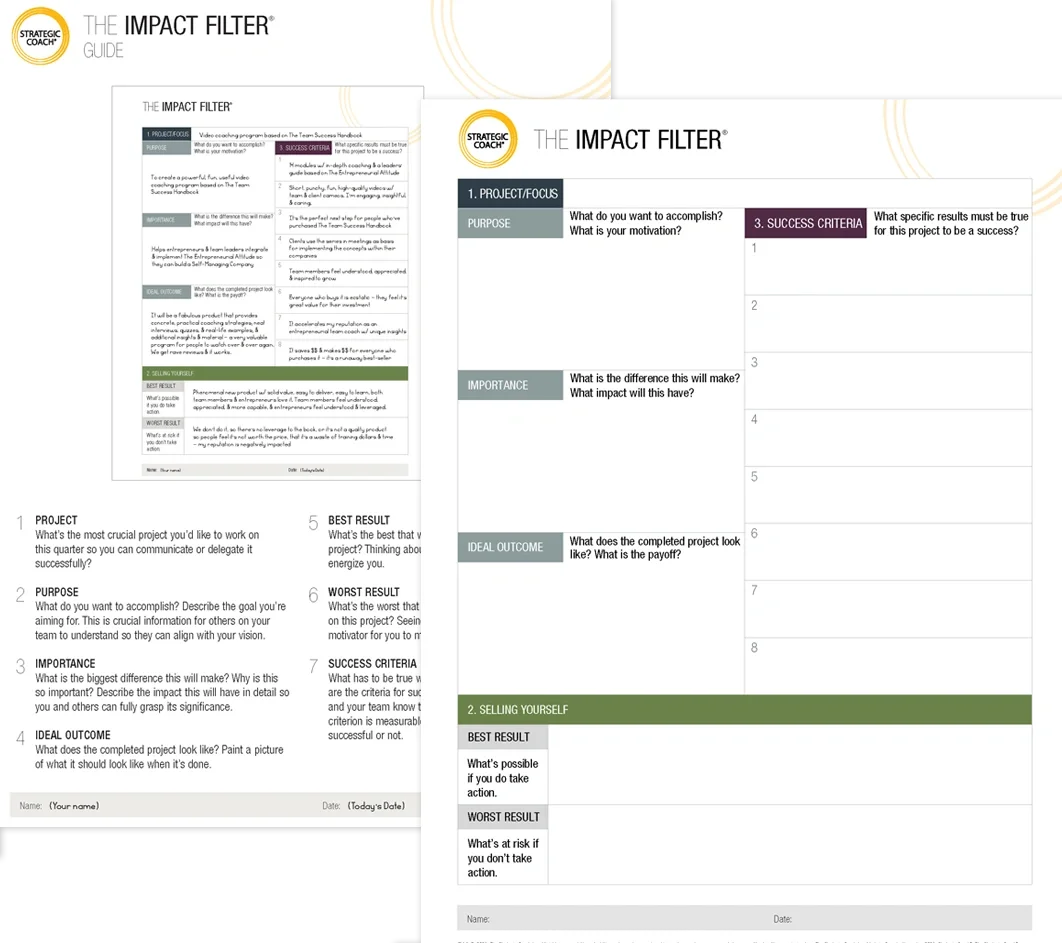
The Impact Filter®
Dan Sullivan’s #1 Thinking Tool
Are you tired of feeling overwhelmed by your goals? The Impact Filter is a powerful planning tool that can help you find clarity and focus. It’s a thinking process that filters out everything except the impact you want to have, and it’s the same tool that Dan Sullivan uses in every meeting.