Magic Happens When Improv Meets Entrepreneurship
March 10, 2026
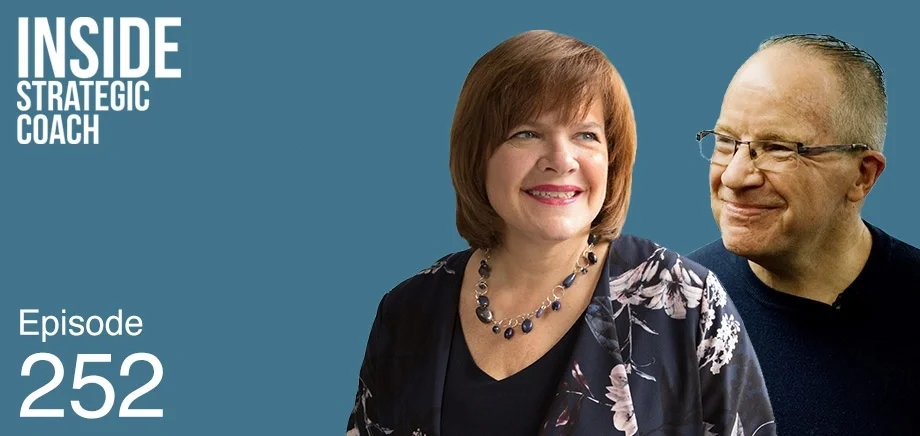
Hosted By
 Dan Sullivan
 Shannon Waller
Most entrepreneurs were trained to win through competition, not collaboration. In this episode, Dan Sullivan and Shannon Waller show how the rules of improv—no one in charge, “yes, and,” and always supporting your partner—create transformative business partnerships, helping you think on your feet, combine unique strengths, and co‑create new value that competitors simply can’t copy.
Here’s some of what you’ll learn in this episode:
- How the first two rules of improv translate directly into powerful business collaboration.
- What instantly shuts down collaboration and kills momentum.
- How Strategic Coach® workshops function as true collaborations between the coach and members.
- The structured way of thinking that Strategic Coach clients use to create new breakthroughs.
- What it really takes to be a great business coach.
Show Notes:
Strategic Coach® has always taken a theatrical approach to business, with a clear structure for entrepreneurs to bring their own content and breakthroughs.
Thinking about your thinking lets you compare experiences, spot patterns, and create better solutions than you’ve had before.
When you combine past experiences in new ways, you generate fresh ideas and opportunities that didn’t exist on their own.
At Coach, the workshop tools may stay the same, but what each entrepreneur focuses on and transforms is totally unpredictable.
Great coaching means being comfortable with anything participants say or ask and using it as raw material for progress.
Your work life and personal life work best when they collaborate instead of compete, supporting the same future.
Most entrepreneurs grow up in a world of pure competition and have to consciously shift into collaboration.
At the highest level, successful companies collaborate with other successful companies to create a “third thing” for shared clients.
This “third thing” is a new value creation that competitors can’t copy because they don’t know how it was created.
In improv and in collaboration, no one is the boss; each partner brings different strengths and has equal status.
The first rule of improv is to say yes to any new idea your partner brings instead of debating or analyzing it to death.
The second rule of improv is to actively support your partner’s progress by adding value to what they’ve started.
Powerful collaborators stay alert, curious, responsive, and resourceful so they can build on what’s happening in real time.
Collaboration dies when your partner doesn’t respond, fails to comment, opposes your idea, or refuses to contribute to it.
The best collaborative days often come from letting go of rigid plans and following the energy of the group’s best ideas.
Being a great collaborator means arriving prepared with a “quiver” of experiences and examples you can draw on in the moment.
You can strengthen your improv muscle by asking unpredictable, high‑value questions rather than trying to have all the answers.
Resources:
Casting Not Hiring by Dan Sullivan and Jeffrey Madoff
Thinking About Your Thinking by Dan Sullivan
Yes, And by Kelly Leonard and Tom Yorton
Episode Transcript
Shannon Waller: Hi, Shannon Waller here, and welcome to Inside Strategic Coach with Dan Sullivan. Dan, earlier we were talking about collaboration and some rules for collaboration, which I think is very helpful, and really likening it to improv. So I think given that we like to talk about collaboration is superior to competition, having some ground rules and some frameworks for really understanding collaboration would be very useful, one of our favorite words. So let's talk about collaboration and improv. How do you define it? How is it different than other structures that people are used to? What are we trying to get at today?
Dan Sullivan: Yeah, well, the definition of improv is that you're putting on a play without a script.
Shannon Waller: Yeah, performance, exactly.
Dan Sullivan: Yeah, in other words, that there's no predetermined how the interaction between the actors is going to take place. When we started coaching entrepreneurs, 1970s, 1980s, first of all, I have always taken sort of a theater approach. And Strategic Coach, I think that we have a real sense of back stage and front stage for the company. And our front stage, our workshops were in five different cities, three different countries where, you know, the entrepreneurs come as groups, you know, as few as maybe 15 and as many as 60 in a room. And it's like we're putting on a theatrical structure and theatrical process. And it's a collaboration between us and the clients, okay? And it's our structure and their content. So we're kind of creating a situation where we create a way for them to take their experience and compare one experience to another in hundreds of different ways, different entrepreneurial situations. And then they start thinking about their thinking and they begin to see how their brain actually approaches different situations. And they come up with better solutions than they've ever come before. So it's a form of theater, okay? Really good workshops are very, very collaborative.
Shannon Waller: Yeah, yeah.
Dan Sullivan: So I'll approach this from two standpoints. What it takes to be a really good coach for Strategic Coach is that you have a framework that you're going to invite the entrepreneurial clients to enter into, and they've got to answer certain questions about their experience. And then we do different things with their experience. You rank your experiences, you combine your experiences to produce new ideas for yourself, okay? And then you're going to talk to other entrepreneurs who've done the same thing. And then there's going to be a general discussion in the room and everything like that. And the only thing that's predictable and guaranteed is that they're going to go through this structured way of thinking. But what they're going to think about and what they're going to have breakthroughs on is totally unpredictable. As a coach, you got to be comfortable with anything that they say.
Shannon Waller: And everything they say.
Dan Sullivan: Anything that they ask, you know, any comments that they make. And so it requires quite a bit of improvisational skill. And we've brought Second City's very famous improv. So we've had our coaches go through improv training with Second City. That's the one thing. But the other thing is that we have three levels of our program and mostly it's, from the start of the Program, it's mostly about getting your act together as an entrepreneur, getting your company together, getting the relationship between your work life and your personal life, having it be not in competition with each other, not in conflict with each other, but there's a collaboration between what you do at work and what you do in your personal life. But the third level of the Program is really about pure collaboration, where your company, as a very successful entrepreneurial company, enters into a collaboration with another company that's also very successful to create a third thing because you share the same client. But you do something that's a solution to one part of the client's life and somebody else does something completely different, but you combine them to create a third thing that hasn't actually existed before.
Okay, and most entrepreneurs grow up and they have to progress in a world of almost pure competition. And then at a certain point you're saying, well, all your instincts towards competition, liking it or disliking it or being competitive and everything, you have to put that aside and now to jump to the next level. You have to now put your Unique Abilities together with their Unique Abilities to create a third thing that actually is extraordinary in the marketplace, that nobody else can do this. And it's quite amazing. So I do a lot of collaborations. I have great teamwork inside the company, and I have collaboration inside the company. But I've done a lot of collaborating between Strategic Coach and other entrepreneurial companies. And some of it's been marvelous and spectacular, and some of it not so. So I've really gotten in touch with the rules of improv. And I've done Second City training on my own. I thought it'd be useful because I'm in a project right now where it's not understood on the other side what the rules of improv are.
So I said, the first two rules are positive rules. And the first rule is that when you're working with your partner, first of all, neither of you is the boss. You're equal to each other. But the first thing you have to understand is any new idea that the other person comes up with, you say yes to it. So you have to put all your debating skills and arguing skills and analysis skills and everything else, you have to set them aside and say whatever the idea is, it's yes, we're going to go with this idea. And then the second rule is you always support your partner in his or her progress. So your job now is to support them with making a contribution that adds to what they're already doing. And it goes against a lot of human instincts. I think it's a very learned skill. And you've got to be so in touch with what's going on with the other person. You know, you have to be super alert what they're doing. And the moment they introduce something new, you have to go with it.
Shannon Waller: Right. Dan, it's interesting because we had Second City come in and work with the coaches, as you mentioned, which was really fun.
Dan Sullivan: And we did it with our team leaders.
Shannon Waller: Right.
When we were smaller, we did it with the whole company.
Dan Sullivan: Shannon Waller: I remember. So I picked up their book, which is lessons from Second City. Yes, And is the title of the book by Kelly Leonard and Tom Yorton. How improvisation reverses “no, but” thinking and improves creativity and collaboration. So, how perfect. So, a cool resource if anyone wants to build on what they're hearing today, which is really interesting. So, those are the two positive rules. Say yes to a new idea and to support your partner's progress. You also have some no rules or what not to do. What are those?
Dan Sullivan: There's four of them, and the reason is that all four of them have happened to me.
Shannon Waller: Oh dear.
Dan Sullivan: In a recent collaborative project. And the first one is that you do something and you get no comment from the other person. And it stops the collaboration, okay? Actually, that's number two. Number one is there's no response whatsoever. It's as if you hadn't done anything. The second one is where there's kind of an indication that they know that you've done something, but there's no comment. You're sort of in the wind. The third one is that they oppose your new idea, not really understanding the idea, they just oppose it. And the fourth one is that they don't contribute to the idea you came up with. And usually if one of them happens, the others happen too. And it's just a deal killer. It's a game stopper. There's no game here and everything like that.
Shannon Waller: Mm-hmm. It's interesting, Dan. You're making me think about some of the Second City performances I've seen, and the comedians are so good. And they just say, yes, and this is what's happened next. And they take these outrageous circumstances. And to some extent, they're challenging their collaborators with what they come up with, which is partly their own desire to just have something to say. But then they also try and not trip up. They're not doing that, but they also like to keep it interesting for their collaborators, and then they just, they're so brilliant. It is so fun to see really good improvisers do their thing in front of an audience. It's kind of epic, which is the same as coaching, just as you talked about earlier. And that's what creates a magical day. That's when you look up and you're like, oh my gosh, it's already five o'clock. Where'd the day go? And it's that ability to just play with what is real, what's there. It means you have to be very, very present, alert, and curious and responsive and resourceful. It's all of those things. But it's interesting, Dan, I think a lot of people don't realize they're in a collaboration and they treat it like they're the boss, or they treat it as though their contribution doesn't matter, or they don't realize the drop in energy that happens when they're not participating fully, which again, just kills the deal right there. It just kills the collaboration.
Dan Sullivan: Yeah, it's expensive. I'm really interested in it because it just seems to me that the business world is moving more and more towards an improv world, where two people just come together and they each can do something different uniquely. They're both unique, but they're different from each other, but they can put the two uniquenesses together and create something that you can't compete with because you don't even know how it got created. And it just strikes me that this is really where the entrepreneurial world is going.
Shannon Waller: Just on that theme, Dan, one of the things we talked about in a previous publication is we're going from a much more older hierarchical structure into a truly networked economy, not just because of AI, but people have an opportunity to develop their own capabilities very powerfully in these nodes. And this is the recipe for how to make it work. And if someone is playing the old rules in the new game, it's not going to work. They'll get either booted to the side. People won't want to partner or collaborate with them. I think there's a consequence for being blind to this.
Dan Sullivan: Yeah. I enjoy it. There are situations where your brain is kind of scrambling, you know, to, how do I support this? You know, how do I say “and,” but move it in a particular direction? You know, how do I say “yes” and how do I say “and,” so you have to become skillful with the “and.”
Shannon Waller: That's a really good point.
Dan Sullivan: Yeah, and I think it's like having a lot of experience. I mean, it's a skill where you can't do this from a dead start. You'd have to spend many, many different situations doing it. But the one where I actually felt best about my own ability to do this, it was a small group. It was the Free Zone. It was about seven, eight years ago, and I had the whole day filled up with printed exercises. There were about three or four things we were going to do in eight or nine hours, and it was all structured. I came in the room and I had an idea. We have these electronic whiteboards.
Shannon Waller: Smart boards?
Dan Sullivan: Smart boards, yeah. I went up and I said, I got an idea. And it really hit the mark and everybody got real interested in the idea. So they went on talking and we used up like the first half hour, you know, and I was starting to feel some friction with the schedule, you know, I don't know if I'm gonna be able to pull off the whole day. And I said, I don't care. So I said, write down the three biggest insights that you've gotten from the conversation so far. And then I had them go into breakout groups. And now we've all even taken a break, end of a session break. So they've gone out and got drinks, food, whatever. And then they came back in and they did the breakout. I says, so what'd you get out of this? And we used up another hour. And at about halfway through that second hour, I said, I wonder if I can get through the whole day, never using any of the materials. And I did, I did.
Shannon Waller: Wow. Amazing.
Dan Sullivan: I felt so good about that day.
Shannon Waller: Yeah. That is truly a 10 Quick Start collaborative day. That is so fun, Dan. And it's interesting that what's great, because we've got the Signature Program, and the second level is 10x, and the third level is Free Zone. And that is the point of Free Zone, is to collaborate. And you're a collaborator with them, and they're a collaborator with you. So it is such a fun exchange and no one's really expecting—it's not about being led through the course materials. They're there as a framework, which is fabulous, but it's actually the collaborative thinking that everyone is there for. It was a very energizing experience. So that makes complete and total sense to me. And the cool thing is they know the rules or they pick them up or if they're not, they're educated and they're fairly quickly, I will add, but they know that that's their contribution too.
Dan Sullivan: But just my thoughts about this is that it seems to me that with technological change and more and more rapid introductions of new products and services into the marketplace, that improv training is really, really great training for entrepreneurs, enabling them to become much more creative and collaborative in creating entirely new, unique offerings in the marketplace.
Shannon Waller: Yes. I love that. There's something about, I just think it keeps you, again, I'm going to go back to your four words, alert, curious, wanting to know more, not judgmental, responsive by definition, if you think comedy, and then resourceful, reaching back, which is why it does take practice. It takes, you know, having, I call it my quiver, having your quiver full of examples and you know, things you've done before that you could try again that could work a little bit differently this time. It takes some practice to accumulate that wisdom and knowledge. So that's another great kind of little checklist there for how to be a person who's great at collaborating and improv is to be alert, curious, responsive, and resourceful. That will, rather than not paying attention, not curious, not responding, and not resourceful, that will kill collaborations faster than just about anything. So I really like this, Dan. This is the way the world's going. There's more and more rapid technological products and capabilities happening. We need to be able to respond to those and be in partnership with them, and I think improv training for entrepreneurs, and I would actually add entrepreneurial team members as well, great idea. Is there anything else, any other practical action that people can take to put this into play right now, other than maybe following your rules? Say “yes, and.”
Dan Sullivan: Yeah, well, I think that our education generally, you know, and that was true for me in the 1950s and 1960s, and my sense is that education is about getting answers, you know, and my sense is the more that you're really good at asking unpredictable questions.
Shannon Waller: Yes.
Dan Sullivan: The more your improv brain will strengthen. So I think more and more that the chief skill that you're going to get rewarded for most as you go forward as an entrepreneur lies not in having the answers, but in being able on the spot to create really, really great questions. So that would be it.
Shannon Waller: Perfect.
Dan Sullivan: And you have situations every single day where that happens.
Shannon Waller: Yeah. Dan, thank you. Very insightful, very interesting, and a very, I would say, refreshing take on entrepreneurial skills and capabilities for our growing, expanding world. So thank you.
Related Content



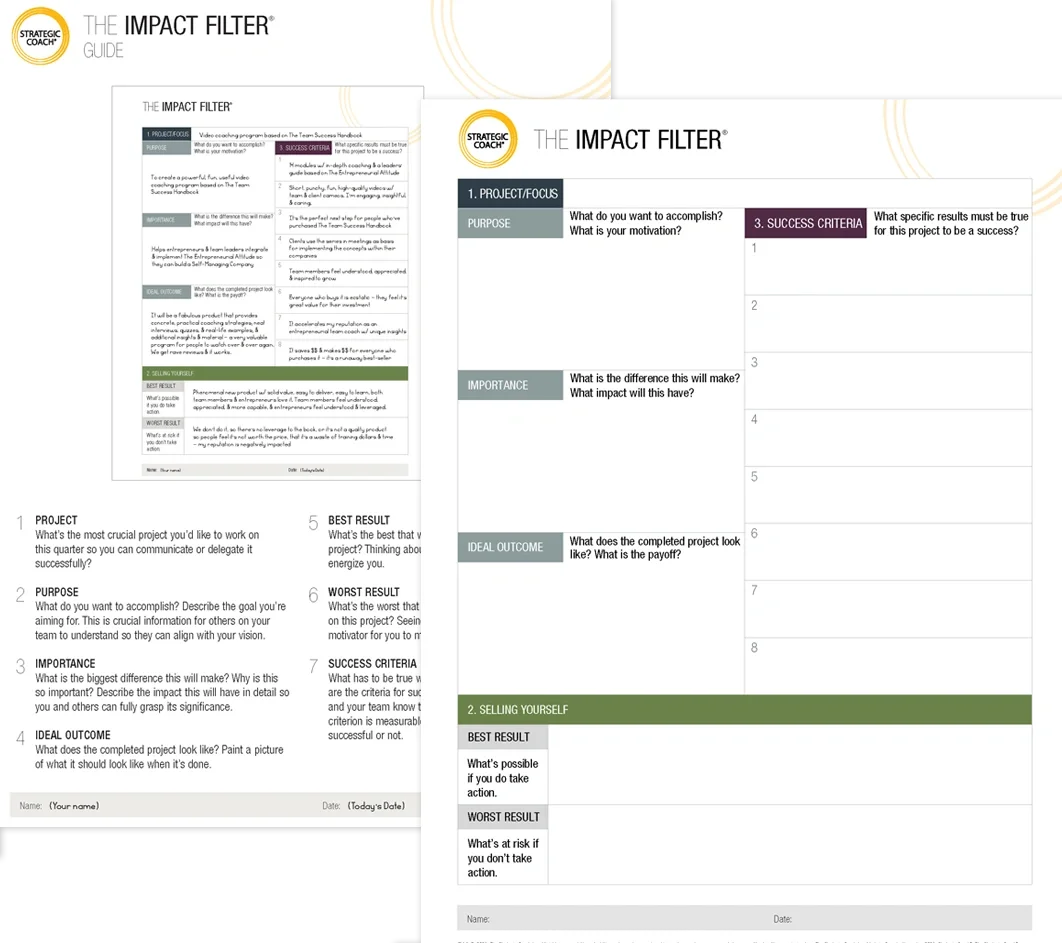
The Impact Filter®
Dan Sullivan’s #1 Thinking Tool
Are you tired of feeling overwhelmed by your goals? The Impact Filter is a powerful planning tool that can help you find clarity and focus. It’s a thinking process that filters out everything except the impact you want to have, and it’s the same tool that Dan Sullivan uses in every meeting.