Technology Isn’t Cool Until It’s Boring
April 07, 2026

Hosted By
 Dan Sullivan
 Shannon Waller
A technology doesn’t truly transform the world until it becomes so normal that it’s boring. As dramatic as AI feels today, it’s headed for the same destination. In this episode, Dan Sullivan and Shannon Waller explore the different stages people are at with AI, what entrepreneurs can expect as it becomes embedded in everyday life, and how they can turn AI into a capability that multiplies their existing strengths.
Here’s some of what you’ll learn in this episode:
- How all technologies go from exciting novelty to everyday normal.
- How entrepreneurs, team members, and the public are each thinking about and using AI right now.
- How big companies are building AI into their products and services so it simply becomes part of daily life.
Show Notes:
Technology only becomes truly useful when it’s so normal in your life that you barely notice it.
What feels disruptive and exciting today will quickly become just another dependable part of how you get results.
AI will embed into every tool you use at a far faster pace than any previous technology shift.
Electricity, highways, and smartphones were once extraordinary breakthroughs, but now they’re simply part of everyday life.
If you’re overwhelmed by AI, the real issue isn’t the technology itself, but unmade decisions about what you want and what it means for you.
Humans are uniquely wired to normalize change, which is why your biggest breakthroughs eventually feel routine.
The faster you can emotionally normalize new technology, the faster you can turn it into a strategic advantage.
No technology changes your character, but it can dramatically multiply the results of your existing habits.
AI is particularly powerful for repetitive, standardized activities that free you up for higher-value thinking and relationships.
If you struggle with people and teamwork, AI won’t fix that problem; it will just expose it more clearly.
Most fears about AI come from team members feeling it’s being imposed on them without context, safety, or a future they can see themselves in.
Your team’s concerns about AI are useful raw material for designing solutions that grow their confidence and engagement.
The real opportunity is not just building smarter tools, but helping people feel capable and confident using them.
Every 10x jump in your business starts with a period of fear, uncertainty, and discomfort that later becomes your next version of normal.
Measuring your progress backwards shows how many things that once felt extraordinary are now just part of how you operate.
Instead of waiting for AI to feel safe, decide how you want it to support your best future and then take small, practical steps toward it.
The entrepreneurs who win with AI will be the ones who treat it as an everyday capability, not a one‑time miracle.
Resources:
10x Is Easier Than 2x by Dan Sullivan with Dr. Benjamin Hardy
Episode Transcript
Shannon Waller: Hi, Shannon Waller here, and welcome to Inside Strategic Coach with Dan Sullivan. Dan, you said something that cracked me up, and I wanted to share that with everybody, because as usual, you have a fun and interesting take on things. And one of the things that you said, after a particular experience, is that technology doesn't become pervasive until it becomes boring, which I'm like, okay, please tell me more about that. And so what prompted this thought? What prompted this conversation that you were having?
Dan Sullivan: Well, I mean, because I was born in the 1940s, I've seen a lot of technology come over that period of time. Telephone technology has improved enormously, television, and then microchip computers, software, the internet, the iPhone, which is actually an amazing computer. I've just began to think that—I just use electricity as an example. I mean, for the vast span of human experience, there was no electricity. And yet, it's so taken for granted that if you were to bring up … the thing I appreciate about my home is the electricity. People would say, what? Yeah. I mean, if you have a blackout and you get the electricity back, you appreciate it for 15 minutes and then it goes back to normal. So I just began thinking like, AI is the big topic now and everybody's talking about it. When we have workshops at Coach and I'm not the coach, I invite as many of the entrepreneurs who are in for their workshop that day. I said, I'm having lunch in the cafe and if you wanna join me, we can talk about anything. I think about the last three of them, nothing besides AI was talked about. So it's a really big deal. But my sense is in the years ahead, there'll be a day when AI is so pervasive and it's in everything. It's become normalized that it's boring. You don't want to talk about AI anymore. It's boring. And people have adjusted to it and they're using it. It's made a big difference. But the moment that something new takes hold and it's exciting, there's a point where it's normal and normal isn't exciting.
Shannon Waller: Normal isn't exciting. It's very true.
Dan Sullivan: Yeah.
Shannon Waller: I feel like we're at the beginning of the phase with AI. And some people are still very anxious about it and, you know, don't want to have anything to do with it. Not most of the people we work with, but there are some folks out there like that. And it's not normal yet. What I can see is that every big company is spending a fortune on all the infrastructure and embedding it in everything that they do. I mean, almost all my Google searches now will like, oh, do you want me to use ChatGPT for that? And I'm like, okay, if you want, like, it's interesting. I see so many people embedding it to make it normal. So I, my sense is that this, the normalization of this technology is going to happen at a much more accelerated rate than any previous technology.
Dan Sullivan: Yeah, well, whatever. [laughs] I remember I was doing a podcast with somebody and they said, what's it going to feel like when robots have become widespread? And not only that, but you actually see robots doing work. And what's it going to? I said, it'll probably feel normal. It'll feel like a normal day. And you can just check that out. We have one of the busiest highways in the world in Toronto. I think it's certainly the busiest in, if you just take Canada and the United States, the 401 North Toronto is right up there with the busiest highways in the world. I think it's eight lanes on both sides. It's a very busy highway. And if traffic is flowing really well, you're doing 50, 60 miles an hour. And I said, you know, it's very recent in human history that this is a normal experience. But nobody's thinking about it. Nobody's thinking, here you are, you know, you're zipping along at 60 miles an hour. Everybody seems to know what to do. I said, it's just a normal experience. So you go back a century and that's not true.
Shannon Waller: Dan, you first wrote about this that I know of in our 10x model, and that if you look at your past level of normal, it felt familiar, habitual, comfortable, and then to grow to your current level of success, you had to be willing to go through periods of fear, uncertainty, and discomfort to reach this level. But then guess what? This feels normal, right? And then when you add another zero, you know, 10x, guess what? It's going to feel …
Dan Sullivan: It's going to feel normal.
Shannon Waller: It's going to feel normal.
Dan Sullivan: Yeah.
Shannon Waller: Yeah. So this is very similar, very akin to that.
Dan Sullivan: You know, and it's the reason why you want to measure backwards, because I can measure back to the first year that we had the workshop programs. We had a number at the end of the year, which was the biggest number I had ever experienced, revenue number. But this past year, it was 250 times that. The revenue was 250 times. So that's 10 times as that. It's about three or four, maybe five, 10 times what we were doing. But, you know, your past seems normal. You experienced it. You integrated it into your thinking. So the big thing about it is people think that you're going to be a different kind of human being when this technology takes place. But I'm still the same person I was when it didn't exist.
Shannon Waller: And robots too. Robots are like the big thing this year.
Dan Sullivan: Yeah. I think technologies appear because they're wanted, you know, that there was a great deal of wanting on the part of people that brought about electricity. There was a lot of things before electricity that you couldn't do, which after electricity, you could do them. And there's a sense of appreciation that you can do that. But we normalize things. Humans are the great normalizing animal. We're always doing new things, but then they become normal things. And I think that's disappointing to some people. They want to have a sense of transformation. Almost, they want to feel like they're a different kind of self.
Shannon Waller: Right.
Dan Sullivan: People say, is there some place that you haven't been to on the planet that you want to go to? And I said, not particularly, not particularly. And they say, well, why not? I said, because no matter where it is, when I get there, it's still me.
Shannon Waller: So that's interesting, Dan. That begs a more personal-type question for people, which is, if you want transformation, you have to do it with yourself.
Dan Sullivan: Yeah, I don't think it's out there.
Shannon Waller: No.
Dan Sullivan: I've heard when you go to the Amazon and you go and you do, you know, you take … Ayahuasca? There it is.
Shannon Waller: Ayahuasca, yeah.
Dan Sullivan: And that I'll experience myself differently. And I've met people who did it like six months ago. And I said, what would you say six months before you had the experience? Is it different than six months afterwards? And they said, no, it's pretty much the same. So, I don't know, I think each of us has our own experience of being ourselves, you know. Technology is a big thing. I mean, one of the things that is becoming normal is that technology is always changing. And that's now become a normal experience for most people.
Shannon Waller: Yeah, so previous generations, things stayed kind of the same in terms of how much information you would deal with or where you lived or how many miles you traveled from home, that sort of thing. And then we just had this giant acceleration of change. And like everything else, we'll normalize that.
Dan Sullivan: Yep. We're normalizing. We're the great normalizing. We're the species that's continually doing different things. They compare intelligence among species, you know, mammalians, chimps and gorillas and that. We don't know what it's like to be inside those creatures, but it's very clear from an outside standpoint that they're not doing that many new things. The fifth generation of a group of chimps is not doing things too much differently than the first generation. That's not true for humans. Humans are doing all sorts of different things.
Shannon Waller: That's a really good point. So, Dan, if people are feeling either overwhelmed by technology, my point is, as usual, you have a way of looking at things, a mindset that tends to be calming for people. So people are getting overwhelmed or distracted or any of the other things about AI or robots or any other technology. What would you say to them in terms of how to think about things?
Dan Sullivan: I've been thinking about this in terms of AI because all sorts of predictions are being made, you know, that artificial intelligence from an activity standpoint is very, very clear that AI is good for handling repetitive things. And then there's the whole question with robots of doing physical things and all sorts of predictions are being made. You know, we have to give everybody a social welfare check because they're not going to be working, and I said, we haven't the foggiest idea of how this is going. If we're 10 years from now, we haven't any idea. Nobody can possibly know how this is gonna play out in terms, but I do know that 10 years from now, whatever the experience is, it's gonna be a normal experience. We'll normalize it. And I think overwhelm is really not about anything outside of ourselves. Overwhelm is that you just haven't sorted out your feelings and your thoughts about what it is that you want to do.
Shannon Waller: Okay.
Dan Sullivan: Or what things mean to you. I don't think overwhelm is an outside experience. I think it's an inside experience.
Shannon Waller: I think that's very true. That's really interesting. I appreciate that, Dan. It's like you haven't sorted out how you feel about something, what you want about something, and so that's what's overwhelming. It might be exacerbated by the external circumstances, but really it starts on the inside.
Dan Sullivan: I was at a conference two weeks ago, and the morning's conversation, without it being scheduled, got into AI and the disruptive impact of AI. You know, I use AI every day. I'm using a capability that wasn't there three years ago. And it's great. It's great. And it's speeded up my writing. It's speeded up getting projects done. It's really speeded it up. It's been great. But the conversation that was taking place in the room had two things. One is people aren't adjusting to this fast enough. I mean, normally these were all entrepreneurial business owners, and they were saying, you know, my team is just not coming to grips with this fast enough. And that was the thing. The other conversation was kind of almost mean. It was, yeah, there's a lot of people are just going to lose their jobs, and it's going to be great when we can have a business that doesn't need people. You know, it was kind of a mean spirit. And I said, If you have a hard time with people, AI isn't going to be a good replacement. You just have a people problem. And to be a human and have a human problem, that's a much more serious problem than technological.
Anyway, so at lunchtime, I just went to my AI and I wrote down, tell me 10 reasons why individuals who are otherwise very productive, they're doing a good job and everything else, should be worried about AI and how AI is being implemented. You know, I had it, you know, it was 15 seconds. It was down there. It was really good. And there was 20 reasons, actually, why people would feel bothered, worried, anxious about this. And so I wrote it up, put it into a Word document, and I gave it to everybody else in the workshop that afternoon. And I said, you know, if you read these, every one of them makes sense why people are resistant being an employee in an organization where they feel that this is being imposed on them. And I said, makes sense. And I said, I have to tell you, when it comes to technology, all the money is in the obstacles. I said, what these 20 pushbacks that people are doing, that tells you a lot of money is going to be earned in the technology world of making people feel safe and secure about using the technology.
Shannon Waller: So true. And if people pay attention to it, there's a ton of opportunity there. And if they ignore it, they'll experience that same resistance that they're getting now.
Dan Sullivan: Yeah.
Shannon Waller: Yeah.
Dan Sullivan: So it's just an interesting thing, but there are children being born into this world who won't know any different.
Shannon Waller: We had digital natives and now we have AI natives.
Dan Sullivan: Yeah. Yeah. This is just life. It's just life.
Shannon Waller: Great. Dan, thank you, because, I mean, first of all, you just have a contextual take on things, which I very much appreciate. I know others do, too. And, you know, the whole thing about technology is pervasive. Well, either it dies, that is another possibility, or it just becomes boring because it's so normal. And I think appreciating what we make normal, humans' ability to normalize things, to just adapt, that is our number one characteristic. I think is really something to kind of hold on to in this whole process, if anyone's feeling strange, or if people around them are having issues. So thanks for talking in such an interesting way about things that could be boring and normal. I love it. Thanks, Dan.
Dan Sullivan: Thank you, Shannon.
Related Content



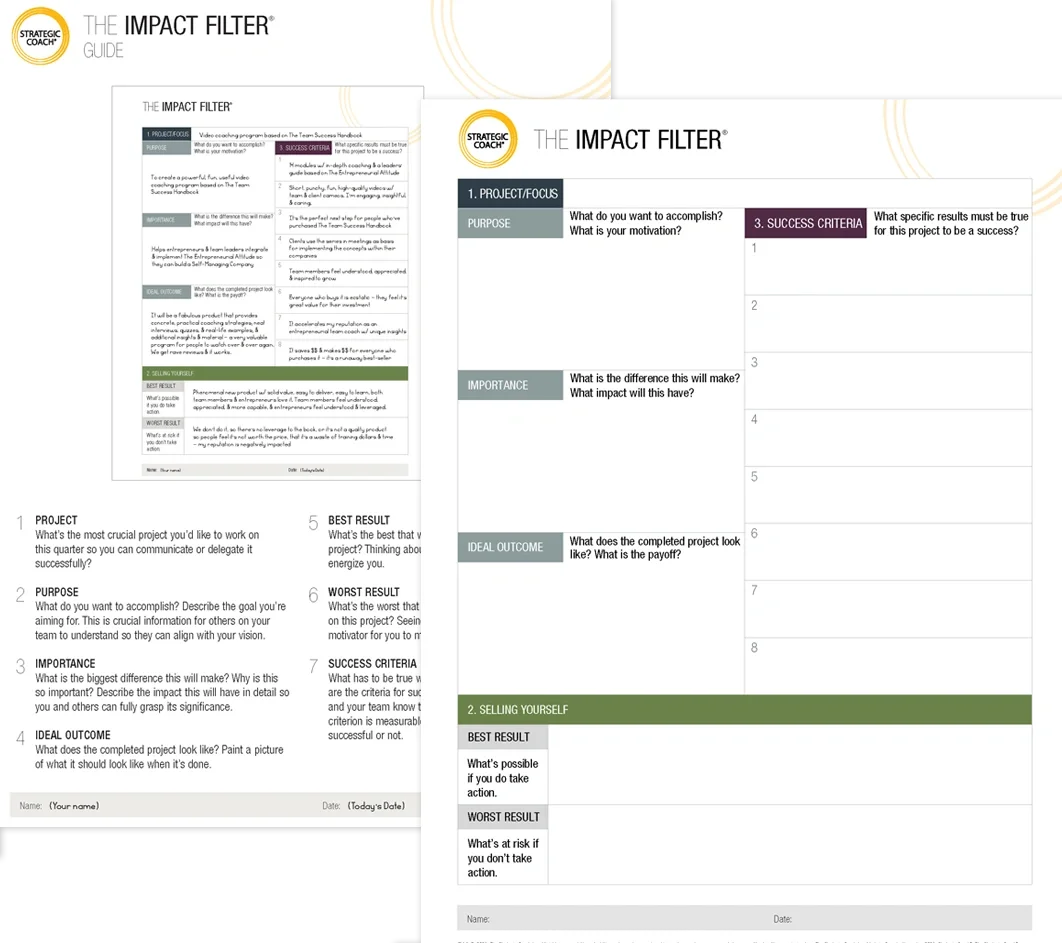
The Impact Filter®
Dan Sullivan’s #1 Thinking Tool
Are you tired of feeling overwhelmed by your goals? The Impact Filter is a powerful planning tool that can help you find clarity and focus. It’s a thinking process that filters out everything except the impact you want to have, and it’s the same tool that Dan Sullivan uses in every meeting.