Unlock A Fourth Level Of Thinking That Elite Entrepreneurs Rely On
June 16, 2026

Hosted By
 Dan Sullivan
 Shannon Waller
Everyone knows what cognitive thinking is, but what about metacognitive thinking? Dan Sullivan uses this term to describe the kind of thinking The Strategic Coach® Program develops in entrepreneurs. In this episode, Dan and fellow business coach Shannon Waller explore metacognitive thinking and how it helps the right kind of entrepreneurs achieve their biggest dreams with greater clarity and confidence.
Here’s some of what you’ll learn in this episode:
- The three levels of thinking most people rely on in daily life.
- The fourth level of thinking that unlocks your best entrepreneurial ideas.
- Dan’s first childhood experience of thinking about his thinking.
- The question that set Dan on a completely different life path from his peers.
- Why entrepreneurs gain an unfair advantage when they learn to think about their thinking.
Show Notes:
One level of thinking is thinking about things. People like things, and they often use shared things as common ground for conversation.
The second level of thinking is thinking about people, which is why social media has become such a powerful phenomenon.
For most people, thinking about things and thinking about people uses up almost all of their available mental time.
The third level of thinking is thinking about thoughts, which is the focus of higher education and high-level media.
In higher education, professors typically teach other people’s thinking rather than developing and teaching their own.
The fourth level of thinking, which very creative people—and especially entrepreneurs—can access, is thinking about your thinking.
Thinking about your thinking gives you the ability to deliberately change how you’re thinking about a situation or problem.
Strategic Coach® provides hundreds of thinking tools to help entrepreneurs think about their thinking in structured, practical ways.
Your emotions are not a direct response to what happens outside of you; they’re a response to how you’re thinking about what happens.
Resources:
My Plan For Living To 156 by Dan Sullivan
Episode Transcript
Shannon Waller: Hi, Shannon Waller here and welcome to Inside Strategic Coach with Dan Sullivan. Dan, I'm excited because today we are going to talk about an article that you have written about what you do and what we're doing here at Strategic Coach and you've called it metacognition. So let's do a deep dive because this is very cool. It's actually “Metacognitive Thinking” is what you called the article. And we are attaching that to the show notes. So make sure that you listen and download that so you can get the big picture. So Dan, in terms of metacognitive thinking, this started with you really young. Before we jump into that, what is metacognitive thinking? Everyone's familiar with cognitive, but maybe not with metacognitive.
Dan Sullivan: Well, basically what I've noticed over time—I'm over 80 now, 82—that people do different types of thinking and I've been able to identify four different ways and they're kind of levels of thinking. And the first one is they think about things. This, I guess, is what contributes to rampant consumerism. People like things. They like useful things. They like frivolous things. And they use that as a basis of communication. It's one way to establish common ground with other people, the people who have the same things. I mean, one of the things I've noticed is that you don't notice that other people have things until you buy one of them, and then you see it all over. One of the things I've really noticed is when someone buys a dog, and they think their dog is really unique, but the moment they buy their dog, they notice that 50 other people have the same dog, but they never noticed it before. So there's something about objects.
Just to give you an idea, when I'm in Toronto, I always have my hair cut every Saturday. And that's been from childhood. I always have had a short haircut. I was in sports; you had a short haircut. I was in the military; you had a short. I just like short haircuts. Never went through the hippie stage. I was born before the hippies, I outlived them, but I never went through their stage. But when I'm in, every Saturday there's a woman having her hair done. She annoyed me at first because she just talks non-stop about all of her things. And then I said, I wonder if she ever talks about anything except her things. And the only time she talks about something else besides things is other people who have things. She's not talking about the people; she's talking about other people who have things. So her basis for communication is things. And it's just interesting to me that probably most of the communication on the planet with a possible competitor is people talking about things. That's what advertising is about, really. It's about merchandise.
Okay, so that's number one level. That's thinking about things. The next level is thinking about people. And this is why social media has been such a phenomenon, I think. And that is, if you go to TikTok, for example, it's about watching TikTok. You're watching other people, what you're doing, but then texting is about people. And it's technological gossip, really, what it is. And people have friends, and some people have hundreds of friends, and they make sure that they're in touch with their friends. So if you put the two together, if you take the first level, which is thinking about things, and then the other one, thinking about people, that uses up all the time that people have. There's no other thinking. They don't have time for any other thinking except talking about things and people.
The third level is a really interesting one because most people confuse this with thinking, real thinking, and that's thinking about thoughts, okay? And the entire world of higher education, the entire world of high-level media, newspapers, television, everything, is thinking about thoughts. But they're not your thoughts; they're other people's thoughts. In higher education, professors can spend 40 or 50 years teaching a subject, but it's about a particular thinker. But it's not their thinking, it's somebody else's thinking. Most people say that's the height of thinking is where you're talking about Plato, you're talking about Aristotle, you're talking about Freud, you're talking about Karl Marx, but it's their thoughts, but this is what you're focused on. You're arguing, did he mean this? Did she mean that? If you go deeper into her thought, what do you come up with? It's your thinking about somebody else's thoughts, but it's not anything original.
But what I noticed, go back to the start of the story, so we got these three levels of thinking about things, thinking about people, and thinking about thoughts, and that's pretty well what most people think thinking is. But what I notice is really creative people, people who are inventors, people who are artists, people who are playwrights, they operate in another realm, and especially entrepreneurs, possibly, possibly. Entrepreneurs are coming up with new solutions that solve existing problems. And my sense is they're not actually thinking about things and people and thoughts, they're just thinking about their own thinking, okay? And they have an ability to go right to their experience and say, how am I thinking about this? Wow, wow, this is really interesting how I'm thinking about this. Now, how could I think differently about this? So the object isn't a thing, the object isn't another person, the object is not somebody else's thinking, it's your thinking, and you're observing your thinking as if it's a movie. And it's called metacognition, because you're getting above your own thinking and looking down at your own thinking.
Now, I know that at 82, but when I was 8 years old, 1952, I lived on a farm in northern Ohio. I had a birth order in the family such that my older siblings were significantly older than me, so I didn't really play. There was a big jump to four older, and there were no younger. Well, I did have one younger, had just been born, so newborns don't count. I loved going into our woods, so we had a narrow farm that went a long way, but at the back of the farm, we had woods. And I used to love to go to the woods because our woods were connected to the woods of about five other farms, and I could jump the fence, and I could explore my woods and their woods. You know, it was this world of my own. But one day I was walking back to the woods, and I noticed that I was thinking about my thinking. And I was thinking about the thinking I had done since I left the house.
And it surprised me. It just surprised me. I said, wow! I'm actually thinking about how I'm thinking. And it's very energizing. And then it went away. I couldn't get back into it. It just surprised me to do that. So I went along. That was a neat experience. And then maybe a couple of weeks later, a long time ago, it happened again. And it was very energizing, but it was very depressing when it went away. And I said, how did I do that? So I checked it out with my mother. I said, can you see yourself thinking? And she didn't know what I was talking about. So I said, I gotta be careful here. And I started sort of feeling around with other people. Do you think about your thinking? And they said, what are you talking about? I don't know what the progression was after that. But one day I said, if I ask myself the question, what am I thinking about right now, I could do it.
Shannon Waller: Okay.
Dan Sullivan: Oh, yeah, I just discovered fire. And I was in school at that time, and I checked it out with other kids, and none of the other kids even knew what I was talking about. I think I tested it out with teachers, and they didn't know what I was talking about. And right away, I was on a separate path in life. And then at the same time, I came up with a great question, because I had mostly adults around. Most of my childhood was growing up with adults. And I came up with this great question, which was, I'm eight years old. When you were eight years old, what was going on in the world? And I noticed there was this amazing change in them. First of all, they would look away and they'd say, wow. And I had next door neighbor, I've talked about this a lot, Mrs. Wetzel, and she was exactly 70 years older than me. I was born in 1944 and she was born in 1874. And it was really cool. But she was describing life in 1874, and I know she got really excited, and she got very, very animated. And my sense is she was thinking about her thinking. To make a long story short, it took me 22 years to figure out what the business model was of selling thinking about your thinking, because that's what we do in Strategic Coach. Shannon Waller: I love that. I love that. Well, it's powerful. Most philosophical systems I've ever seen, they try to get you to that point of thinking about your thinking, but no one else, Dan, has the question. Even something, sounds simple, but what am I thinking about right now? You're like, oh, that's like the key to the secret. Very few people do that, but that's exactly what we do in Coach. And just to relate a similar story, when I went to university, I was really disappointed because I thought that that's where I was going to go to think new thoughts. And then it was probably the first six months I went, oh, that's not what university is about. University is about learning what other people already know. In other words, other people's thoughts. So my conclusion was, if I'm going to think my own thoughts, that's going to happen in my own time. That's not going to be educated into me. Then I could be at peace, actually, with what I was learning in school and other people's thoughts. And it's useful to have that commonality in terms of conversation.
But it wasn't until I met you that I was like, that's actually what I was looking for. And then I met you 35 years ago, I was like, aha, this is what I've been looking for, which is so fun. And I only had to wait five years to find it. So that was, I got to shorten that one a little bit. So Dan, let's talk about how this works with entrepreneurs, because as you said, entrepreneurs have the possibility of being people who think about their own thinking, doesn't always happen. So talk to me about how you do this at Coach or how we do this at Coach and what you see is the benefit to entrepreneurs. Like, why is this important? And this is a very different approach than any other coaching company I've ever heard of. So what's the significance of it for our clients?
Dan Sullivan: Yeah, well, first of all, you know, I have a hunch that entrepreneurs are entrepreneurs is because they do think about their thinking. but don't realize the distinctions that I made, the four levels of thinking. One little thing I'd like to add in this, that when you're thinking about thinking, it's not that you don't think about things, people, and thoughts, it's that from your ability to think about your thinking, you end up with really, really good things, really, really good people, and really, really good thoughts. Other people have really great thoughts. These are not worthless, but if you have the ability to think about your thinking, then you develop an enormous sense of discernment about which things, which people, and which other people's thoughts. So, I'd just like to put that there, because this is—with entrepreneurs, entrepreneurs have bet their life on their ability to create new forms of income, create new forms of value in the marketplace. Most people, they have to have a job. Somebody else has to create the economic opportunity. And, you know, I think I'm good enough that I can just hit a problem in the marketplace head on. And by thinking about my thinking, I can come up with entirely new ways to solve it, you know, to create a better solution.
So to give you an idea, the very first thinking tool that we have in Strategic Coach is called The Lifetime Extender. I noticed a strange thing, that everybody dies, but nobody knows when they're going to die. Seems to me kind of crucial. Life and death, you know, it doesn't get any more binary than that. And I won't give the backstory, that's a subject for a whole another podcast, but it really livens up really boring social events. You meet someone and you say, I'd just like to ask you a question, at what age are you going to die? And they say, what? I say, well, everybody dies. I just wonder at what age you're going to die. And it sort of stuns them. And everybody knows. What I notice is their eyes look away, and that tells me they're thinking about their thinking. If they're looking directly at you, they're not thinking about their thinking. They're thinking about your reaction to them.
But if they look away and the person says, 85, and I don't ask him why 85, and I said, okay, 85, I want you to tell me when you're 84, a year before you die, how do you want to be physically? How do you want to be mentally? How do you want to be financially? How do you want the quality of your relationships? And the person, let's say they're 50, you know, it's 35 years in the future. And then what do you want to be able to say about the life you've led when you're 84 years old? And they talk and talk and talk and talk and talk. And you can just see they're totally in the realm of their own thinking. I've probably done it thousands of times. I have easily done it with thousands of people, because oftentimes I'm talking to a number of people at the same time. But they've done an amazing amount of work with their own brain, and it's all their experience. They're taking their entire lifetime experience to come up with a number.
And I say, so being that way, and I repeat back to them, you're going to be really in good shape when you're 84. Mentally, you're going to be sharp and not any loss of ability to think. Financially, everything's taken care of. You're really well off. Relationship-wise, you have great supportive relationships. You're really proud of what you've done. You feel very, very fulfilled. You've contributed an enormous amount. You've had great experiences. So that being the case, what are the chances are you die a year later? And they say, oh, not at all. I wouldn't die. You might get hit by a truck. You never know. But it wouldn't be as a result of your failure. It would be an accident. So then I say, so if you were that way at 84, how much longer than 85 could you live? And they said, 15, 20 years. And I said, which? 15 takes you to 100, 20 takes you to 105. And they said, 105. Their life just changed.
Because my sense is that each person has something just below the surface. They have a number, but don't know they have a number. It's based on family history. There's actuarial tables. There's mortality tables. They're checking out old people that they knew, you know, older relatives and everything like that. They have this number, but it's a floating, hazy number. And just by asking them the question, all of a sudden they say the number. The number that they come up with has great meaning. And my sense is that everybody has this number, and where they are right now, their whole sense of their future, they're bouncing whether they do this or not do it based on the number they have, but they don't know what the number is. So they don't know why they are not certain about a lot of things. This is a thinking tool. You know, this is just one of 250 thinking tools we have.
Shannon Waller: I love it. You said something which I think is really key, is that it's underneath the surface. So it's there, but it's unconscious and you're making it conscious, and again, based on their own experience. So it's not something out there, it's not theoretical, it's not abstract, it's there. And if you look at any one of our 250 thinking tools, it is that reflecting back on your experience from this particular context, this week it was failure actually, failure to break through, and then looking at it from this context and then what can you learn. So at no point, and you say this in your article too, are we telling people what to think. You're helping pull that out of them. So can you talk about the multi-dimensional ways that our tools do that? Because that's what you have. They're thinking tools. In no way, shape, or form are they forms, right? People get caught up in that. I'm like, there's no forms in Coach other than maybe the registration. I always call it putting my brain on paper. And I love it because I always feel smarter at the end than when I started based on your question.
Dan Sullivan: The point you just made about being on paper, it's always just on paper. We live in a world where people have digital tools, and I say writing with your actual physical hand, especially with your dominant hand, I'm right-handed, as many people are, but you have an opposable thumb, and you can only write because you have an opposable thumb. Humans are very gifted with their opposable thumb. That thumb and the use of your hand has an enormous impact, direct relationship on your brain. I had a neurologist in the Program, he says it's amazing how much our brain operates according to our dominant hand. You know, some people are ambidextrous, haven't looked too deeply into that. There's generally one hand that they use more than the other hand. But that hand, so much of your doing in life is dependent upon the use of your hand.
And I say that when you're thinking and you're writing down your thoughts, your brain really pays attention to this. You know, we have a little box on the sheet where they write down 85, you know, like in the example I'm giving you here. They write down 85, then they write down 84. Their brain has never done that before. A number of things I'd just like to say happen immediately. All of a sudden, their notion of life just got bigger, and this takes about an hour, the very first hour of Strategic Coach. They came in, an hour later, their whole sense of their life and the possibilities and their plans just changes. And then we get everybody to talk about it. So everybody shares their experience of doing this exercise. And they notice that everybody's very, very excited about this. And I don't know what they've written down. I mean, if they tell me, I know what they've written down. But for the most part, I don't know what they've written down. And my job isn't to know what they wrote down. My job is to help them, whatever it is they're thinking about, to actually record it.
Shannon Waller: You say here, which I think is really well articulated, you create these tools by listening to entrepreneurs, recognizing patterns of confusion or opportunity, and designing structured frameworks that help people access their own consciousness in new ways. And as you talked about at the very beginning, Dan, it's so energizing. And I know, because my closing question for whether or not I joined the company was, do I get to do the Program? I didn't qualify back then. So I've been in the Program since July of 1991. So I've gone through almost 35 years of this, is that all of a sudden you have a new perspective on yourself, on your future, on your experience, and that can create a new, different path that you hadn't had access to before. And it's all just lying there, just underneath the waterline, which is kind of magical. And your questions and your frameworks help pull that out. What's cool is there's no right way to do it. There's no best practice anything. It's best practice for you as an individual. There's no overall, which I find very liberating, to be honest. So it's very personal. And everyone's growth path becomes very unique.
Dan Sullivan: Yeah, one thing about this, and this came up in a conversation that we just had yesterday, that this isn't social thinking at all. The level four thinking is completely not social. You're not saying what's acceptable, or will other people think I'm weird, or what if people knew that I was doing that. You're completely separated from any social, you're not comparing it with anything outside your experience. I think that's just an absolutely rare experience for anyone to be thinking completely out of social implications. Some people are just totally dominated by what other people think. Their whole brain is filled up with other people's judgments and opinions and disagreement. And this completely frees your brain up from what anybody else would think or say or do. And you're just saying, what do I want here?
Shannon Waller: Well, and I appreciate that, Dan, because I think we've all had the experience, or most people have, of following someone else's path and like, this is the right way to do it. This is the path to success, money, happiness, whatever. Like, here's the right way. If you haven't figured out your own way, you might follow along with that. It was the right way for them. It wasn't the right way for you. You end up feeling empty and kind of lost and disconnected, and there's sunk cost because you put some time, effort, energy, and attention into that. And you'd end up no further ahead in terms of what progress actually looks like for you. So the thinking tools, which are everywhere, which I love, just allows you to create some immunity to that. There's no animosity, by the way, but it allows you to go, oh, these are my thoughts.
My husband and I took a fabulous trip on a river cruise up in Europe. We explored lots of history and other people's thinking. But because I have my own thoughts, I can go, oh, I like that way of thinking, I don't like that way of thinking, that makes sense for me, that doesn't make sense for me. Coolest place ever, Embassy of the Free Mind in Amsterdam. That's where people have been thinking about their thinking. It was pretty cool to see that. But you end up with this sense, once you put these tools into practice, that you do have your own thoughts and you can figure out what is best for you. And it's going to be unique to you. But then when you're also with other people who are also figuring out what's unique to them, there's a camaraderie, I would almost say, Dan, or we can support each other on our own individual paths, which is really fun. And all of us are solving our own problems, which is kind of cool, or maximizing our own opportunities. So there is a collective thing to it, just no one's dictating to me what I'm going to be doing. So it's just a very creative process is what it feels like.
Dan Sullivan: I was just thinking about your trip. And my sense is that, you know, as I've gotten older, I've done more thinking about my thinking to the point that I'm not very much influenced by other people's things, you know, other people's behavior. I mean, I'm interested. I said, well, that's interesting behavior, but it doesn't really relate to me. The other thing is I have an enormous appreciation for my own experience. And I don't feel I'm lacking anything. I don't feel there's any deficiencies or anything. As a matter of fact, as I get older, I just realized the vast amount of experience that I haven't really processed yet. One of the things it does, I think children have this, and I think it's probably 10, 11, 12 years old, that they move out of their, well, relationships with their parents and family, for one thing, but they've done a lot of playing. They've done a lot of play, and I think that thinking about your play is very much thinking about your thinking.
Christmastime, oftentimes, the most interesting thing about Christmas wasn't the gifts I got, but what I could do with the boxes that everybody's gifts came in. All of a sudden, there were all these boxes around. The new toy was interesting for about an hour, and then it was old, okay, because the toy is somebody else's thinking. The toy is somebody else's creation. But the boxes are supposed to be thrown away. And I said, the interesting thing is the boxes. You could put them inside each other and you could do everything else. My toys were sticks that I fashioned into rifles or spears or anything like that. So it was far more interesting to me as a child what I could do with the things that weren't designed for me.
Shannon Waller: Right. So that's interesting, Dan. You're taking the raw material that's around you, boxes, sticks, what have you, and then accessing your own creativity, right? So that's perhaps to think about your thinking, is then you can come up with new things. And then you could change the stick into something else in the next five minutes. Like it didn't have to stay static or stuck in that particular idea. So there's just this, you know, experience of your own creativity that is refreshing, energizing. I want to keep circling back to that word you mentioned in the beginning, and it's fun, but you're totally right. The toy is someone else's idea. It's someone else's thinking. And so it's fun for a bit. And then you're like, hmm, I'd rather play with my own.
Dan Sullivan: Well, it's not only somebody else's thinking, but they did extensive focus groups about the toy. They're asking what people's reactions are to it. But creativity doesn't lie at the level of reaction. Creativity is you own the experience and then you start doing what you want with the experience. One of the things I think is that we could have 20 hours on this, but I think that artificial intelligence, the newest technology, is kind of taking away all the things that people were interested in, and they're putting it into code. Everything that's ever been written down will be available to you on AI. A lot of the thinking that you might have done before levels 1, 2, and 3, things, people, and thoughts, all of a sudden doesn't become as interesting.
And I think there's a lot of mental illness right now because people's identity has been their things and their people and other people's thoughts, and it's being taken away from them by AI, but they never developed this fourth type of thinking. There's a lot of mental illness right now. The more that technology fills up our lives, people have a hard time establishing, well, who am I and what am I and what does all this mean? So my sense is that what we're doing in Strategic Coach is that we're establishing this new form of thinking where you'll say which things are interesting, which people are interesting, which thoughts are interesting, but you're not dependent upon them. You're using them as expansions of capability. So anyway, I mean, these are all the interesting thoughts that this brings up.
Shannon Waller: It's true. You know, as you were talking about mental illness, it's like if your identity is hooked into your things, right? Or the people, social status, or how much of an expert you are on someone else's thoughts, right? A lot of experts out there. And those things are all of a sudden available to anyone. Just with a few strokes on the keyboard, your identity is lost, because you haven't figured out for yourself what is true. What I'm hearing is that this is actually an even more important skill right now. And I would say that's also true with social media, because there's so much input coming in for your own well-being, I'm gonna suggest. It makes sense to have your own consciousness of yourself to be able to meet that, to go, yes, that makes sense, no, that doesn't. You used the word discernment earlier, so that you can actually be discerning. Otherwise, you don't have a framework through which to assess, this makes sense for me or this doesn't. So, Dan, I've said this to you numerous times, this is really more of a philosophy than anything else. Can you talk about that? Because I've always agreed, and the first thing I signed up for in university was a philosophy degree, of all things. This makes sense to me. But it's a philosophy rather than something else.
Dan Sullivan: Yeah. You know, to go back to the definition of philosophy, it's a Greek word, philosophia. And what it means is love of wisdom. And I don't think thinking about things or people or thoughts is philosophy, okay? It's knowledge, but it's not necessarily wisdom. And I think wisdom is understanding how you tick. If you do thinking about your thinking, my sense is that one of the outcomes is that you really like being with yourself. You really enjoy your own company because you have this magical ability to not see thoughts, but actually see the process of your thinking. And you can say, well, I'm thinking this way. And there's emotional responses that come with thinking. So much of what we are is we're emotions. And people get into situations where they just have the most negative emotions. But the emotion is just a response to how they're thinking. Envy, jealousy are very emotional, but it's not your feelings of emotion or envy that are at the center of this, it's how you're thinking about things. You're optimistic or you're pessimistic, and there's feelings that go along with optimism and pessimism, positive and negative. Your emotions are not to something that's happening outside of yourself, your emotions are a response to how you're thinking.
Shannon Waller: And so when you can get distance from your thoughts or look at them, you can then choose, is this thought serving me? Because if you talk about jealousy and envy, that's you comparing yourself, right? So again, where's your internal structure here? And when you look at that, you can go, oh, those thoughts aren't serving me. I'm not enjoying the emotions that go with them. And then you can consciously change your thinking and then you'll have a different experience showing up.
Dan Sullivan: Powerful. I love it. Yeah. If you have this ability to think about your thinking, then what's the best situation in life for you where number one, you can get paid for this. I mean, capability is a wonderful thing. A lot of people have capabilities and talents, but the problem is they don't get paid for it.
Shannon Waller: Right. Yep.
Dan Sullivan: That was, I think, the next stage of my life after eight years old until I was 30. I said, how do I get paid for doing this type of thinking? You know, I had a lot of trouble with, it's not that I haven't been employed, but wherever I was employed, I was feeling tension and friction because they wanted me to do something in a particular way, and I would go into thinking about my thinking, and I said, I think there's a better way of doing that. So I'll suggest to them that there's a better way than what they told me, and they didn't want to pay me for that.
Shannon Waller: Like any true entrepreneur, not really an employer.
Dan Sullivan: I wouldn't pay anybody, you know. If I was the employer, I don't know if I would pay for that. But then, you know, I tried with all sorts of other people and I found entrepreneurs are the ones you did this with. One is they really liked it. And the reason is that they've been doing this all along and not really realizing this is what they're doing. So I think what Strategic Coach does is we introduce people formally to their own brain. He actually introduced you to the uniqueness of your own brain and allow you to be really happy with that.
Shannon Waller: And one of the things you say here that really struck me is that you teach that true entrepreneurial growth comes from being useful, creative, and energized by the act of creating value in your own unique way. So can we touch on, just to wrap up this conversation, because you end the article with talking about Unique Ability. And when you get introduced to your own brain, and especially the way that it is uniquely put together to create value in the world, it's just like, that's the jet stream.
Dan Sullivan: And get highly paid for it.
Shannon Waller: And get highly paid for it. And trying to do anything else less so. Because this to me is kind of the call to action or the how to take action on what we've been talking about, is to really discern your own Unique Ability.
Dan Sullivan: But I had to go out into the marketplace, declare myself an entrepreneur—this is 1974. And then I realized that the best way to get paid is to ask questions to people about their own experience. The first experience that we say is what you're thinking about dying, which that wasn't right off the bat, that came a long time afterwards. But it's basically, what do you want? A year from now, if we were having this discussion and you're sitting here, what achievements do you have over a 12-month period for you to feel happy with your progress? And that's the first. I want this, and I said, so a year from now, today, what are five things that would represent progress that would make you really happy with your progress? What are the obstacles right now that have to be transformed in order to get that and how's the way to the races?
Shannon Waller: It's such a powerful question, and then that just gives you all the fuel you need to come up with additional thinking tools, which is so great. Awesome. Dan, this is a fascinating conversation about thinking about your thinking. There's one last thing I just want to capture to make sure that you just really appreciate what entrepreneurs do. If they stay focused on being useful, creative, and energized by the act of creating value. And to do that, it's understanding who you are, understanding what the world needs, what you're going to be highly valued for, get paid lots of money for it, and stay in that energizing, I'm going to add the word creative, path. To be able to do that is just it just clears away all the clutter. You know, we work with people every quarter, and in the 89 days in between workshops, there's a lot of things, there's a lot of other people, there's a lot of other people's thoughts. And having at least that one day a quarter to help focus in on what's your approach to it, even just one day out of 90, regardless of any other connections with us, is so transformational.
Dan Sullivan: There's a point where they're like, going to a gas station and their tanks run out in between from one 90-day, you know, time-wise, the gas stations are 90 days’ distance apart, and they start running low on gas. They can get very, very confused, you know, they can get sidetracked, they can get distracted, they can run into obstacles and everything like that. And my sense is that it takes a lot of muscle to think about your thinking because you have to start ignoring a lot of other things in your life. I mean, one of the things that I noticed, which was a tremendous breakthrough of just being someone who creates thinking tools for other entrepreneurs to make them more capable of thinking about their thinking. And it's not my line. I just heard it from someone. What other people think about me is none of my business.
Shannon Waller: I love that.
Dan Sullivan: But we spend too much thinking about what other people think about us. And it's paralyzing. First of all, you have no way of knowing. They don't even know. And the truth is they don't spend much time thinking about you at all.
Shannon Waller: No, they're thinking about themselves.
Dan Sullivan: Yeah. Yeah. You're invisible.
Shannon Waller: Yeah. They're worried about what other people are thinking about them.
Dan Sullivan: Yeah. Yeah. So anyway, thanks for doing this. I saw a lot of new things and answering your questions. But I'm struck by the concept that if you don't want to be freaked out about AI, get in touch with your own brain. Take ownership of how your own brain, because my feeling is that AI is a capability, but it's how your brain thinks about AI and how your brain thinks about your own thinking that's the real issue here. It's not AI that you have to think about.
Shannon Waller: It's your own thinking.
Dan Sullivan: Yeah.
Shannon Waller: Fantastic conversation, Dan. Thank you so much.
Dan Sullivan: Thank you.
Related Content



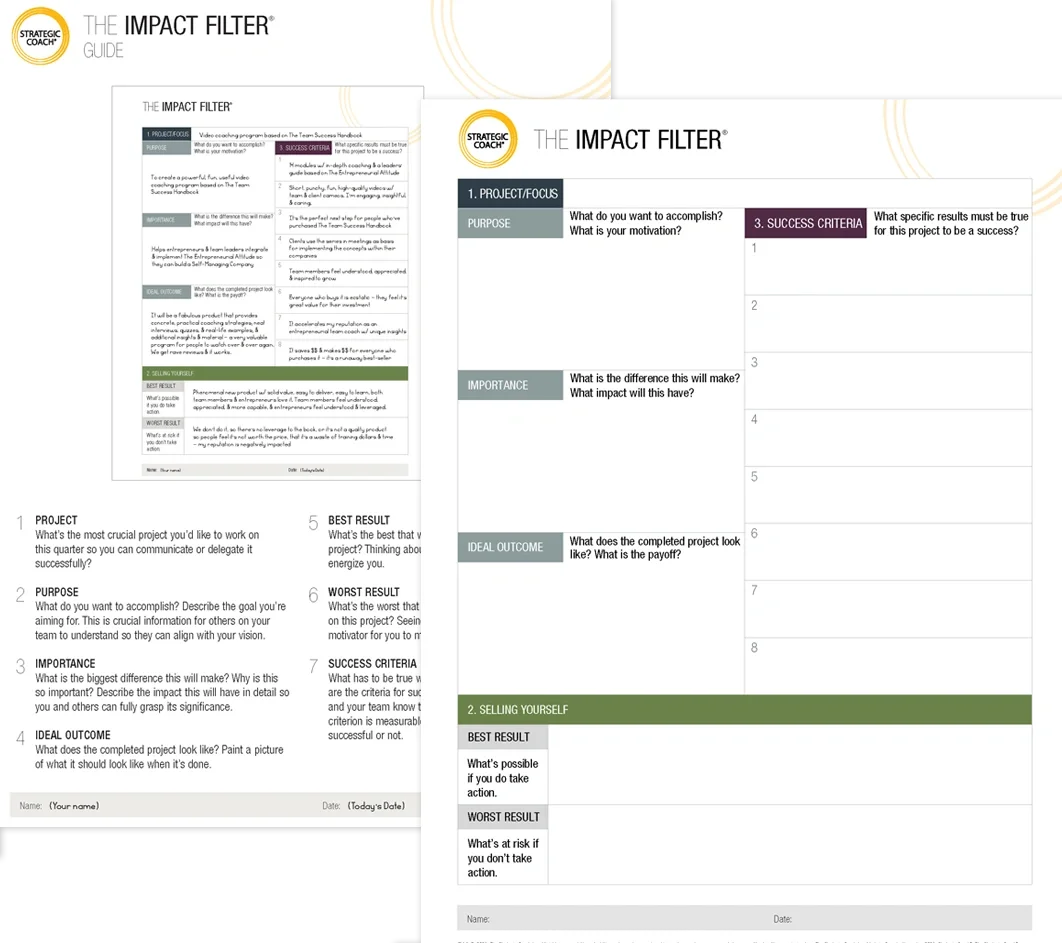
The Impact Filter®
Dan Sullivan’s #1 Thinking Tool
Are you tired of feeling overwhelmed by your goals? The Impact Filter is a powerful planning tool that can help you find clarity and focus. It’s a thinking process that filters out everything except the impact you want to have, and it’s the same tool that Dan Sullivan uses in every meeting.