The Unexpected Path From Ordinary To Unstoppable
December 04, 2025

Hosted By
 Dan Sullivan
 Gord Vickman
Are your most ambitious years behind you, or still ahead? Dan Sullivan and Gord Vickman explain The Six-Year Framework™ from Dan’s latest book, Always More Ambitious, and share why recent capabilities are the best fuel for your future. They also discuss how to stay smart in a distracted world so teamwork and technology keep you calm, creative, and increasingly ambitious at every age.
Show Notes:
The Six-Year Framework keeps you focused on three years of recent achievements and three years of future growth.
There’s a direct connection between capability and ambition: expanding one naturally expands the other.
The real fuel for your next jump isn’t more goals—it’s taking your strongest capabilities and deciding where you want them to go next.
Teamwork and technology are the two biggest multipliers behind entrepreneurs’ best decades.
Pairing your smartest past decisions with your most exciting new possibilities makes the future feel bigger and more achievable overnight.
A fixed six-year window gives you a clear sense of progress instead of the stress of chasing a constantly moving goalpost.
Entrepreneurs need to resist getting lost in new tech and instead let their team find and build the right tools.
Deciding that your later decades will be your most ambitious changes how you use every year between now and then.
Resources:
Always More Ambitious by Dan Sullivan
Shannon Waller’s Team Success podcast
Episode Transcript
Gord Vickman: Welcome to the next episode of Podcast Payoffs. My name is Gord Vickman here with Dan Sullivan. The name of the game on this show is teamwork and technology. Dan, we're going to team up to talk teamwork and technology today.
Dan Sullivan: Feeling very positive, feeling very expressive.
Gord Vickman: Well, it's a positive time and it's a great time to be ambitious. And the new quarterly book is called Always More Ambitious. And I read the book over the course of the past few days. It's a very quick read. You can get a copy for yourself at strategiccoach.com. Click store. It's probably the first thing you're going to see. And inside that book, Dan, is a dead simple framework for how you can increase your ambition without building anything new or anything other than that which you have right now. And I thought that could include team members, that could include tech stacks, that could include just about anything you're using. So. If you have a VA, an EA, if you have an AI agent, if you have anybody helping you to achieve your dreams, this episode is for you. Dan, before we begin, it's a newer concept for you and I know you well enough to know that every concept and every idea you have has a story. The six-year framework is what I was alluding to earlier and teasing earlier. Where did that come from? Where were you? What were you doing? Was this a shower thought, a midnight thought on a beach, on a plane? Where were you when this came to be initially? And then you flesh that out.
Dan Sullivan: We started coaching 1974, so I'm past the half century mark. And early on in my coaching career, this would be the 1970s, I noticed if you're coaching people and you're picking a time period ahead, that you should use three years. Three years seems to be the best. And I've experimented with a lot of other time periods. And I think the reason why three is good is that three years is the year after the year after next. And most people can visualize, you know, and you get a sense that if you set a goal that some goals, it's useful that you spend three years on them. And then you're going to have a lot that are a shorter period of time. And so you're going to have a lot of goal achievement. And all our clients are ambitious entrepreneurs, talented, successful, ambitious entrepreneurs.
But then as I've coached more and more, and first of all, it was just one-on-one coaching. First 15 years, I was just doing an individual coaching plan for individuals. And then we learned enough that we could do it with a group. And then gradually, we've created structures, tools, 250 now, and the Patent Bureau in Washington seems to like our, we have 75 patents, we have 75 pending. So these are thinking structures that we have. About three years ago, I was just approaching 80, so I was 78, 79, 81 now. I just got thinking about my life and it seemed to me that the most productive creative achievement decade of my life was since I was 70. Okay, so 70 to 80 was going to be way, way bigger than any of the previous decades. It was very useful going over and just, you know, doing a checklist of different things. And these individually, they were bigger than anything that I had done in that category, but together they were easily 10 times, 15 times more than I had ever achieved in any other decade. So that was one thought.
So I created a thinking tool for the entrepreneurs. It was called Your Best Decade Ever, and I had them go back and break their life. I mean, some are 30 years old, some are 50, not many my age, but there's some that have five or six decades before. And to a person, they said that the last decade was by far the best decade that they had ever had. So then I flipped it and I said, well, if you have, you know, the achievements, these are sort of measurable achievements. And what came across to everybody is that they had developed an enormous amount of new capabilities in the previous 10 years. I said, so are these capabilities that you want to take even further? And they did. And so what happened, I had them take each of the capabilities that were the high mark for their last 10 years, and I said, where do you want to go with each one of these capabilities over the next 10 years? So for me, it'd be 80 to 90. I'm 81 right now, so nine more years.
Two factors really determine why the last decade was the best ever, and that is they'd all gotten good at teamwork and technology. So they had bigger teams, so much greater other people's capability. And then they had technology. And of course, you know, this was happening right at the time when ChatGPT was introduced. So they had already gotten a lot out of technology, but they had a sense that this new one was going to be a multiplier for them, and especially when they put the teamwork and the technology together. So without a doubt, everybody said the next decade is going to almost be bigger than all my previous decades put together. So that was an interesting experience, and I did it with probably 200, 300 entrepreneurs, I did that exercise, and it really left a mark on me. And I said, you know, all these years, you've always been looking into the future. People are more or less making up stuff, but they really haven't done the stuff that they're doing. They're saying, I want this result, but most of them didn't have the capability to do it. So by doing it backwards first, by going back 10 years, what I discovered, I was giving them the best possible raw material, doing it for myself first, and then they were going forward.
And something clicked about it is that there's a connection between capability and ambition. So they weren't using as the building blocks, they weren't using things they wanted, they were using things that they already had. So that was a big lesson, you know, that if you want to know what the bigger future is, start with the best capabilities you have right now. So then last year we had our first big network-wide conference in Nashville, and among the participants were a lot of clients who had never met me. They've been members of Strategic Coach for, you know, some of them 15, 20, and one of them that was 25 years came up, he introduced himself and everything. But this is the first time I'd ever met him, because right now we have 15 other coaches. So there's lots of clients that have been at Coach for a long time, but I have not met them personally. And he said, you sound really ambitious at 80. What's your ambition when you're 90? You know, I could have told him some goals, but I said, you know, I think he's asking a different question. And what occurred to me was that my ambition for when I'm 90 years old is that I'm even more ambitious than I am now. And I don't know what he got out of the conversation, but I walked away and I said, this is a powerful thought—that instead of setting all sorts of goals for yourself, that being the first thing that you're doing, take all the capabilities that you already have and make them bigger, and they'll automatically make you more ambitious.
So that's really where the thought came from. And then I create new tools every quarter, and I thought we'd done the 10-year thing. You know, 10 years is, it's harder to get a grasp of 10 years. And I said, let's take three years, three years back and three years forward, and make your reality, your daily reality, that you're operating in a framework that consists of three years backwards and three years forward. But it's not a moving line. So my latest one was July 1st, 2025. So I'm about six months into it. And I said that the most important things that I've ever done in my past is probably in the last three years, not in the 77 years or 78 years behind it. And I've already done that one anyway. So I'm just going to take three years back. What did I do? And then how can you take the thing that you now have complete power over, this capability, you already have the capability, you know it works—and what do you do with that thing now during the next three years, which takes me to 2028?
One of the hardest things for human beings to do, and we've had conversations, Gord, about this, is that it's hard to be in the present because our brain is attached to the past and our brain is attached to the future and sometimes there's a collision between past and future. But the one thing about the past and the one thing about the future is that you're not in the present. And what I noticed over the last six months, I've gotten very, very calm, I've gotten very, very centered because I'm just going back and finding something in the last three years, making it better, you know, getting it clear, appreciating the significance of that capability, and then I'm moving that capability into the future. And like everybody else who's an entrepreneur, I have access to better and better teamwork, and I have access to better and better technology. So any capability I have now is going to get better if I just multiply it with teamwork and multiply it with technology.
Gord Vickman: One of the insights I had as I was going through the book was, you know, you've talked in the past about entrepreneurs who are in charge, but not in control. So you're in charge, but you're not in control. How irresistible do you think it would be for an entrepreneur because of how interesting and fun the teamwork and technology has become now, especially that AI is in the game? Do you find that you're encountering people who, after having read this book, they might be talking to you and you see them slipping into that control thing where they feel like they're the ones that are going to have to go and find the right tools and find the right AI agents? I guess if they want to, if that's something that turns your gears, you can do that. But have you found yourself having to maybe pull some of them back and go, oh, hang on a second here. It's still about, you got to have the team involved and allow the people on your team to go and find those tech stacks and don't get too deep in the weeds here.
Dan Sullivan: I'm just starting to encounter the readers of the book because we started getting it out to all the clients that I'll be talking in December. We got it out to them in September and October. It's an intriguing thing for them because they have a temptation to go too far back into the past for lessons. And I said, probably the last three years is the richest three years of your life in terms of actual new insights, new knowledge, new connections, new opportunities, new capabilities. So I said, why don't you just say three years is good enough and just keep going back and documenting what you did. And it's one of the regular patterns in the coaching program in our workshops that I always get them to tell their past now. For example, we have a new tool that I just created, which I'm testing out starting in December, and it's called Always Getting Smarter. And there's a column, you know, the first column, they brainstorm, and I said, where have you been really smart in your entrepreneurial career or your personal life, things that you really did?
You know, and for example, I was really smart, I really married well, I really chose the right marketplace. So they'll do about a dozen of them. And then I say, and in terms of neat new possibilities, I brainstormed a couple of minutes, point for them, and they said, good, you have two columns, you had where you've really been smart and new possibilities. Now, let's identify the three ways where you've really been smart. Of all the ones you put down there, what are the three smartest? And they do that. And I say, now, what are the three most exciting possibilities? And then I have them go through an exercise where they put the number one smart with the number one opportunity, number two, number two, number three, number three, and then they start comparing them and all of a sudden the future just explodes for them.
The big thing is, I'm taking them into their past so when they think about the future they're doing it on the basis of solid achievement. You know, they're not making up the capability. They already have the capability. They're just applying the capability in a new way. And that gets to the essence of the book, and that is ambition is the number one capability that you have. It's what allows you to create all your other capabilities. But anytime you create a new capability, that expands your ambition. So there's this chicken and egg situation that you have going, where the ambition is creating more capability, but new capability is creating more ambition.
Gord Vickman: It's an interesting name for the tool, Always Getting Smarter. There are entire industries out there right now that could conceivably be called perpetually getting dumber. Always Getting Dumber brought to you by TikTok. Rotting the brains of teenage girls everywhere. Courtesy of China.
Dan Sullivan: Yeah.
Gord Vickman: TikTok is not available in China as it is in North America. In China, you're not even allowed to go on TikTok as it is in North America. This is true. They don't let children in China go on TikTok because they said it's too addictive and it'll destroy their brains. Let's ship it to America.
Dan Sullivan: Yeah, when I first got involved with people who were really into technology, when our entrepreneurial clients were really deeply into technology, they were passing on, they said, the most interesting thing about new technology is that it's usually given away for free. I said, who else does that? I said, drug dealers do that. The first sample is always free. Anything that's free, you're the product. You have to realize that if it's free, you're the product. So the actual product of the TikTok industry is all the people who are hooked on TikTok. They're selling brains to other people.
Gord Vickman: Is this the first generation? And this does not encapsulate just my generation, your generation, or X, or whatever, millennials. This could be the first period in time where we have to almost battle and fight to not get dumber. Because I'm thinking back to my grandfather, okay? Nickel miner, born in Finland, came up as a child in Canada, Northern Ontario. So let's pretend you're living in the twenties, you're living in the thirties, forties, fifties. You'd almost get smarter by default because there's just things to do all day that you have to figure out by yourself. So, you know, you grow up, grandpa grows up and the retaining wall in the backyard is broken. So now he's like, well, shit, I got to get a retaining wall back there. I don't want to pay someone to do it, so I'm going to do it. So now you have to figure out how to build a retaining wall, even though you've never done it before. And then there's probably something else. Maybe grandma has some problem that you're figuring out. So almost by default in the past before we had social media or before we had rapid access to AI and all the information at our fingertips, you were forced to get smarter. But now we've reached this period in time where it's almost a fight to not get dumber every day by offloading all of our thoughts and all of our instincts and all of our ideas. And I don't know if we've evolved to know what to do with all this information.
Dan Sullivan: There's a real difference, I notice, in the thinking capabilities of people who, well, you can use almost any breakthrough. But for example, I was born before television. I had seen television, but we didn't have one in our home. And I'd grown up on radio. And radio is really good for visualization because you have to supply all the visuals when you listen to the radio. And there are a lot of stories and, you know, there were programs that are just like television programs. They were on radio.
Gord Vickman: Theater of the mind.
Dan Sullivan: Theater of the mind. And you would sit there, and I was an avid reader from an early age, so when you're reading, you have to supply the visuals. You know, if it's a story, especially if it's fiction, you have to supply it. And I noticed that I've really retained this all my life. I have great visualizing capabilities. But my sense is probably social media. I just looked it up that social media anyway sort of appeared in the early …
Gord Vickman: Early 2000s.
Dan Sullivan: Early 2000s. I think that, you know, when it really becomes significant, it's around 2012, 2013, you know, where it really becomes a major medium in people's lives. Like, if you're doing more than a couple hours with a medium, it's a major medium. On average, you're doing more in two hours. But the big thing is, I think it's rather important to know how to fight the fight that you're talking about, is that you've had an experience of not being in contact with the medium. The other thing is, I absolutely love YouTube because anything you're interested in, you can go deep in interviews, you can go in documentaries, great discussions, and then you can see one, and then you see the other, and you start making judgments. But you're doing a lot of thinking when you're doing it. So I'm technologically involved with Zoom. I'm technologically involved with YouTube. I love AI, but I just have one app. I just have Perplexity, and I use it just for helping with my writing. And it's certainly increased my speed in the last year and a half since I've been involved with it.
I knew you were going to ask me the question about it today because you sent the structure of this particular podcast. I said, he's going to ask me, why have you avoided social media? And it seemed to me like gossip, and I've always been averse to gossip ever since I've get it. Somebody tells me something, I never pass it on. If somebody tells me something, it's information for me, but it doesn't get passed on. It struck me that people who are prone to gossip really get caught up with social media. It's kind of the same instinct, not a technological instinct, but I think it's a psychological instinct, you know, that you want to know everything about somebody else. It's like currency. You have currency. I can trade you a scandalous story for your scandalous story, and I'm richer. We're both richer with inside stories.
Gord Vickman: You know, just backing up momentarily before we wrap today, Dan, we were talking about Theater of the Mind. That was always the, you know, the line that we used even during the radio days. And I remember stories that my dad would tell me of him and his brother, little brother Bill, they'd be crowded around the radio and the whole family would be listening to Bonanza or The Lone Ranger—these were radio dramas. They don't exist anymore. I'm sure you can find them. There's definitely podcasts. And you know what? I should probably go and try and find some of these. I'm sure my dad might like it. He just inspired me to go find old Lone Ranger episode, bringing it back to the present. We have a two-and-a-half-year-old, Gabriel, our little guy. We noticed something very definitive and it was a stark contrast in the toys. So we have friends who have purchased him toys that I'll call like techno toys. He's got a little alligator, the [inaudible], and it shouts at you and it drives itself around and it blinks and it's, you know, very exciting. And then he's got sort of little action figures. He's got his Spider-Man, he's got his farm set.
And I noticed two very distinct differences in how he plays with each is the techno toys that blink, scream, and make noise. We're not sure who's playing with who, because all he does is sit there and stare at it. But when he's got an action figure, he's creating little dramas in his own mind. And he's got the cow talking to the Hulk and he's got the pig talking to Spider-Man. And then these guys have a beef over here and they got a problem they got to figure out. So you can see his imagination going, because I was wondering, my wife and I talked about this. It's like, I remember playing with action figures when I was growing up, you know, you'd have GI Joes, the good guys and the bad guys, the Joes and the Cobras, they'd have a peace summit. It would never work out because they got to fight, obviously. You need the money shot at the end. But that was part and parcel to me developing, I like to believe, a fairly vivid imagination, and at least encouraged me at that age, at least something that we're trying to bring forward to our own kids or our own child specifically, because he's the only one that we're, you know, dealing with and have control over what he's doing on a daily basis.
But forcing him to use his little brain in whatever stage of development it's in right now to create those scenarios, I don't think it's dissimilar to what my dad was doing when he was younger. You know, when you're listening to The Lone Ranger radio show, you got to figure out what the Lone Ranger looks like. You got to figure out what Tonto looks like in silver, right? What color is the horse? I don't know. It could be a totally different color than what his brother pictured, but they each had that vision in their mind. And that's what I think is going on with our kid right now, when we give him toys that force him to play with the toy as opposed to being played with.
Dan Sullivan: Well, he's actually playing with his mind. Just a little add-on to your story about your father, you know, growing up with radio. So I had three programs I listened to, and one of them was Sky King. Sky King, and it was an adventure. It involved somebody with an airplane, and there was good and bad people, and, you know, there was problems to be solved, crimes to be solved. The other one was Sergeant Preston of the Yukon and his faithful dog King, Yukon King. I would listen to that. And then the third one was The Lone Ranger. And then when we got the television, so I was born in ‘44 and, you know, I'm sort of conscious of listening to the radio maybe five years later, six years later, you know. 1949, 1950, and I could really visualize what was happening. Then when we got to television, these programs had moved from radio to television, and I didn't watch them because my picture of what was going on was much better than what the TV producer was doing, the cameraman was doing. My picture of how this was happening, where it was happening, was much more powerful. So, to a certain extent, that's a crossover, that I have one where I have to really use my brain to one where I don't have to use my brain very much. It's similar to your child with the action figures, which don't move, which don't say anything, don't entertain him. He has to do the entertainment, develops his brain much, much more than the toy. Going into AI now, you can just say something and it gets created for you. I don't think it's doing your brain much good.
Gord Vickman: No, I tend to agree.
Dan Sullivan: I'm not saying it's doing bad, but I don't think it's doing much good.
Gord Vickman: No, I think you're right. And, you know, I think the battle right now is, you know, we've discussed before, it's been said a million times, money loves speed. AI can guarantee speed. I was playing around with Notebook LM the other day. I made an infographic for Shannon Waller based on her latest episode of Shannon Waller's Team Success, part of the Strategic Podcast Network. You can check that out, strategicpodcasts.com. And I said, holy smokes, it would take a designer probably three days to pull this off. And there's still some hallucinations. There's typos. It hallucinates websites and all kinds of things, but it just shows what's possible. And if money loves speed, AI can deliver that. And that will be the battle between the slop and what's real. But Dan, we kind of zigged and zagged on this episode, which is always fun because we're unscripted just the way we like it and just the way you like it too.
Dan Sullivan: We can do a plug for the book again. People can download the book.
Gord Vickman: They sure can. Always More Ambitious. Go to strategiccoach.com. Click store and it will be right there for you. You can download your copy. You can get a digital copy or you can actually get a physical copy of the book there too. Really super simple. We've got a great new KP store just launched last month. It's gorgeous. super simple to order it and a copy for yourself. Dan, any parting thoughts? What did you get out of this episode?
Dan Sullivan: The big thing is the six-year framework gives you an entirely new framework. And just to tell you why you might find this very satisfying, it's a fixed six years. So I started on July 1st, six months ago. But it doesn't slide ahead. It means that in July 1st of 2028, I've completed three years of the future. And now that three years of the future becomes the three years of the past and I create a new three years. So it's, I find if you have a moving line, you don't get a sense of achievement. You don't get a sense of excitement. So it's just a new timeframe. And I think it's especially good for entrepreneurs.
Gord Vickman: Me too. And I love the concept and I love almost the bumpers in between because for me anyway, and a lot of people like me, maybe you're like me, looking ahead too far could cause anxiety. Going back a little bit too far can dig up some demons. Yeah. It's, you know, you can put those guardrails there. And as we mentioned, the promise we made right off the top, it's a dead simple framework and we're going to give you a little taste of it today. And I think that's what we did. So we hope you enjoyed it as much as we enjoyed creating this episode for you today. If you liked it, share it with someone who you think needs to hear it. Dan, thanks so much. On to the next.
Dan Sullivan: Thank you.
Related Content
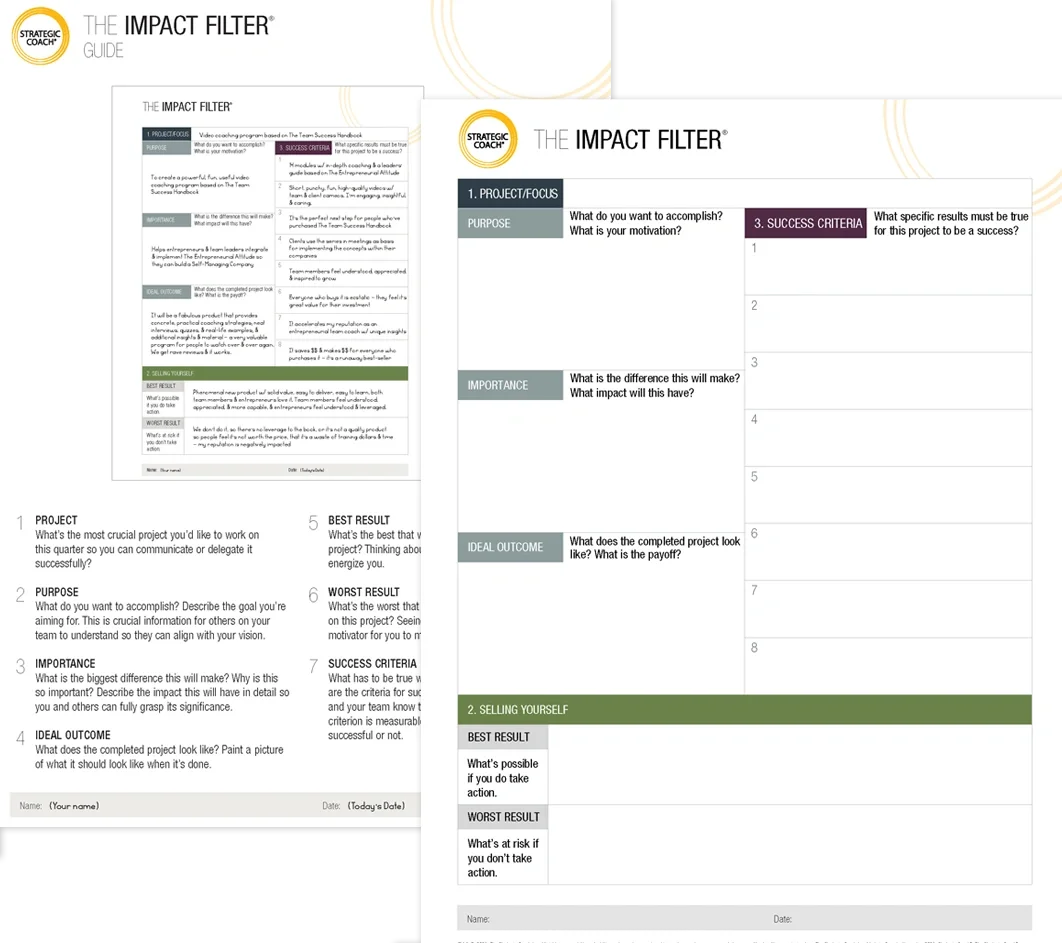
The Impact Filter®
Dan Sullivan’s #1 Thinking Tool
Are you tired of feeling overwhelmed by your goals? The Impact Filter is a powerful planning tool that can help you find clarity and focus. It’s a thinking process that filters out everything except the impact you want to have, and it’s the same tool that Dan Sullivan uses in every meeting.