The Greater Game: Chapter 8 – Greater Agency
August 05, 2026
Hosted By
 Dan Sullivan
 John Bowen
It’s time for entrepreneurs to play The Greater Game and go 100x. In this episode, Dan Sullivan and John Bowen explore Greater Agency, the eighth of the 10 Multipliers, and show how taking full ownership of your results lets you create new markets, bigger opportunities, and breakthroughs from even your toughest setbacks.
Show Notes:
Agency means you take ownership of your experiences—positive or negative—instead of blaming the circumstances.
When entrepreneurs see something broken in the marketplace and take ownership, they turn that gap into a new capability.
Entrepreneurs who operate with agency don’t just compete in existing markets; they create entirely new ones.
Creative entrepreneurs spot opportunities that others miss because they’ve taken ownership of their entrepreneurial lifetime.
Many non-entrepreneurs assume entrepreneurs just copy what already exists, but the best entrepreneurs redefine the game.
The greatest entrepreneurs expand an entire industry by turning their market impact into new opportunities for everyone involved.
At this stage of The Greater Game, you’re building platforms that turn former competitors into collaborators in a bigger game.
Your greatest setbacks, obstacles, and failures are actually the raw material for your biggest breakthroughs.
Resources:
The Greater Game by Dan Sullivan and John Bowen
Who Not How by Dan Sullivan with Dr. Benjamin Hardy
10x Is Easier Than 2x by Dan Sullivan with Dr. Benjamin Hardy
Episode Transcript
John Bowen: Well, Dan, it's great to get the band back together again here. We are on episode eight, “Greater Agency.” And I know we care about all the multipliers, but this is one that's really important on so many fronts.
Dan Sullivan: You know, more and more, I'm seeing this concept of agency entering public discourse. There's a very famous psychologist out of the University of Pennsylvania, Martin Seligman, who has created an entirely new branch of psychology, which is called positive psychology. He said that most psychology theories and most psychology studies have to do with what makes people unhappy. So he focused for 60 years on what makes people happy. So I talked to him, I did a Zoom call with him, and I said, is happiness the center? And he said, no, he says happiness is actually a result of another factor, which is called agency. And he says agency simply means that whether you're having a happy experience or an unhappy experience, you take ownership for it.
We have some great examples in chapter 8 of The Greater Game of people simply taking ownership of the marketplace where something doesn't work, and they use their personal agency. We have a great story of Mark Young. He actually created an entirely new video network, a television network, in 2,000 stores, and it's been such a big hit that everybody wants to do it, but it is the whole point that he took ownership for something that was not being done well, and took the initiative to actually create a new form that created a new capability in the marketplace. And this could go to hundreds of different places.
And then Carter Froelich, who tells a great story about creating a form for getting new developments, new industrial developments, new residential developments, bypassing an enormous amount of paperwork and very, very complicated regulatory regimes so that people can service and get a new development going. First of all, he tested it out in Texas, and now he's going across the United States with it. So the big thing is that entrepreneurs who take agency create new markets. They create entirely new capabilities in the marketplace.
John Bowen: I might take a step back, because I do want to dive in. Mark, I would count as a good friend. I've met through you. Carter, I don't know as much, but I think this is one of the most important ones, Dan. If you're listening to this, you're not going to see what I'm putting on the slide. It's The Greater Game Pyramid. But what we'll do is, again, under these, you can just go and download the slides that we make available. We've gone through and we've shared, Dan and I, stage one, the foundation for freedom. This is getting started, the first two multipliers, the ambition, security. Then we went to energy, and we talked about motivation and intellectual property. The idea is, with the whole book, is how can we use this pyramid, this ladder, if you will, these four stages to really explode.
And then we also covered the collaboration and multiplication. Once you've got this foundation, you got the energy, you own the IP, we start building the community, teamwork, and autonomy. But we're just jumping into that exponential growth. And to me, this is such an important one. I think this is one I'm going to give you a lot of credit. I think I'm pretty creative, but you pushed me that this is about creating markets. And I want to put up another statistic real quick. 49.1 percent. So really half of our foundational survey, you know, they went and they're creating their own markets. They're not reacting; they're creating.
Carter, you mentioned 2 billion dollars created by just doing one constraint. I haven't had the privilege, I don't think, of meeting Carter along the way, but I got the interview and just an amazing, you know, it's one of those simple things. He just said, you know, let's get rid of the big problem with it. And then Mark, the 3 million daily views with advertising, the noise of AI, you and I have talked about, he's reinvented the ability to market. And all of a sudden, instead of him being an agency, now people are coming to him for the distribution of it. And you spent a lot of time talking about it. I might just put up the statistics just for a second, too, or the two creators. Maybe go a little deeper, Dan, because this is such an important one. And these guys are leaders in it.
Dan Sullivan: Yeah, and that's the interesting thing. When people who are not entrepreneurs think about entrepreneurs, they say, well, they're just doing something that existed before. And they don't appreciate that creative entrepreneurs who've really taken ownership for their entrepreneurial lifetime, the automatic impact of that is when they go into the marketplace, they spot opportunities that other people just don't see. We have two other podcasts to follow this. One of them is on commitment and the other one is on courage. And that basically, these are people whose impact on the market creates entirely new opportunities for an entire industry. And a lot of them put several industries together.
John, you're further ahead than me. You gave me the compliment. I'm telling that you're much further ahead of me because you've been in the banking business, you've been in the investment business, you're right at the center of the financial services industry, and that basically it's all about money. And a lot of people don't realize this, that money is looking for new opportunities to create growth. But it takes an individual entrepreneur to be the first one in. These are like pathfinders. These are like pioneers who took civilization into the wilderness. And it just shows that after you've done all the previous seven levels of The Greater Game, now your Unique Ability has everything that needs to go out and create many, many more different kinds of marketplaces, not only for yourself, but it includes hundreds and thousands of other individuals.
John Bowen: This is a really important point, putting the pyramid up again. And you get through level three and you're doing phenomenal. Now we're looking for exponential growth. And one of the key things, and Dan, we used in the book, we called it the market participation versus market creation. And the idea was when we did the research, the empirical first, and you've got tens of thousands of entrepreneurs you've talked with, coached, and so on. But very few create new markets. They're participating. They're grinding it out. And this is where being a business owner, entrepreneur can be really tough. On the other hand, if you can take the step back and you build each of these three stages and now say, okay, where are the opportunities? Where are the gaps in the industry that I can create a market? It's a wow type thing.
Dan Sullivan: Somebody said if you were a chess player, what would you want to be? Would you be the white pieces or the black pieces? And what we're talking about in this chapter of the book is that you're actually the chessboard where everybody that you have considered a possible competitor up until now gets a new chance. You're actually creating capability for those individuals who might have up until now been rivals. They might have been competitors, but you're creating such a bigger game. And I think this whole notion of the greater game that we're writing about in the book. This is where you really start seeing it, where it's not just multiplying your own success, but you're multiplying the success of all the other players in the game.
John Bowen: Let's talk about Mark Young, because I know that story really well. Mark is a good friend. We both are into cars. He's got a 720 McLaren. I do too. I do track days. He races, and he's very competitive. We're pretty close to the same age. So I mean, that's a huge event by itself. Mark saw in the pharmacies, he has an agency business. He's helping them market all this stuff. And he saw empty space where they had the blood pressure cuff machine there. And hardly anybody ever used it. It's cheap enough to buy the blood pressure if you're going to monitor it. And he goes, why don't I put something else there? And he created PharmaVision. And he's now in, I think, over 2,000 locations in three years, 3 million daily viewers, dead screening machines to Media Empire. I mean, that's changed Mark's life totally. And he just saw this one gap, and wow.
Dan Sullivan: Yeah. What was interesting about Mark was that he needed a partner, a collaboration partner. And it turned out that one of his main fellow drivers, because he's a professional race car driver, and this man was the head of all the pharmacies in a major pharmaceutical company. And he said, you know, I got this problem. This was an idea from 20 years ago, where the company put in blood pressure machines right in the pharmacy part of a grocery store. It was using up space and it cost them money. They were still paying for the licensing rights to another company, but nobody was using that for a decade. So he said, why don't we rethink it?
So they took this space. I mean, all retail based, how many dollars are you getting from a square foot of your stores? And they had 2000 stores where this was not only not producing money, it was costing them money. And Mark, who's a phenomenal advertising agency, said, let's create a shelf with products on it, but a huge screen so that when people are waiting in line at the pharmacy, they can see the products, and the products are sitting right there. I mean, it's the fastest television message to somebody who is waiting in line, and you can buy the product because the product is sitting on the shelf that the TV is describing. And then they just went through 2,000 stores and replaced this. It was showing a huge profit within 90 days.
John Bowen: Yeah, before I went on camera, Dan, I'm going to share this one too, is that for us, I'm looking at where are the gaps in the industry for CEG. And one of the things that's really hard is we help financial advisors be more successful in serving entrepreneurs, high net worth, ultra high net worth individuals. The challenge is you can't practice on clients. You want to deliver a great experience from the beginning. And doing role playing between financial advisors, they'll do one or two and that's it. So we own a research company. We said, hey, why don't we create synthetic data, create avatars, and be able for everyone in the meetings that the advisors could do a role play with a synthetic client, but that would be as close to real because we have 20 years of data. And wow, we're just about ready to release it. We've been giving promos to our large corporate clients and it's been unbelievable response, because it's not only that you practice, but it tells you what you could do better. It's not, you know, an automated thing.
I was demoing it and it was really funny. I got very successful entrepreneur, did a major transaction. I'm walking him through. And I said, you know, we would go over the fees in the next meeting, because I don't know what we're going to do. He got drilling me on how the fee structure was and so on in front of a bunch of corporate clients. But people don't do scripts. And again, I believe it will be several million dollars of revenue for our firm. And this is where if we can create the market—there's no one else doing it, certainly in the wealth management industry. There's a couple random sales enablement ones, but we do look at competitors from a collaborative standpoint, but we're not looking to see from the standpoint of, geez, we got to do incrementally better than them. No, we're going to march our own. And this is that big part of creating the market that you've done well in Strategic Coach.
Dan Sullivan: Yeah, well, the big thing is that having John Bowen and Dan Sullivan on the screen together, we were both coaching companies. We were in Strategic Coach workshops and we kept comparing notes. But I think the real breakthrough, John, of why our collaboration is working, is because of your research company that you purchased. And that is that I've had tremendous anecdotal proof that if two people who seem to be in the same industry are … you're a coach, I'm a coach, I have a coaching program, you have a coaching program. But the other thing is we've each done it uniquely, and if we take your uniqueness and my uniqueness, but then you brought in another factor, and that is what you're getting in the form of anecdotal proof, I can actually provide you with the numbers that back up what your insights are. And I think that was the breakthrough, is that something new happened with one of our capabilities.
But one of the other capabilities that I brought to it was that we, within the last four or five years, have been creating best-selling books. And we had a great in with a publisher, Hay House, who's our collaborator on getting these books out, and as a result of that, we were able to put a lot of separated capabilities together in a single framework, and this goes out to my clients, it goes out to your clients, and I was just reading a really interesting statistic. We're doing this in 2026, and the Small Business Administration of the United States just released the results for June, that in the United States there were 500,000 new business starts in the month of June. We should all be celebrating that too. That's what gets the economy going. 3.5 million new business starts in the 12 months from June to June.
So we can see, certainly in the United States environment, there is this tremendous movement towards people becoming entrepreneurs. We're bringing this book out right now, and the dashboard that you and your tech team have actually created is now available to 3.5 million new entrepreneurs right at the beginning of their career. We're giving them the structure. Look, we're talking to people who have been at this for 40 years, but every one of them if you said if we'd had this structure at the beginning, I would have killed to have this. We're taking agency. We're combining things. We're not just optimizing our own niche in the market. We're actually saying, what's the uniqueness that we can each combine? And we're taking agency for creating an entirely new structure into the marketplace.
John Bowen: Well, and the other thing we were doing, Dan, is, you know, you and I teamed up on the research. So every month we're surveying 500 successful entrepreneurs and we're getting insights. Matter of fact, let me show the dashboard because I'll show where you can get that. And then we're going to put this into kind of a publication. We haven't figured out exactly what it is, but we'll be sharing success stories. Because I don't know about you, but I get pretty excited. I mean, when I talk to Mark and Carter, and I think we have 26 stories or so in the book. But I know when I'm in Strategic Coach, I come up to Chicago. I get inspired every time again, because it's the success stories of seeing what people are doing. And I get all kinds of ideas, and then we focus in, and what can we do?
But let's go to the dashboard real quick. And in the dashboard, this is, if you've read the book, you should be doing this along the way. If you've done the Audible, we now have a download, too, that you have all the information there that you can use as well. So you have it in print, but the idea is, you know, go in, you start the assessment, you're going to be asked for each of the 10 Multipliers, a series of questions, and you just score where you are. We do get the data because we're a research firm, but it's anonymized. So don't worry about not looking good. Be truthful to yourself. And what happens is we go in—you can come in at any time. And one of the new features we just did is you'll have this entrepreneur pulse. And right now it's just the research part. But every month we're going to talk about what the confidence is. What are the five things that we're seeing that are important to you? And then what moved this month?
And again, this is all your peers. This is 500 successful ones. What was unexpected? And again, this is really just helping you. One of the things, Dan, I know you're passionate about, I'm certainly passionate about, is fellow entrepreneurs. We want you to be successful, whether we're working with you or not. I showed the pyramid, but what's even more valuable is getting your own numbers. Where are you? What can you do? Where are you on financial? Where are you on your biggest gain if you're keeping track of yourself? A recommended action we have, you can get a second opinion through one of my companies, the BFO Connect. And certainly if you've not explored, you should explore being part of a community. Oops, coming up and it's popping up that I should with that score, check my financials.
But again, joining Strategic Coach or having that discovery meeting, get the starter kit, it's free. Valuation, this is something Dan and I are really big on. Unfortunately, with the way I'm running the business where I'm just building the foundation now, the multiples are going to be low. What we want to do is get them up, obviously. And then when we look at peer benchmarks, you can look at kind of where you stand with your peers, with the top five, and then as we add up all the entrepreneurs who have participated. You know, one of the things that we're both committed to is entrepreneurial excellence. And this is a great tool to help you really get focus rather than I always think of the vital few things. We can't do everything. What are the three things that we should do over the next 90 days? And, you know, in the book, we talk about 100x because you got 25 years. Just do three things every quarter. The world is taken care of. Dan, anything there to add on that?
Dan Sullivan: I just think that this is going to grow and grow. The biggest thing, again, John, that you have brought to the table is it's going to be the deepest entrepreneurial model that's ever been created. And it's being added to every quarter. And what I feel very strongly with is entrepreneurs love numbers. But the problem is there's so much of what constitutes a successful entrepreneur that is more in the subjective, qualitative realm than it is in the measurable, quantitative realm. We're going very, very deep with the stories, and the entrepreneurs love entrepreneurial stories, but entrepreneurs also love entrepreneurial numbers.
John Bowen: What we want to do, Dan, is help them create their own numbers, their own story, their own narrative, that they are just taking these 10 Multipliers, doing them systematically, and really having that exponential growth. It's not about just making money. I mean, Dan's 82, and the reality is, I've talked with him many times, his ambition has never been higher. And I do know his financial situation reasonably well. He doesn't need to do it. I'm 70, going to be 71, and I don't need to do it either. We're doing it because of our passion. And this is one of the things that I take away from the whole book, Dan, as we were writing it is, you get to be successful on purpose. You get to design the business and the life you want by playing this greater game. And you're never going to have more fun. I mean, if you like being an entrepreneur, you're never going to have more fun. One final thing to add as we close out.
Dan Sullivan: Yeah, I think the big thing here is that agency can be developed on anything. So this isn't just your business life we're talking about; we're talking to your personal life. And in the final two chapters of the book, we're gonna show you that the greatest entrepreneurs actually get their greatest breakthrough strategies and their breakthrough progress through constantly turning negatives into positives. They're looking at the friction and say, how do we turn the friction into a solution? How do we turn the setbacks into breakthroughs? But it starts by taking agency. Look, I have good days, I have bad days. I'm going to take responsibility. I'm going to take ownership for both experiences. And I'm going to be surprised that the greatest setbacks, obstacles, failures actually are the raw material for creating the greatest breakthroughs.
John Bowen: And I think every entrepreneur knows that we don't have to go out and hunt for those failures. They show up, but we can take them, embrace them. And when we get back with you on our next podcast, “The Greater Commitment,” we are going to talk about the compounding effect of strategic stubbornness. And this is a really important one. So we'll see you there. And in the meantime, continue to make an impact.
Related Content

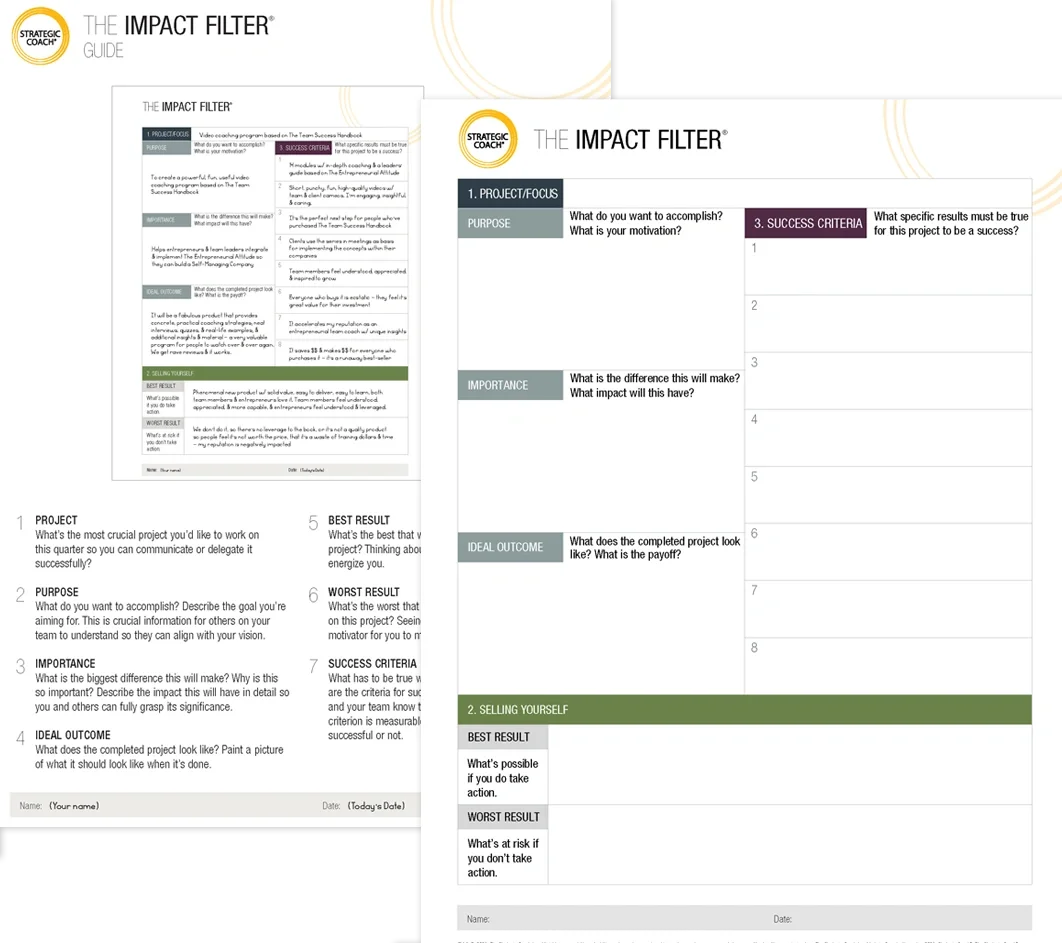
The Impact Filter®
Dan Sullivan’s #1 Thinking Tool
Are you tired of feeling overwhelmed by your goals? The Impact Filter is a powerful planning tool that can help you find clarity and focus. It’s a thinking process that filters out everything except the impact you want to have, and it’s the same tool that Dan Sullivan uses in every meeting.