The Greater Game: Chapter 9 – Greater Commitment
August 19, 2026

Hosted By
 Dan Sullivan
 John Bowen
What becomes possible when you commit to a long-term vision, even when the path is full of setbacks? In this episode, Dan Sullivan and John Bowen explore Greater Commitment, the ninth of the 10 Multipliers, and explain how strategic stubbornness helps entrepreneurs turn obstacles into fuel, create greater value, and build momentum that compounds over time.
Show Notes:
Greater Commitment is the compound effect of strategic stubbornness.
Entrepreneurs are the only people in the marketplace who can make decisions quickly and invest in the people, tools, and opportunities that help them move forward.
The Strategic Coach® Program turns entrepreneurs’ real-world experience into thinking tools that help them expand not only the success of their entrepreneurial life, but the enjoyment of their entrepreneurial life.
Entrepreneurial success is never a straight line; there are wobbles along the way, and some of them are significant.
The obstacles standing between you and what you want can become the raw material for achieving it.
Persistence can eventually produce results, but commitment creates momentum that compounds over time.
Becoming an entrepreneur is a life sentence in the best sense: your ideas, independence, and vision can make returning to conventional employment difficult.
The improvements you make through the 10 Multipliers can increase the value of your entrepreneurial company, whether or not you ever intend to sell it.
Reactive stubbornness is simply resisting other people’s expectations, while strategic stubbornness means staying committed to a meaningful future while remaining flexible about how you get there.
Resources:
The Greater Game by Dan Sullivan and John Bowen
Your Life As A Strategy Circle by Dan Sullivan
Episode Transcript
Dan Sullivan: Hi everybody, it's Dan Sullivan here and I'm here with John Bowen and we're taking you through our great new book, which is called The Greater Game, and this is for entrepreneurs who are committing themselves for the next 25 years to take their results 100x. You've got to be stubborn about this. If I take you back 25 years, John, where have you been the most stubborn? You had something in your mind. You saw it way out on the horizon. What was it that you have just totally stuck with?
John Bowen: Well, 26 years ago, I started CEG, the companies that I have now. And it would have been so easy. I was a successful financial advisor, had an asset management firm that was successful, was CEO of a pretty large U.S. holding company on the financial side. And it would have been easy to just do the investment. And I said, really, what I love is I love doing the research on what really works empirically. I loved it on the investment side when I was involved there, but doing it for financial advisors. And then I loved really helping other people being successful. And I thought, geez, if I could do the coaching, and you and I are both coaches, coaching, let's say 10,000 advisors, I could help a million people, high net worth, ultra-high net worth, be more successful with their families, financial situation, their communities. I mean, the impact, the ripple effect, got very excited about. But I got to tell you, Dan, it was hard sometimes. I know your story, too. It was hard on you, too. We call it “Greater Commitment.” It's the ninth Multiplier, chapter nine, the compound effect of stubbornness. And I think most people would agree that you and I are fairly stubborn along the way. It's not just being persistent.
Dan Sullivan: It's being stubborn. Yeah, my contributing story to your story is when I was 20 years old, I was out of school a couple of years and I took a program called Outward Bound in Scotland. I'm very, very impressed the number of entrepreneurs who have either gone or have had their children go to Outward Bound. And I wrote a diary and, in the diary, said my goal is to create an entirely new type of school. But it's going to be where people use their actual daily experience as the lessons. And what we'll do is we'll take their lessons and we'll formalize them. We'll turn them into thinking processes that produce actual results. And it took me 10 years of experimentation to figure out, who are the people that you really want this for? And they were entrepreneurs.
And the reason is that entrepreneurs are the only people in the marketplace who can make a decision on the spot that they're going to do something. And not only that, they can write a check on the spot for the privilege of utilizing your services. So that was at age 30, and I've been at this for two 25-year periods. It's been remarkably consistent, especially last 37 years, how consistent we have been at just following through. Let's use the entrepreneur's experience to create entrepreneurial concepts, to create entrepreneurial thinking tools that help them expand not only the success of their entrepreneurial life, but the enjoyment of their entrepreneurial life.
John Bowen: One of the things, and we talked about this in the last podcast with agency, is that stuff happens. You're thought of as being very successful. I think I am too. And it's not this straight line. There's all these wobbles along the way. And some of the wobbles are pretty big. We both know some for each of us, but it's that ability to be stubborn and really work through that and then take that as fuel to make it even better that provides this unbelievable exponential impact that you can make in life.
Dan Sullivan: Yeah, I think back to 1982, and I was a one-on-one coach in those days. You know, I'd been doing a lot of planning of different entrepreneurs, and I had one, and I suddenly had a breakthrough that all the obstacles which stand in the way of what it is that you want are actually the raw material for getting to that. It's called The Strategy Circle. It's one of our very first tools. I think the commitment really comes, you have to fundamentally alter your notion of what obstacles mean, what friction means, what setbacks mean. The moment that you can switch and say anything that stands in my way is actually a gift to me so that I can take the opposition and flip it into a new capability. And I think that's where the stubbornness comes from.
I think the obstacles that successful entrepreneurs have in their lives are almost an unfair advantage, because most of the general public looks at obstacles as the thing that's going to stop them. They can't go any further. So it's almost unfair that entrepreneurs look at opposition and negativity in their life in a completely different way. Not always. We have our bad days, but we get back to the thing is, let's look at this thing that's standing in the way and let's reconfigure it. Let's look at it in a totally different way. And we've got some great stories in chapter nine that point this out.
John Bowen: Well, let's give some statistics first, because both of us like research a lot. And this is in the book. And what we have is, when we look at this, and again, you can download the PowerPoint slides. There'll be a link wherever you're getting your information, wherever you're watching this podcast or listening to it. But the Greater Commitment, what we're looking at is the compound effect of strategic stubbornness. When we look at the most successful 28.1 percent of the entrepreneurs with 50 million dollars or more are saying, hey, we're constant. We're going to go unwavering. And we all have good and bad days. But it's a lot less when we're at 10 million dollars or less. When we go to 20-year vision, this is where I want to talk about Steven is one of the examples in the book. To me, I'm not as good as you, Dan, on the three days type thing. I might have to buy some cottages to do this as well. But three days, the recharging is just so important. I'm finding more and more as I get a little older that that's even more important.
And then 79.7 percent of the entrepreneurs we surveyed, lack of consistent long-term commitment. And, you know, persistence does the same things, but it takes a lot longer. Commitment is where it compounds. And this is really what Dan and I were talking about. And I want to put up the examples. We have two: Steven, and again, I know Steven just a little bit, but I'd love to have you share that story. And Sara is a public figure. I do know her because of some of the advisors she works with. I know both the public and a little bit of private, but I'll just share the public. But yeah, let's touch on Steven. What did he do? The Superpowers stuff.
Dan Sullivan: First of all, if you get to know Steven, you'll get a picture. He had an unbelievably chaotic childhood. I had a happy childhood. But Steven really turned himself around. I mean, he was facing bankruptcy. These are normal stories. But what a lot of people don't realize when they become entrepreneurs is that it's a life sentence. The very qualities that made you into an entrepreneur, in other words, having your own ideas, having your own notion of what direction you want to go, makes you fundamentally unemployable as an employee for someone else.
John Bowen: I totally agree. I did sell a business, was an employee for two years. I was CEO of a pretty major division. You can't do it. You shouldn't do it.
Dan Sullivan: You know, if I step back and look at myself, would you ever hire Dan Sullivan as an employee? There's no way I would ever hire this person. He's too wayward. You know, he's got too many distracting ideas to have him as a good employee. But what Steven did is that he had his experience from the financial services, very successful. He had a buyout. It was a big buyout and put him in the position where he had the freedom of time to actually create something that he had a passion for, and that was to create a global structure where your executive assistants can be from anywhere on the planet, but now that we have virtual communications, we now have the electronic means that the person to support you can come from anywhere else in the world.
And then they have a matchmaker. It's almost like the old eHarmony.com. This is who you are and who you're looking for, and this is the executive assistant someplace else in the world. This is what they do, and this is who they're looking for, and they match them up together. They don't have to see each other. They can see each other the way that John and I are communicating today on Zoom. And he's just showed that you add the executive assistant and then the executive assistant can add other people to your entrepreneurial company. And he calls this Superpowers, that basically, if you have the capability of doing this, it just makes a remarkable difference in the creativity, the productivity, but especially the profitability.
You know, we're all heading in a direction here with The Greater Game that your improvements that you're making as a result of the 10 chapters, the 10 Multipliers here, this translates directly into the valuation of your entrepreneurial company. The vast majority of entrepreneurs have no notion whatsoever of what someone else would be willing to pay for their company. Not saying you're going to sell it, but it's very, very important for you to actually know what it's worth. And that gives you the ability to look long and say, if I put in another 25 years, another twenty years, what do I want to see the impact be? And that's where your strategic stubbornness comes in, is that you know what it looks like if you just keep improving using the dashboard here in The Greater Game.
John Bowen: Well, let me give some numbers. I'm a number guy. And, you know, Steven exited in 2019 at 25 million dollars, which is in the book. He built Superpowers in three years. He had a reoccurring revenue of 4 million dollars. And, you know, it was very profitable, all that stuff. This is where you can have the exits. You start … I mean, I think Dan, you talk about that. If you have an exit, if you don't start something within a year, usually it's easy to miss. I mean, I do believe you need to have a little quiet period to think it through, go to your friends. You got to get back in the saddle. You got to get back in. And there's nothing better. And we talk about this. And you know if we go back to the foundational stuff, Foundation For Freedom, what I love is you now have total security as long as you're working with somebody that they've arranged the financial affairs so you can be totally independent, and that positions you for this exponential impact you can do. But you know what are those areas that you've been stubborn, you've been working on, you see the opportunities you can create.
We talked about agency in the last podcast—you're creating markets. This is where it really takes off. And I like the story from Sara Blakely from Spanx. I have never worn any of her products, but I have some friends that are friends of hers and advisors of her. And I've heard the story over and over again that for seven years she tried to start her company, because she didn't have capital. She got nos all the time. She took 5,000 dollars somehow, I think credit cards, and that she put together, and 1.2 billion dollar exit. And she's off on more adventures where you can go into her new businesses, but she didn't have a single competitor for 21 years. When you're doing it right, when you're playing the bigger, the greater game, you're thinking big.
And one of the things, Dan, you and I struggled a little bit when we first started writing the book, because you had a super successful book, 10x Is Easier Than 2x. And we go, well, geez, with AI and now all the tools and what we know, 100x is possible. And we're talking about not 100x in one week. We're talking about 25 years. And if we're going to be successful on purpose, putting this together is so powerful. And Dan, I've shared in previous podcasts, I know your growth has been phenomenal. But as we're writing the book, you've put more of this in place than I have. I'd like to say I'm perfect on everything. I'm not. I am working toward that. But we grew 50 percent last year. We'll grow 50 percent this year. And we already have contracts in place where I think we'll grow 50 percent next year. We have the systems and so on, and it's because of this pyramid. So I want to share this with everyone that they can do it as well.
Dan Sullivan: Yeah, the big thing is that strategic stubbornness is very, very different from reactive stubbornness. There's a lot of entrepreneurs that their entire career has been saying no to the way that other people want them to live their life. But there's nothing creative about that. You're just refusing to be influenced, and you're refusing to be told what to do by someone else. This isn't what we're talking about in this chapter. What we're talking about is that you're buying into the message of The Greater Game, but you realize that there's a part of your life where you have to really be single-minded. You have to say, I believe if I can utilize my best entrepreneurial abilities and namely what I'm really good at and what I really love to do, I can see in the future that this impact would be possible.
So you're simply lining yourself up for a great outcome on just who you are. But I'm willing to change my mind on who should be around me. I'm willing to change my mind about who the best customers and clients are. I'm willing to change my mind about my competitors might not really be my competitors. They might actually be collaborators if I approach it. So you're very flexible in your present thinking that there's a single goal ahead, but there might be a dozen different paths that I can take to get there, and I'm willing to change my behavior, I'm willing to change my mindset in the present, so that I keep going towards the single goal in the future. That's what strategic stubbornness is.
John Bowen: I put in place to a part I call strategic stumbling. As we're being very strategic, we're doing the 10 Multipliers. Just as you're saying that you can change your mind, well, the reality is things show up—opportunities, problems that aren't being served in the target market that you want to serve. My guess, Dan, if you go back to your initial plan for Strategic Coach, I still have the business plan for CEG. I have kept the very first 26 years ago. The audience we're serving, the target market we're serving is the same. But the rest of it's very different because we were stubborn, strategically stubborn in this. And then things showed up where we could add more value to our clients and do it in a way that we're successful as well. And that's really what so much of entrepreneurship is about.
Dan Sullivan: I noticed probably five years into The Strategic Coach Program, so that'd be around 1994. So we had started the formal workshop program in 1989. What I was noticing is that I think all entrepreneurs' goals at the beginning of their career is about making sure that they actually have a job at the end of every month, you know, that they're ahead of the game. But it's all about them. And what I realized, the real crossover for strategic stubbornness is the value that you're creating in other people's lives. And I have to tell you, that's an area of knowledge that never gets smaller. More and more you'll get into a mind frame where you're living inside of other people's vision for their own success, okay? And you're saying, how can I be more useful to what other people are trying to achieve? That's basically how you, John, and me are approaching The Greater Game. We're already successful, but what we have is a passion of getting inside the thinking of thousands, tens of thousands, hundreds of thousands of entrepreneurs and saying, we'd like to be helpful here. We'd like to be helpful here. And we're going to provide you with the best possible research and the best possible capabilities that are out there for you to be successful. Because if you're successful, we're exponentially more successful.
John Bowen: No, very much. I've seen you in so many conversations with successful entrepreneurs and I see the wheels going on. How can I help him or her be even more successful? And the same with me for financial advisors. And we have a privilege because we're working with so many people and we have now the empirical research. We've got the applied experience of what's working and that's where it makes it so valuable. But let's switch over and just touch on the dashboard real quick, because what we're doing as we're doing this, we want to create, I'm going to call it a community. We are committed, Dan and I and our companies, to continuing this. And on the empirical research side, we're surveying every month over 500 successful entrepreneurs, high net worth, ultra-high net worth. And you have access to the data. Our corporate clients are paying an awful lot. We're giving you all the highlights at the dashboard.
And we're going to be putting in the success stories from Strategic Coach as well. And this is where having both the empirical, but I also love the applied, you know, seeing how people are doing it. Dan, I'm in Free Zone with you. Quarterly, we get together in Chicago, and without exception, there is a new story of somebody doing some major breakthrough. And it's not only that we're cheering on their success, but the lessons that we're all learning from each other for doing this, it's just been amazing.
Dan Sullivan: Yeah, you know, the closest that I can find of another activity, another industry on the planet is musicians. Musicians love getting together with musicians. There's what I would call a creative jealousy that goes along with someone who is living the same life as you are. You know, you have to go in the marketplace, you have to find an audience willing to pay for you to do what you like doing. But when you get together with people who are also that way, there's a fundamental understanding of what the other people have gone through to get to the point where they're this good. And you say, gee, I'd never thought about these notes. A little jam session type thing. And this is where self-comparison is actually important. And the reason is they're aspiring to grow in the same way that you're aspiring to grow. They want to get better at their craft. But the biggest thing is they want to get better at having an audience. The real enjoyment is that you have a paying audience.
So my sense is the only other people I've ever seen that share this community that they put together is that I want to know how this person is emotionally responding. I want to know how they're overcoming the difficulties. They're overcoming the breakthroughs. I want to know how they're doing. I can learn from them. I can learn how they came back from a bad month, a bad quarter, bad years sometimes. This is a completely different kind of knowledge, and this is what we're doing. But you have to have a quantitative structure so that when you're by yourself, you can actually grade yourself on how well other people are doing. We've got the master plan, the master data results of how other people are doing, and you can compare yourself. You can give yourself a number—your brain loves taking numbers—and then say, if I'm at a five, how do I get to a seven? And then your brain translates it into actions that you can take during the next 90 days, during the next 30 days to actually get there. And I think this is the gift that we're giving to the world right now, the entrepreneurial world. We're giving them a way to take their subjective experience, their qualitative experience, and turn it into actual measurable numbers that identify the actions they have to take for improvement.
John Bowen: Well, let's show them, Dan, too. And so if you're listening to this, you can go to thegreatergamedashboard.com. We are very creative on the name, thegreatergamedashboard.com. You just come in, take the assessment. There are 10 Multipliers, as you know. There's four stages, 10 multipliers, that we want you to go through. And to really hit that 5.4 percent of our initial study, and you just answer these. It's very easy. It'll take 15 minutes, something like that, maybe less. Now, one of the new features that we have, and we're going to keep on adding to this, Dan and I, we've got our 25-year plan. We're only two years into it. We've got to keep on adding more value here.
But The Entrepreneurial Pulse, when you click on this, I'm giving you the highlights of the monthly survey on your fellow entrepreneurs. What are their confidence level? And you can see we started it just a little bit before the book launch. The book came out in May. And we're going to always be one month behind from the standpoint of the survey. But you can see kind of all the different things. And this is something where I think you can go through and come monthly and really see and think about how you're doing. And we're going to be adding more and more features on this as we go through. And then you can also go into and see your scores. You can dive deeper. You can look at your financial side. As you come back, you can take the assessment again, see how it changes. We can look at recommended actions.
We have a company called VFO Connect. We found that in our surveys, 59.2 percent of the entrepreneurs really wanted to replace their financial advisor over the next few years. And we said, let's do a second opinion. You don't need a switch or anything like that, but just get a second opinion. I have a company that does that. And then Dan, and this has been so valuable for me, Dan, I can't thank you enough, both for the collaboration partnership, but more really the, I've been in the Strategic Coach since 2009. And it's been invaluable, not only Dan and his thinking tools, the strategy part, but also the community that he's created that is equal, if not maybe even more valuable. And you can get a Starter Kit here.
One of the big things we're talking about is valuation. I want you to move way over here where we're getting 15x. This is how can we move from being founder dependent to being enterprise dependent. And that gives you that freedom that we've talked about. And again, you can go in and compare your benchmarks, you, your peers, top five for the book benchmark, and then all the updated. And Dan, this is something both you and I are proud of, because it's one thing to have a good book and get a great framework and you put it aside. This is something we want people to live and really play this greater game because they're going to make a much bigger impact and have fun doing it.
Dan Sullivan: Yeah, and they'll get other people that they know, other entrepreneurs involved in this, and you'll start using the dashboard on a continual conversational basis. What part of the dashboard are you working on this quarter? This is like musicians talking to each other. I have to tell you, I've been coaching entrepreneurs since 1974, 52 years at this point. And the number one problem that causes all other entrepreneurial problems is loneliness. You have this sense that you're on your own. You're ignorant about what other people are doing. You don't have objective standards to know how you can improve. But the biggest thing is you don't have a community of other entrepreneurs who immediately comprehend what it is that your life has been about, but they also have a sense of what you aspire to be doing in the future. It resonates with them so much, but we feel that we've created the quantitative structure that can engender and expand all those conversations that you're having so that you're not lonely.
John Bowen: Well, I want to make sure nobody's lonely and they can join us in the next podcast, which will be the tenth, our final one together here, Dan, called “Greater Courage.” And one of the things that we both talk about is that fear is a compass, because no entrepreneur gets out of life unscarred. There is fear, and how you can use that as a compass to really make an even bigger impact. So we'll look forward to seeing you in the next episode of The Greater Game Podcast.
Related Content


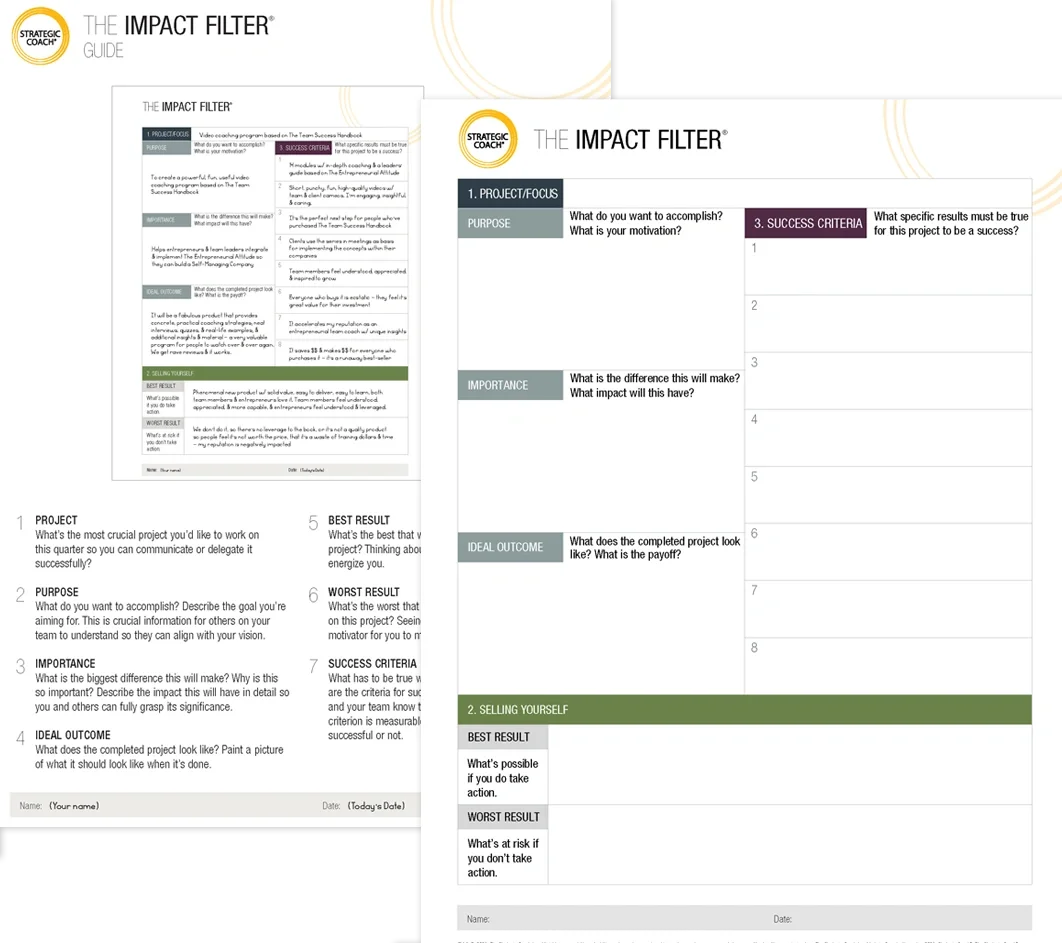
The Impact Filter®
Dan Sullivan’s #1 Thinking Tool
Are you tired of feeling overwhelmed by your goals? The Impact Filter is a powerful planning tool that can help you find clarity and focus. It’s a thinking process that filters out everything except the impact you want to have, and it’s the same tool that Dan Sullivan uses in every meeting.