Turning Silence Into Your Secret Weapon For Sales
February 25, 2026
Hosted By
 Dan Sullivan
In this episode, Dan Sullivan shares how one powerful question can transform any sales conversation. Instead of pitching, you invite prospects to imagine their bigger future and talk themselves into working with you. Learn how The R-Factor Question® builds instant trust, filters out wrong-fit clients, and makes every sales call about them, not you.
Here’s some of what you’ll learn in this episode:
- How to use one question to turn any sales conversation into a deep, future-focused discussion.
- Which types of businesses and professions can most effectively use The R-Factor Question.
- What it means—and what to do next—when someone refuses to answer The R-Factor Question.
Show Notes:
A great sales conversation starts long before you speak, with a trusted referral that pre-sells your credibility and lowers resistance.
The R-Factor Question instantly signals that the conversation is going to be about the prospect’s future, not your offer or your agenda.
When you ask someone to imagine their life three years from now and describe what progress would make them happy, you shift them into possibility thinking.
The person who does most of the talking in a sales conversation is the one doing the buying, so let your prospect talk themselves into their future.
Silence after you ask the question is your best tool because it proves the question has landed and gives the prospect space to think deeply.
When a prospect openly shares their dangers, opportunities, and strengths in response, they’re demonstrating real trust and a desire for a relationship with you.
If someone refuses to answer The R-Factor Question, they’re telling you they don’t trust you, and the most productive move is to graciously end the conversation.
The first thing anyone truly buys in the marketplace is a relationship, long before they decide on a product, service, or program.
People don’t actually want your answers; they want better questions that help them discover their own best answers and next steps.
Asking questions you genuinely don’t know the answer to keeps you curious, keeps them engaged, and reveals what they really want to transform.
By focusing on their three-year future, you immediately differentiate yourself from every salesperson who is focused on this quarter’s sale.
A prospect who shares painful parts of their past or their failures with you is demonstrating deep trust, which is the foundation for any meaningful transformational work.
Knowing early that someone is not a fit protects your time, energy, and team so you can focus on clients who genuinely want your help.
Resources:
How To Improve Business By Asking Good Questions
Episode Transcript
Dan Sullivan: Hi, this is Dan Sullivan. I'd like to welcome you to the Multiplier Mindset Podcast. I'd like to tell you a story about a sales call I had. This was someone who has referred to me to join Strategic Coach. Very good referral. The person who referred this particular man into Strategic Coach was a long-time, very, very successful entrepreneur and a really great fan of Strategic Coach. So that points out one thing about a great sales call is that when you're get a tremendous referral, then most of the barriers are already handled about your credibility. The fact that someone they trust and someone that they have found to be incredibly useful, that counts a lot for the willingness of the prospect to actually hear what I had to say.
So anyway, I got on the call, let's say his name was Jack, and I said, hi Jack, it's Dan, I'm really happy to talk to you. And he said, that the person who referred to him, he said, you know, he said such good things about you, but he didn't really tell me what the Program was about. So could I just spend a few minutes learning how this program actually works? And I said to him, well, before I tell you how it works, I'd like to ask you a question. The question is that if we were having this discussion, and it was three years from today, and you were looking back over your experience over the past three years, both personally and professionally, what has to happen in your life, let's say over the next three years, for you to be happy with your progress? Then I didn't say anything more. I just let the question sit there. And this is another thing I want to tell you that after you've asked your question, shut your mouth. don't say anything, because one thing you know by the silence is that the question has really landed.
So, after what seemed to me like a minute, it was probably only 10 or 15 seconds, he said, well, I'll tell you, Dan. He said, three years ago, I was a complete and total alcoholic. And he said, it's taken everything that I could do over the last three years just to dig myself out of a hole. So I'm just at ground level now. And I have to tell you, this is what I want to do over the next three years. This is what has to happen in my life over the next three years. And he went on. And from the moment he started talking, I checked my watch. We talked for 23 minutes straight. I had just asked the question, let him think about it, and when he was finished the 23 minutes, he says, well, Dan, he says, your program sounds really, really good. So let me know how I sign up for it. So when I tell that story, it always gets a big laugh at the end. People say, well, you didn't tell them anything about the Program. And I said, well, did I tell them anything about the Program? And some people twig to what's happened right away. And they said, well, yeah, you did tell him. You told him that the Program was going to be about him and not about you. And I said, yes. And that's exactly what most people want to know about buying anything. Is this whole experience going to be about you, the salesperson, or is it going to be about me, the customer?
By keeping my mouth shut, for 23 minutes, I absolutely convinced him that the whole purpose and the focus of The Strategic Coach Program was really going to be about him and things that were most important in his life. There were other things that happened in this discussion that I had with this person. And first of all, it established the fact that the number one thing that we buy when we involve ourselves in any kind of transaction in the marketplace, the first thing that we actually buy is a relationship. Before we buy a product or a service or an experience, the first thing that we actually buy is a relationship. And what he was doing when he got on the line with me from the moment I started talking, and I didn't talk very long because I just talked about a question, he was evaluating, is this a relationship that I'm actually going to buy? And by the fact that I just asked a very open-ended question, this question wasn't for my benefit, this question was actually for his benefit, he could make a very, very good judgment about whether he wanted to have a relationship with me personally and whether he wanted to have a relationship with Strategic Coach. And so he was satisfied.
And that's why at the end of his answer, he said, your program sounds really good. And what it meant to me was that he had bought the relationship. And as far as the program goes and what was gonna happen in the Program, he had satisfied himself. He just knew it was gonna be very good. And he knew he was gonna learn a lot about himself because he was going to be asked really good questions. And you see, people don't really, really want answers. They actually want questions that allow them to discover their own answers. So based on the fact that this is really about relationship, we call this question The R-Factor Question. Sometimes it's called The Dan Sullivan Question because I'm the one who came up with the question. But I recommend anybody who's in any line of work where you're selling something to actually use this question. And the reason why it works besides the things that I've already told you about, namely that the other person is doing the talking, which is always good for a sale, and the other thing is that it gets them to buy a relationship.
The other thing is that it tells them that they trust you. Someone who had an experience with alcoholism and what he was telling me about was failure, you would never tell that to a stranger unless you trusted the person. So right off the bat, what the question establishes is that if they answer the question, you can be very sure that they trust you. And they made up their mind about that in the first very, very few seconds after the question was asked of them. If they didn't trust me, they wouldn't answer the question. You ask this question of someone and they don't answer it, remember they don't trust you and there's nothing you can do from that point forward to actually get them to trust you. It's over. The game is over. There's no point in going forward. I asked that question and the person said, look, he said, I don't even know you. I'm not going to give you that kind of information. Well, guess what? He would never give me any kind of information. It's over.
And I see such tragedy with people trying to sell people who, if they had just been observant in the very few seconds, the person was telling them very clearly, I don't want to have a relationship with you. I don't trust you with this kind of information. Well, it's dead in the water. There are seven billion people on the planet. How many of them do you need as prospects and customers? So immediately say, well, look, you're not willing to give me this information. Then I want to tell you, since I can't get this information about what you're really shooting for, there's nothing I can do for you. So thanks a lot for the time and I hope you do find someone who can really help you. Dan Sullivan isn't that person, and Strategic Coach is not the Program. So I'm really clear about that. We're not for everybody. I'm not for everybody, and not everybody's for me. But I just want to sort that out really clearly in a matter of minutes. I don't want to go along trying to make something work for three months, six months. I've heard cases where people try to sell something over a year and a half period when it was clear in the first five minutes that there was no possibility for anything to happen. And it just makes everything really clear cut.
So this is called The R-Factor Question. I'm just going to repeat it. The question is, if we were having this discussion and it was three years from now, and you're looking back over those three years, what has to happen for you to actually feel happy about your progress, both personally and professionally?
Related Content

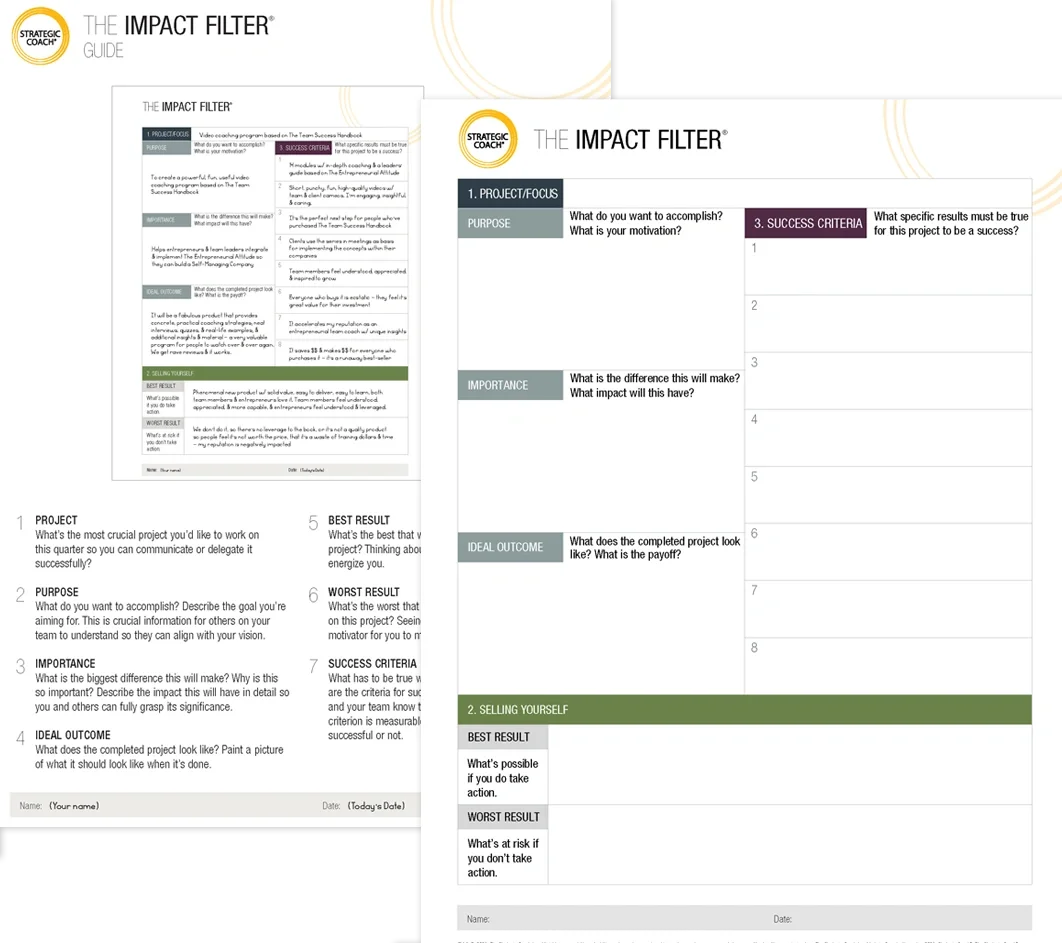
The Impact Filter®
Dan Sullivan’s #1 Thinking Tool
Are you tired of feeling overwhelmed by your goals? The Impact Filter is a powerful planning tool that can help you find clarity and focus. It’s a thinking process that filters out everything except the impact you want to have, and it’s the same tool that Dan Sullivan uses in every meeting.