How A Walk In The Woods Shaped A Life Of Freedom
March 18, 2026

Hosted By
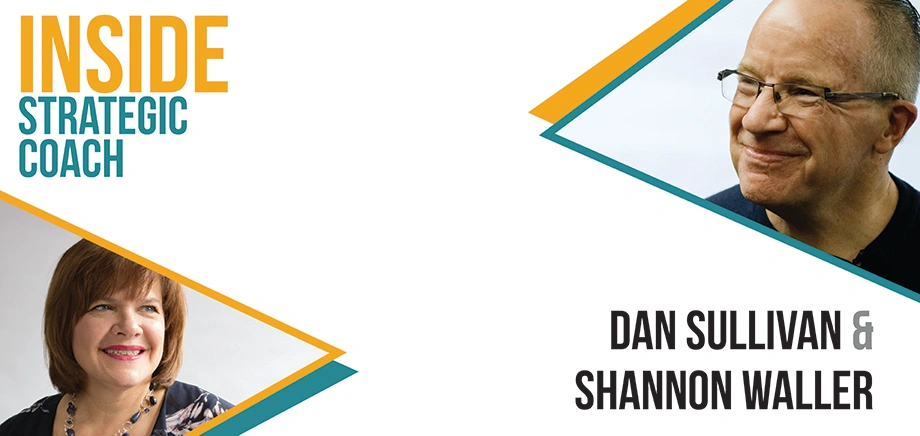
 Dan Sullivan
As a six-year-old exploring the woods alone, Dan Sullivan discovered that freedom plus responsibility creates confidence, creativity, and self-trust. In this episode, he connects that childhood experience to the way entrepreneurs grow today—by choosing freedom over fear, embracing intelligent risk, and creating environments where exploration and imagination can thrive.
Here’s some of what you’ll learn in this episode:
- The kind of childhood freedom Dan was given to explore on his own.
- How that early freedom directly connects to how he created and continually expands The Strategic Coach® Program.
- Why it might seem like the world is more dangerous for children than it used to be.
Show Notes:
Giving a child room to explore something a bit risky teaches them to take responsibility for their own safety and choices.
When parents are ruled by fear, they overprotect their children and tightly organize every activity, unintentionally blocking growth.
Constant surveillance and control erode a child’s sense of freedom and make independent decision-making feel dangerous instead of natural.
Being trusted to “go into the woods” on your own is an early version of entrepreneurial freedom: you decide, you act, and you own the consequences.
Making up your own fun in unsupervised environments trains the same imagination entrepreneurs later use to invent offerings, markets, and business models.
Today’s world isn’t objectively more dangerous than it was 75 years ago, but 24/7 media makes rare tragedies feel constant and personal.
Dan’s parents made a conscious decision to tolerate risk in exchange for developing a strong, independent, and confident mind.
That parental mindset mirrors great entrepreneurial leadership: you protect against true catastrophe but don’t smother initiative with control.
Overprotective environments create compliant rule followers, while freedom with responsibility creates self-managing value creators.
Episode Transcript
Dan Sullivan: Hi, this is Dan Sullivan. I'd like to welcome you to the Multiplier Mindset Podcast. One of the things I find very, very different about the way that a lot of children are raised here in the 21st century is comparing it or contrasting it to the way that I was raised in the late 1940s and early 1950s. I grew up on a farm, it was about an 80-acre farm and it had somewhere between 15 and 20 acres of woodland behind it. The woods were always fascinating to me as a child and up until the age I was six, I couldn't go into the woods alone. I could wander the field alone as long as I didn't go outside the fence line and I didn't cross the street and the road in front of our house, so I could pretty well wander from the time I was four or five years old. I could wander the field, but I wasn't allowed to go into the woods alone, but on my sixth birthday, I was given permission to go into the woods alone. And I'm one of seven kids, and I'm the fifth child, and I just happen to have birth order on both sides of me where I've got a lot of years to the next oldest and I have a lot of years to the next youngest.
And so I was home with my parents and we always had dogs and the dog at the time was a collie dog. Very, very nice family pet. And wherever I went on the farm, the dog always went with me. So I remember my first time in the woods. I had been there with my brothers, but I had not been with my own, and I got to really wander in the woods. And you know, when you're six years old, the woods look bigger than when you're in your seventies. So it would seem a very small woods to me today, but it was a very big woods. It was a bit like the Amazon going, and there were vines and there was overgrowth and everything else, and I just found it an amazing experience, you know. And I would climb the trees, and they had a lot of vines hanging down from the trees, and I would secure them, and then I would swing down the vines and I would climb up to the first branches and hang by my knees,
So the first time I did it I came running back to the house. It was quite a ways, it was, I would say easily three quarters of a mile from the woods to our farmhouse. And I came in and I said, Mom, Mom, guess what I did down in the woods? And she stopped me and she said, I don't want to know what you're doing down in the woods. I don't want to think about what you're doing down in the woods. The dog goes with you. If anything happens to you, the dog will come back and bark and we'll find you. I do not want to think about what you're doing down in the woods. I want to tell you, I probably didn't realize it at the time, but very quickly as I got older, I realized that my mom probably did worry about what was happening down in the woods, but she wanted me to have my freedom. And I think that being given permission to actually go into a place that might be a little bit risky or dangerous really developed that I have to be responsible. So I don't want the dog rushing back to the farmhouse and barking and then them having to come and search for me. I said, I do not want that to happen.
So I think I developed a sense of really watching out for myself. And it really struck me that that's kind of the essence of freedom, when you have responsibility for someone like my mother did, but you also want that person to grow. And I'm so struck today by all the stories of parents being desperately scared of anything that's going to happen to their children, and therefore the children are always protected and all their activities are organized and supervised. And I think it has a very negative effect on their sense of personal freedom and their sense of exploration, the sense of being really creative, because I made up wonderful games when I was down in the woods. I was always a big Robin Hood fan because I got my first Robin Hood book when I was six years old and the woods at the back of our farm automatically and permanently became Sherwood Forest. So all the characters in Robin Hood, I would see them, because I make them up, and I knew all the stories, and so I would act out one story on each day and I came back and it was just tremendous for my imagination. And this was just a wonderland for me, and that 80 acres of farm also had a lot of interesting things.
So, I don't think life is any more dangerous than it was in the 1940s and 1950s, but I think that there are so many bad stories on television and in the movies about children being on their own that the fear that the parents have is interfering with the development of children's sense of freedom and sense of exploration. So I'm not going to necessarily do anything about it or anything else, but I just really am appreciating enormously the last 65 years since those experiences happened that I was given an amazing gift by my mother and my father. My father was in agreement with this, and they just trusted that the risk of something bad happened to me was worth it to ensure that I developed a really independent and confident mind. So, you know, I sit here having created this Strategic Coach over the last 40 years with Babs and all the thousands of entrepreneurs, and I think the sense of freedom that I have in developing the Program and continually growing the organization is directly tied back to that type of early experience that I just described, my freedom in the woods at six years old.
Related Content


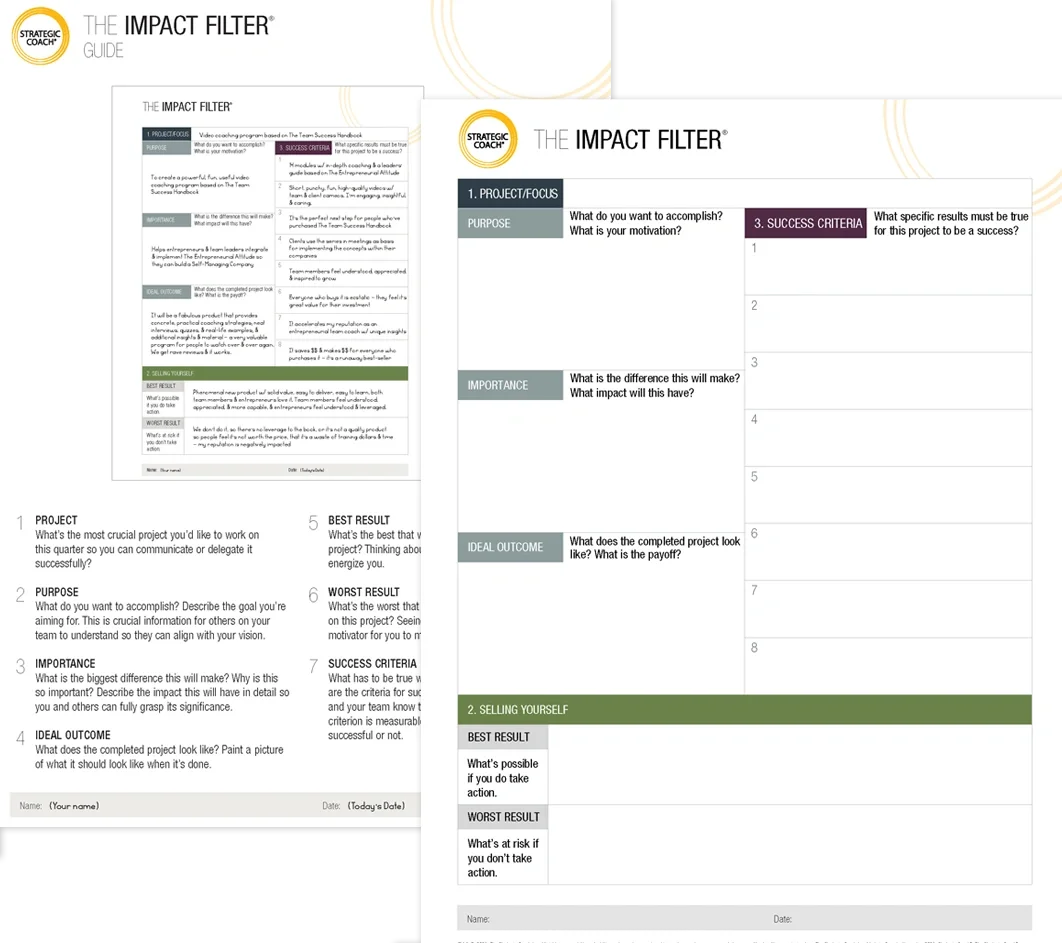
The Impact Filter®
Dan Sullivan’s #1 Thinking Tool
Are you tired of feeling overwhelmed by your goals? The Impact Filter is a powerful planning tool that can help you find clarity and focus. It’s a thinking process that filters out everything except the impact you want to have, and it’s the same tool that Dan Sullivan uses in every meeting.