What Is An Impact Filter? An Entrepreneur’s Tool For Clarity, Delegation, And Results
What is an Impact Filter? It’s the tool I use to do my thinking before I do anything else. And it all comes down to one principle I’ve learned over decades of coaching entrepreneurs: almost all the trouble you’ll get yourself into as an entrepreneur will come from trying to sell someone on something you’re not sold on yourself.
To avoid this, I always use The Impact Filter to sell myself on every project or idea I’m involved in before taking any action whatsoever. This process keeps me highly focused on the exact result I want to see, and the half-hour or so it takes to complete it not only saves time for me and everyone else involved, it also weeds out projects I actually can't sell myself on.
Download The Impact Filter PDF for free and try it on your next project →
It’s a hugely effective productivity strategy for organizing your thinking, getting any project launched, and planning effective teamwork.
What does the thinking process behind The Impact Filter look like?
1. What You Want To Achieve.
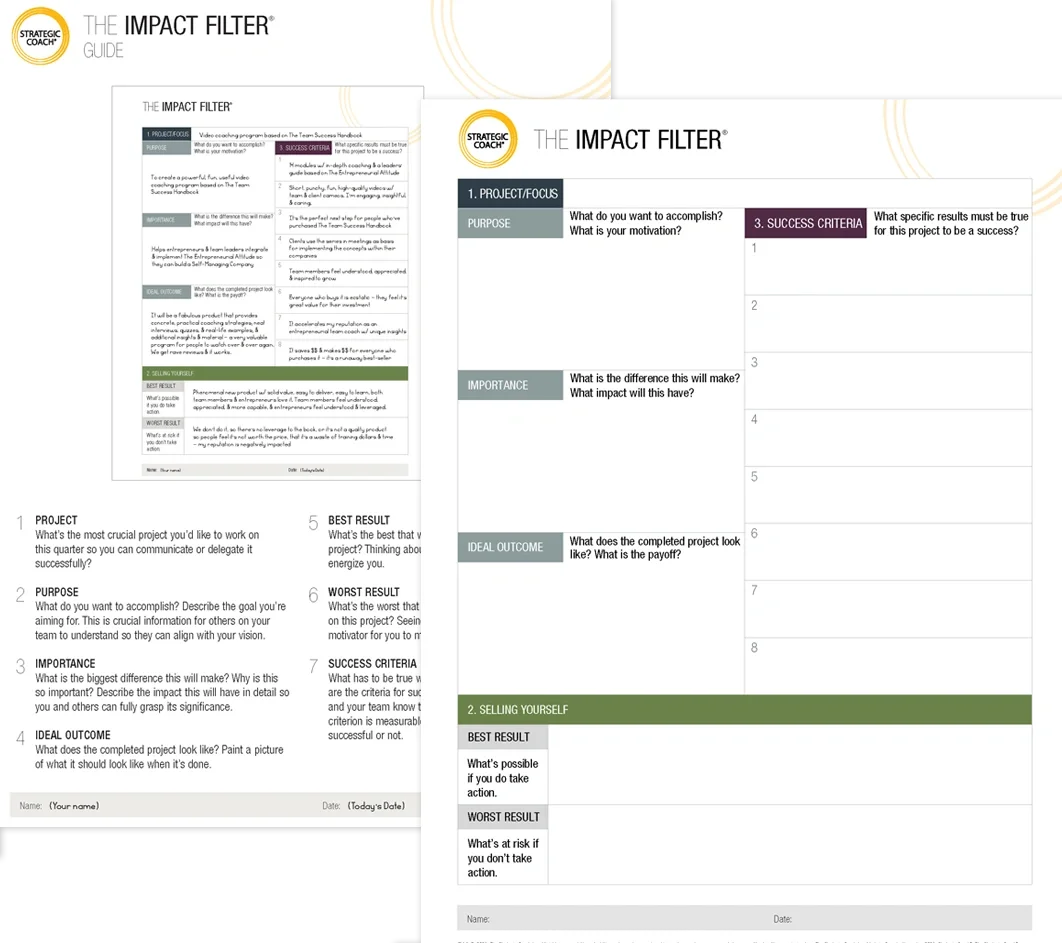
The first step is to ask yourself what you want to accomplish, what the biggest difference achieving this will make in the end, and what the completed project ideally looks like. Describe not only the more concrete details, but also how you would feel in this situation. This could point to troubleshooting you might need to do, outside resources you might need to invest in, a change in timing, or any number of factors that will affect the project’s success.
- Consider things like what it will mean to you personally—for example, your confidence, your belief in yourself and your goals, your values, your reputation, your financial situation, your ability to keep growing your company, new opportunities opening up, your physical and mental well-being, and so on.
- What about others who are involved? How will these people be affected—your client or prospect, your team, your partner, your spouse, family and friends, the people in any of the communities you’re involved with? The more detail you can capture, the better prepared you’ll be to move forward with confidence.
At this point, you’ll either have sold yourself or you won’t have, and you’ll have to decide whether to move forward or let go of your idea.
2. Best And Worst.
Next, look not only at what the best possible result would be, but also at the worst-case scenario in detail. (In fact, I recommend doing the worst-case scenario first.) Detail is the key here: Put your imagination and articulation skills to work, capturing each result as fully as you can. Once you’re done, you’ll feel like you’re living that moment of elation or defeat. Either is a tremendous motivator when you think about it.
3. Success Criteria.
Last, it’s critical to have clear-cut criteria for measuring the final result. What you’re looking at here is what has to be true at the end of the project. Again, the more specific you are on what your success criteria are, the more likely you’ll be able to get the outcome you’re looking for. Success criteria are actions, decisions, communications, and completions.
Actual numbers, dates, dollars, and other ways of measuring success will not only get you much clearer on what you want to achieve, but they’ll also give you solid benchmarks to measure against after the project has been completed—useful information for next time.
The intentionality process I’ve just described is most powerful when written down, diagrammed, or otherwise captured for future use on other projects. This document is not only a great way to repeat successes more efficiently, but it’s also one of the most effective ways to delegate.
The Impact Filter as a delegation strategy.
I use this thinking process before starting any new project, workshop, or marketing event. I also go through it before speeches, interviews, and client meetings. These are all examples of how one tool applies across very different situations.
If I want to sell clients on a new idea or the team on a new project, I know that I have to sell myself on it first, then sell it to them, and then get them to emotionally commit. This is always my delegation process, without fail.
I’ve set out my expectations and measurements for a successful result—the “why” of it. With all of this clearly laid out, my team has everything they need to get started, and they’ll figure out on their own the best way to achieve the result.
I don’t tell other people how to do things. I rely on the fact that if I’m asking them to do something, it’s something I know they’re better at than I am.
No one said that it has to be you doing all the work, and, in fact, I believe you shouldn’t. This is where The Impact Filter connects directly to our Who Not How philosophy. Why work harder and longer? Use this intentionality process to delegate, and devote your newfound time to doing more of what you love.
Why intentionality matters for entrepreneurs.
Being intentional means having a powerful sense of purpose. It means knowing the importance of what you’re doing and being very clear about what your ideal outcome looks like. It’s actually selling yourself on and emotionally committing to any project or situation in life.
For entrepreneurs, it’s all about results, with every decision and action focused on growing their business. This means intentionality is a critical mindset for any entrepreneur. By using this Impact Filter thinking, you’ll gain more clarity in any given situation or on any project, and achieve better and faster results—plus, the easier it will be to sell others on the idea and get them emotionally committed too.
Want to try it out for yourself? Download your free copy of The Impact Filter PDF now to learn a quick and simple way to multiply the results and impact of every entrepreneurial project.
FAQs About The Impact Filter.
How do you fill out an Impact Filter?
You begin with the purpose and importance of the project, then describe what the ideal outcome looks like and how you’d feel achieving it.
Next, write out the worst-case scenario in detail, followed by the best possible result.
Finally, list your success criteria: the specific actions, decisions, communications, and completions that need to happen. The whole process takes about 30 minutes, and by the end, you’ve either sold yourself on the idea or you haven’t.
How does The Impact Filter connect to Who Not How?
The first step in tackling any goal should be to clarify exactly what the goal is, what the outcome should be, and what success looks like.
Learn how the Who Not How philosophy works with The Impact Filter →
At Strategic Coach, we suggest using an Impact Filter for this. Once you’ve done this, then and only then can you begin the search for your “Whos.” The Impact Filter gives you the “what” and the “why.” Your Whos figure out the “how.”
How can an Impact Filter help with focus and prioritization?
The biggest reason people can’t focus is that they haven’t actually sold themselves on the thing they’re trying to do. The Impact Filter solves that.
When you’ve clarified your purpose, importance, and ideal outcome, and you’ve laid out your success criteria, focus is not a problem. You know what you’re doing and with whom and for what result.
Be in teamwork with yourself first.
The clearer you are in your communication, both with yourself and others, about what you want to achieve, and the more clearly you lay out your success criteria for a given project, the higher your likelihood of achieving the results you want. And the smoother the process of getting there will be.
That’s what The Impact Filter does. It’s a simple tool with an exponential impact. If you want to be in great teamwork with people, be in teamwork with yourself first.
Make it a habit, and see your results and teamwork soar.
Download The Impact Filter.
As a leader and entrepreneur, if you’re not clear on what’s most important, why you’re doing it, and what success looks like, your team isn’t either. The Impact Filter helps you clarify your purpose, envision what success looks like, and break down the criteria for getting there. It’s incredibly simple, yet immensely powerful.
Get a PDF copy of The Impact Filter →
The entrepreneur coaching program with thinking tools that change everything.
For over 35 years, Strategic Coach has helped successful entrepreneurs gain what they need to achieve their next level of growth in business and in life.
“What happens here is a gift. The value on my health, sanity, and quality of life cannot be exchanged. Coming here forces you to step out, put the oxygen mask on, and look from 50,000 feet so that you don’t end up getting sucked into this automatic, reactionary cycle. The outcome when you’re proactive and intentional cannot be compared with anybody who’s living in that reactionary, day-to-day, knee-jerk response.” —Carrie Coppinger Carter, Coppinger Carter P.S.
If you’re an ambitious entrepreneur who wants access to the thinking tools, proven frameworks, and entrepreneur community that will help you multiply your results while simplifying your life, our coaching program was built for you.
When you’re ready to invest in transforming your thinking into new levels of freedom and growth, we’re here.
Let’s talk about how Strategic Coach can help you reach your next level of growth →