The Repeating Pattern Behind Outrageous Tech Promises
July 28, 2026
Hosted By
 Dan Sullivan
 Jeffrey Madoff
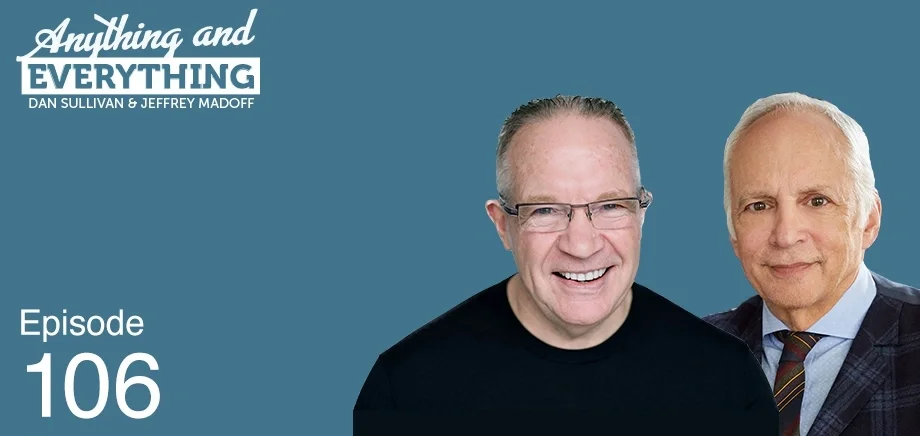
Every new technology seems to arrive with a wild promise that it will “change everything,” and AI is no exception. Dan Sullivan and Jeffrey Madoff explore how technological breakthroughs really create growth; why consumers, not inventors, capture most of the value; and how entrepreneurs can use AI as a practical multiplier instead of a magical fix.
Show Notes:
There have been about 10 major technological breakthroughs in the last 200 years, and each one arrived with big promises and bold predictions.
When it’s predicted that something’s going to “change everything,” it usually changes only some things, in powerful but often unpredictable ways.
The people who profit most from new technologies are usually consumers, not the inventors or platforms.
Most consumers use new capabilities to improve what they’re already committed to rather than reinventing their entire business or life.
When most people start using a new technology, they tap into only part of what it can do, which leaves room for entrepreneurs to use it more strategically.
Founders who bet everything on a new creation often push more extreme marketing claims that don’t necessarily match what real customers want.
Any new technology creates new kinds of problems, especially as you expand your number of locations, platforms, and touchpoints.
It’s not a bad thing when something gets replaced by something new; that’s simply an evolving marketplace and shifting opportunity.
Resources:
The 4 Freedoms That Motivate Successful Entrepreneurs
Casting Not Hiring by Dan Sullivan and Jeffrey Madoff
Learn more about Jeffrey Madoff
Dan Sullivan and Strategic Coach®
Episode Transcript
Jeffrey Madoff: This is Jeffrey Madoff, and welcome to our podcast called Anything And Everything with my partner, Dan Sullivan.
Dan Sullivan: I've had competitions for who would be the ideal partner on this podcast, and nobody else showed up except Jeff Madoff, so I won!
Jeffrey Madoff: You won. You won.
Dan Sullivan: Yeah. And we were talking about technology, which is a big part of everybody's life these days, and we were talking about previous technological breakthroughs that made outrageous claims that this would change everything. And it seems to follow a pattern. So there's probably about 10 major technological breakthroughs in the last 200 years. And they seem to have a pattern. And the newest one is probably a combination of AI and robots. And outrageous predictions are being made. And my feeling is that this follows a historical pattern.
Jeffrey Madoff: Yeah, it reminds me, remember when I was a kid and I would see like, no matter what it was, it could be Tide wash detergent, or it could be some cereal: new and improved. You know, forget that other shit we were selling you, this is new and improved. So all that I see as marketing, so much of it is marketing. And what sticks and what causes what to stick, I think is a really interesting story. You sent me the article that you had written, “10 AI And Robot Obstacles.” And your article is, to me, seems like a deliberate counter-narrative to a lot of what we're hearing in terms of AI and what that outlook for it is. So why did you write that?
Dan Sullivan: Well, my feeling is if I look at, and you know, I can go back to the microchip because it coincides with when I decided to be an entrepreneur, so 1974, and the word microchip was just being used for the first time. It wasn't what it was called when it was invented. It was called integrated circuit—1950s, 1960s. But integrated circuit is not a sexy marketing name. You have to have a little bit more conciseness and a little bit more what I would say that you're creating a new concept. And microchip was neat. It was small and it was a chip. And they were making all sorts of predictions back then that this was going to change everything. And my sense is when people predict that it's going to change everything, it means it's going to change some things, but mostly unpredictable. Over the years, I've just kind of figured out, well, who made the money on the new things?
And there's a pattern to it that basically the people who profit most by something new are actually consumers. It's about 70 percent of all the money that's made is really by consumers who have a new capability, but they apply the new capability, not the whole capability, but the new capability to something that they're already committed to. They're trying to achieve greater efficiency, they're trying to create greater effectiveness, greater profitability, and they just use part of the new thing to actually do what they're already doing better or do what they're already doing bigger. But the people who actually create the new thing oftentimes aren't the winners. And I think they have an awareness that they bet the ranch on something new, and they're so committed, and they're in such severe competition with everyone that they have to become more extreme in their marketing claims about what they're doing, whether that has anything to do with what people are looking for or not.
Jeffrey Madoff: So one of the areas that I think that we all share as common ground being humans and dealing with banks is the ATM story, which is quite interesting. It's something I had gotten into once before, because I thought the idea of it was really interesting, kind of a money vending machine, if you will. And you cited it as an example of how automation can expand employment, can expand employment rather than reduce it. And that's an argument many people make. ATMs also contributed to the consolidating in banking. There were more branches, as what you had mentioned, which is true. There were more branches, less people per branch, but more branches and overall more tellers, more people in the banks. Although the teller's job changed, as opposed to just dispensing cash or taking in deposits, they try to talk you into—whether it's a mortgage loan or a credit card thing or whatever it is—all the different financial services that you can get.
So for about 30 years, when ATMs first came out, the tellers needed per branch on the average drop from 21 to 13, which lowered the cost of running a branch. And that meant opening more branches in that very competitive world, and more branches overall meant more tellers overall, which grew the population from 500,000 to 600,000 tellers. However, the new numbers coming out now, labor statistics coming out now, is they're expecting a 13 percent decline in teller employment in 2034. So we'll make a note. I'll put it on my Google calendar. We'll talk about that. Let's see if that in fact happened. But I think that an important question is the difference between task automation, which is like what we're talking about with the ATM, and purpose automation. And what are those two and how do you look at those?
Dan Sullivan: Well, first of all, they're just picking one particular job description, which is teller. But any technology creates new kinds of problems, especially if you're expanding the number of branches. You've got to integrate all these branches. There are all sorts of new jobs that don't even exist, like software integration, new types of programming. So what they're looking at is a part of the iceberg that you can see, and it seems to be melting. The iceberg is getting smaller, but underneath the iceberg is actually getting bigger. There's more behind-the-scenes jobs that are actually being created that didn't even exist before ATMs were invented. And, you know, it's really interesting with ATMs. One of the things I find remarkable is I've used them thousands of times in the last 30 years. I use an ATM probably every two weeks in the last 30 years, and it's never been wrong. I always got exactly the cash that I wanted, and they charge you two or three dollars, but the convenience is worth it. What's a half hour worth of my time now compared to 30 years ago?
And I'm very struck with it when I go to London, because London is my big overseas travel, and it's about a two-block walk from the hotel where I stay. And I go there, and they ask you what language you want it in, so it's English. And then I go through, and is it checking account? Is it savings account? You check it out. And then you hit the button, and all of a sudden, you hear these sounds. Do-do-do-do, do-do-do-do, do-do-do-do-do, do-do-do-do-do, and out comes the cash, and they ask you if you want a receipt, and you get a receipt. And what it indicates to me, each of those little dits are actually probably something that's moving from one site to another. In other words, it's checking out numbers, it's checking out, you know, does the person actually have the money that they say they have in their account. And the people who are involved in all the extra little dits is way beyond the number of tellers where you had to go into a bank, you had to go to a person. So with technology, there's an enormous number of more back stage being created that you don't see. And what you used to see front stage is fewer, and you say that technology is getting rid of people. But my sense is behind the scenes, it's actually creating a lot more people.
Jeffrey Madoff: Well, and that's why I drew the distinction between task automation and purpose automation. So the ATM did a very specific task that a teller used to do. And so that was very circumscribed what that did. And other examples like the task automation is like using AI for surgery, robotic surgery. There's a specific task that can be executed in next to flawless ways, yet you need people to determine, is the surgery necessary? Are there complications that are arising? All of the various outcomes and all of these things, you need a skilled human involved aside from the robotic surgeons. Accountants and tax software, which we hear is going to be wiped out, but that's not gonna be wiped out because again, there's that human aspect who can interpret ambiguous, mathematical outcomes, who can make recommendations judgment-wise on what you should do to generate the most income for yourself and all of that sort of thing, so that the routine mechanical aspects were automated, but the need for human intervention is still the same. We still need all of that. And, you know, it's also, I think of what I love doing, what I like doing more now is research. You know, you can stay home and have access to the largest library in the world. So it can do a lot of the specific tasks that journalists did in terms of research. However, it's interesting—last night, it's the 50th anniversary of All The President's Men. And did you ever see that?
Dan Sullivan: Mm-hmm, mm-hmm. Remind me of the plot, because it …
Jeffrey Madoff: It was Woodward and Bernstein uncovering the Watergate break. And it's a complete procedural. It's not a political story; it's a procedural story. What journalists do and all that is great, and it holds up totally. It was Dustin Hoffman and Robert Redford and Jason Robards, a wonderful cast. But I've been in newspaper offices recently and there aren't the typewriters going and it's not that hustle and bustle; it's laptops and desktop computers, and a busy newspaper office means people aren't sitting in the office. But anyhow, so there are specific things that are task automation, then there are those things that require the human intervention, or a human in the loop, as it's called, where that does create the more jobs in those areas. So it's quite fascinating. And the purpose automation actually does get rid of full categories of jobs, eliminates them totally: video rental stores. encyclopedia salesmen, travel agents. Even brokers had to figure it out once you could …
I remember when I first started investing in the stock market, it was a lot of money to do a transaction. And then with E-Trade and some of these others that came around, transactions cost nothing anymore. But those companies are bigger than ever, so they clearly have replaced that income with other things, but their purpose, you don't need to go to a travel agent. You don't need to go to a video rental store. I mean, Netflix was so smart about what they did and laid the groundwork so well. Those are kind of category killers. I'm not saying that's a bad thing. That's just an evolving marketplace and ways that this can replace that.
Dan Sullivan: Yeah, well, I think the big thing is that they're sort of management tasks. In other words, that you're handling what already exists. But when technology enters the field, you're actually creating new categories of activity because you have to do new things to do it. And to give you an example, I've sort of paid attention, you know, I'm writing these articles for my entrepreneurial clients. So everybody, we have 2,500 right now. And so 2,500 people will get this article. And then, you know, the ones that I meet will ask questions and they'll engage in a conversation with a person who's directly related to something that they're paying for, which is the program they're paying for it. And this is anecdotal, so it's not, you know, I don't have a researcher who's keeping exact numbers. But in the last, say, six months, I haven't found one of my entrepreneurs, and I've interacted with 200 or 300, I haven't found one of them who's not using AI for something. I said, is there anyone not using AI at all? And everybody says, no, we're using AI. And I said, are you finding it useful? And everybody's finding it useful.
And then I'll get some examples. And people say, it saved me this amount of time. I was able to do this much faster. I wasn't able to do this before, and now I can do it. So it takes different explanations of why they see it as an improvement. And then I say, at the same time, how many of you are hiring new people? And almost everybody's hiring new people. And I say, what are the people doing? And they said, well, we've created new roles now. And the new roles free me up so that I can do more multiplier work. In other words, I'm working on projects that multiply where we're going, income, multiplying market share, whatever it is. So I'm getting these two messages back that everybody's using AI, where they weren't, you know, two years ago or three years ago, and everybody is hiring people during a time when there's a lot of nervousness in the marketplace. They're hiring new people. And I'm putting the two together, that their acquisition personally of a new capability is making them more ambitious, and therefore they're hiring people for future growth.
Jeffrey Madoff: Yeah, that's an interesting way of looking at it. And I think that how that manifests ultimately, I don't know yet. I think there's right now, it's the same thing happened with, I remember websites started and I was dealing with lots of fashion companies and who had retail brick and mortar presence. Initially, people were reluctant to put their credit cards online or not actually try on the clothing or something. So there were obstacles in the way that eventually got overcome and that websites are often the largest part of a retailer's business, you know, at this point. And I think that there was a lot of initially with websites FOMO, the fear of missing out because the, and I think that's true with AI too. You know, that if you're not using it, you're somehow falling behind, which may or may not be true depending on your application needs and what you're doing. But I think that everybody feels like they either have to be a naysayer or they're using it and they're growing like they've never grown before. And again, the truth is probably somewhere in the middle there. Because I think there's an awful lot we don't know how it's going to affect things.
Dan Sullivan: Most of it. Most of it, yes. Enormous amount of guessing and betting going on, folks.
Jeffrey Madoff: Yeah, yeah. And to your other point, at this moment, the companies, the platforms, are going through unheard of financial burn on their way to, they hope, lifting off profitably. But the rate of change, the competition, and the competition's among all the largest players, is just wicked. And how that's going to play out, because there's so many different arenas. The phrase from The Four Seasons, you know, the systematize so you can humanize. That's the task application of AI, which makes tremendous sense, which can lead to more hiring because it should not go unattended. The companies that are getting wiped out probably were in denial. I mean, I saw this also in a technology change in filmmaking. When digital cameras came out, there were a lot of people that did not want to use digital cameras. And one of the main reasons, initially, first of all, they weren't as good. But to me, it was clear that it would be that good.
Dan Sullivan: Well, and there's something to get better at.
Jeffrey Madoff: Exactly. That's right. That's right. So it would be irresponsible of me as a business owner to not explore those new offerings out there that seem to be having a significant impact. And I think that, to me, that's kind of the phase where a lot of businesses are with AI. Where others, like, you know, I just had an MRI at Mount Sinai. That's where I had my health plan. And very trippy having that. I've never had one before. Hope I don't have to have another one. But it was interesting, the cost of those machines, and it still, though, takes the human to put the contacts on you, you know, to give you the injection when you're having a contrast MRI. So they can be the most sophisticated piece of equipment in the world, but you need an operator there. Now, maybe you don't need 10 operators, but you need an operator. I mean, there's one person operating this, and it's the same person who injected me and did the other stuff. And I think that some of these things AI has been working on for a while.
Dan Sullivan: Yeah, well, I think the big thing is that, you know, it's a trust factor. I mean, all movement forward is a function of trust, that anything you're doing new, you're taking a chance. And if it was just you interacting with technology, I think your trust would be less, because you don't have someone giving you the context of the experience that you're entering into. Okay, and humans are good at providing context. I don't think machines are good at providing context at all, because they can't see things from your point of view. You know, humans can see things from your point of view, and they can say, oh, I understand what's going on here. So my sense is, I think technology expands the scope for human interaction. I think there's an increase in the different ways that humans can interact with each other. And for every new experience, there's where you don't feel trust, and there's where you do feel trust. And it takes a human to figure out what it's going to take for me to make you feel okay about going through a new experience.
Jeffrey Madoff: Well, we went through a new experience, Margaret and I, on Friday evening. We went and saw this play called Mexodus. And what was unique about the play, it's a two-person play, and the two stars are the ones who develop this. And it was really interesting. What they did, they tell you at the beginning that they're using a sound-looping technology. And the guy who is very active but is totally behind the scenes is the guy who's mixing things in real time. So one of the actors just tapping the side of their leg, or it might be they're hitting a spike with a hammer. And then it becomes the sound bed, and then they're playing live over the looped thing they just created. Really cool, really fun. And I think that in creative fields, it opens up so many potential doors of things that you can be done, because it's really complicated programming. They have these little buttons all around the stage. They're marked, but, you know, they got to step on this one at that point and this one on that point, so the mix is right and it works. And it was flawless and absolutely fascinating and entertaining. And, you know, my whole job history has been in creative fields. And it's interesting, this play, tickets were really expensive and it was way off Broadway. And the tickets were like 185 each for that in this small theater. Worth it, in the sense of relatively speaking worth it. Nothing seems worth it anymore in terms of how prices have gone.
Dan Sullivan: You were engaged and you were entertained.
Jeffrey Madoff: Totally, totally, yes. But it was such an interesting mix. of technology and a creative use of technology happening, being made on the spot, like the open kitchen. You're seeing the ingredients happen on the spot. It was absolutely fascinating. So I think there are so many possibilities and creative people, by their nature, try to come up with a way to use it that nobody else has.
Dan Sullivan: Yeah. Yeah. First of all, the cost of entry into new fields now is really going down. We just went through an experience where we had picked up as part of our lease a complete production studio. So Toronto is a big post-production center for the movie industry. And it all depends on where the dollar is, where the Canadian dollar is in relationship to the U.S. dollar. And there's so much that gets moved north of the border now that I think that the Canadian dollar is now permanently at a significant lower than the Canadian dollar. It's a dollar 39 this morning. So that means a dollar that you bring across the border and spend in Canada, you can get 39 cents more value because they have very high skilled people. I mean, there's no difference in the skill level. There's 15 to 20 major studios in the Toronto area.
Anyway, we had one of the top post-production studios in Toronto, probably Canada, in our basement. And they went through a period where the Canadian dollar was too close to the American dollar, and they went bankrupt. There's a magic point, I think it's probably around a dollar 20, that if the American dollar is more than a dollar 20, the business comes. If it goes lower, then the business doesn't come. So it's an interesting point. It's the difference between water and ice. You know, you reach a certain temperature and the water turns into ice. So we picked it up at a ridiculous price, like 11 dollars a square foot for a very, very big studio. And we had a floating studio and, you know, first class. And then three years ago, because of lack of maintenance, a water main from the city of Toronto broke and it went underground and it just destroyed our basement, totally destroyed the studio. I mean, concrete was coming up like an earthquake. It just destroyed everything. We had other activities we were doing in the basement.
So anyway, long story short, we go through the insurance and we get the money from the insurance company. You know, we had to negotiate. We had to go back how much to create that level of studio from 25 years ago, how much that would be. We have a brand-new studio, and the actual building of the studio, the price was just equal to the building of the studio in the first place. What was different was the technology. The cost of the technology 25 years ago was a half a million dollars. The cost of technology to replace that capability was 50,000 dollars.
Jeffrey Madoff: Yeah, well, I went through a real-world example of that when we converted from analog to digital in terms of editing. One of the state-of-the-art special effects units was called an ADO, Ampex Digital Optics. Paid 35,000 dollars for just that plug-in unit, sold it for 1,200 dollars. Because when digital like it, it seemed like essentially overnight. All of a sudden you couldn't sell analog digital bays anymore for editing. And you could do all these special effects, not with a dedicated black box that did something. You could do it with software. And you could do it even better. And so yeah, those changes, where the expense is, if you decided to go into the AI business, you better have really deep pockets. So if you're making that part of it, the cost of entry, which benefits them, is very, very high.
Dan Sullivan: Yeah. If you look at the 5 percent of people who are involved in something brand new and they hit a home run, we're now talking in the billions of dollars. We might be talking in the near future in the trillions of dollars. But that one winner, the number of losers is greater in terms of total income. The railroad industry as an industry, the players in the industry, never made a profit. It was a losing proposition. The airlines are the same. I'm sure television is the same radio. But it's what the consumers of the innovation do that causes all the economic growth.
Jeffrey Madoff: Well, it's interesting. In television, it was believed that the money in television was selling televisions. And they figured, well, nobody's got one. So there's going to be a huge market for TVs. So there were companies like Muntz, M-U-N-T-Z, Emerson. I mean, Emerson's still around. It was interesting how pretty quickly those companies went out of business because that's not where the money was. The money was selling your audience to advertisers. So what appeared to be free which was your TV shows. Of course, you were the product. It's funny how that hasn't changed. You can substitute social media, you know, and online, and even, which I hate, the reason you went to streaming was not only because of the access, but because there was no advertising. Now you actually have to pay more money to not get it.
Dan Sullivan: Yeah, I just thought of something here, and you have lots of experience to look back on. Would you say that when somebody creates something new, totally new, let's say AI right now, would you say that they're going on the experience what previously worked the last time there was a breakthrough? The analogy I can get to is that when television movies started coming in the 1950s—what was the series with the actors Charles Foyer, David Niven, Ida Lupino? Four Star?
Jeffrey Madoff: Four Star Theater. Four Star Theater.
Dan Sullivan: Well, they would show, to open up, it was a theater, and the curtains would part, and then they would show the theater. But they were picking it up from theater. They were taking what worked in a previous medium. And they were saying, well, we're going to get people used to this new medium by showing them something from the old medium. Would you say that that probably there's a lot of AI people who are trying to take examples from the software world when they created software?
Jeffrey Madoff: Oh, yeah. I think in every business that happens, what are the successful aspects of it? I mean, when basically the first TV shows were vaudeville performers, you know, like Milton Berle and Mr. Television, as he modestly called himself. So, you know, looking at what are the acceptable conventions. So there's no reason to have curtains open on a television, right? But it was a familiar convention that the show was starting. I think about that because, for instance, I mean, I've been doing photography for a long time. What initially they tried to do, what's still going on actually, is that the digital cameras, you know, the high-end Nikons, Canons, Hasselblads and all of that, look like the old ones. There is no reason to have a click sound on your digital camera, but that's a convention that photographers like. So yeah, I think that happens all the time. What are the conventions that we can use or adapt to make it not seem like something so new it's off-putting? So what's the gee whiz that you could mix with the opening curtains to make it all work?
Dan Sullivan: Well, it's interesting, Strategic Coach, we've gone through, I think, a real transformation in the sense that most entrepreneurial coaching, I've been able to understand it from talking to our clients who have used other programs, is about using your imagination to create an entirely different kind of future. And you would put all sorts of measuring sticks like revenues and profits and everything. But it's kind of creating a powerful future that then is going to direct you to change your behavior now based on something in the future. And we've taken the opposite approach. We've taken a particular type of activity like gaining new capabilities. What I notice is that people grow by acquiring new capabilities.
So what I do is I take them in the past and I say, what are the best new capabilities that you've already created in the past that are creating where you are today? And they do that. And then I have them take three of the best ones that have gotten them to where they are and say, if you put this capability that you already have with this capability that you already have, could you create a new capability? And then you do that three times, and eventually it comes out with six new things that they could actually do now where they already have the proof that the capability already works. And I said, now, during the next 90 days, taking what you already know works, how could you do it different? So we're having them use their past to not create the far future, but just create the immediate accessible new future. And it works like a charm.
Jeffrey Madoff: Yeah, I mean, I love that, just like the talking to your future self, you know, be that about matters of business or it might be about your health. You know, what do you have to do if you're looking back from your 90-year-old self, you know, what are the necessary steps to maintain your health and well-being as best you can? You know, when I had my shock, I was 24 years old, and looked like I was in very good shape. And Kenneth Cooper's book on aerobics had come out, had just come out. And you had to be able, by age category, to run a mile in under eight minutes. And so I ran the mile in seven minutes and 47 seconds and thought I was gonna die. I was sweating and I couldn't catch my breath and I'm thinking, what the hell? I'm not even 25 yet. What's it gonna be like when I'm 30 or 35 or 40? And that really got me that dialogue with, where do you want to be in the future? What do I have to do to do that? Regular exercise, eat healthy, all that kind of stuff. And that really took, you know, it really influenced me. And I think there is something in that time travel that you also do and you look both forward and back, you know, I think is an unexplored inventory of experience that a lot of people don't pay attention to.
Dan Sullivan: Yeah, and one of the reasons we do that is a lot of the projecting into the future is very competitive, because you're picking up messages from society. People are starting to talk about five years from now, 10 years from now, this is how the world's gonna change, and put you in a competitive mode with other people, where with your past, nobody has access to your past except you, and you're the only one who can make the judgment about what really worked and what didn't really work. So it's a hidden, and nobody's going back there. I mean, first of all, nobody knows about your past. Nobody knows how you're thinking about your past. Nobody knows what you're learning about your past, and nobody knows what you're taking from the past and are reassembling it, transforming it in the present to create the immediate future. And my sense is that if you can get people out of a competitive mode, where they're actually using their present to collaborate with the best things they've already done in the past, they'll actually create their future, but it won't be a five-year future, it won't be a 10-year future, it'll be the next 90-day future. And they already know something about the next 90 days, you know, they know what's available and they know what's needed.
And more and more, I have the next book I'm writing, my quarterly book, and it's called Yesterday Creates Tomorrow. And I said, you know, if you just pay attention with the direction you're already going in—and not everything you're doing is creating tomorrow, but some of the things are creating tomorrow. So why don't you just zero in on what you're already doing, and that way you're already confident. You don't have to make a huge guess. You just have to choose to do certain things that you're doing and not do the other things. You're just changing your behavior slightly. It's like sailing, you know. You have a straight line toward the destination, but you're going back and forth. You know, you're jibing and tacking, I think the terms are, to get there. So that's the reason why I think a lot of AI is being used, and I think a lot of AI is being very valuable, but it's not the huge projections that people are making, it's just little course changes, you know, and then you have one of them, and then you have three of them, and then you have five of them, they start to become a new operating system.
Jeffrey Madoff: Yeah, one of the problems I think with entrepreneurs, and most of them are small businesses, a lot smaller than your business.
Dan Sullivan: The vast majority.
Jeffrey Madoff: The overwhelming task it can seem to be to try to implement something new just because it's so much to do and maybe there's under five people in your company. Maybe it's your company's you. And I think that that's really a tough thing. How do you suggest people go about that exploration without jeopardizing their present business?
Dan Sullivan: In our program, we have four freedoms that you want to increase. One is freedom of time, how you're using your time. And that would be both personal and business. And then the other one is freedom of money. What's the way you're making money right now where you get a lot more money and it's more enjoyable money? Then freedom of relationship, which are a function of the first two. If you have freedom of time, freedom of money, you start making more discerning judgments about who you want to work with and who you don't want to work with, both inside your company and outside. And then there's freedom of purpose. I mean, what's the whole journey mean? Why do you even do this? You're not earning money the way that most people earn money. You're not financing yourself the way that most people. So why are you doing it? And every quarter, you can make adjustments to those four freedoms. You know, I'll be 82 in a month, and I was looking back, and I worked the same number of hours at 82 that I did at 52, but it's radically different what my time is being spent on.
Jeffrey Madoff: Well, you're very fortunate to be in that position because, you know, you're at a point where you can choose what it is you want to work on.
Dan Sullivan: Well, there are some things that are more needed, you know, by the company, and I'm the best person to do it. I'm not the only person who has crucial things to do, but I have my part. And the company's just grown as a relation. Actually, the number one rule in our company at all levels is free up Dan.
Jeffrey Madoff: Oh, free up Dan, yeah.
Dan Sullivan: So the people who free me up, they have to be freed up. There's sort of this focus on do it, but I put in the same amount of time. I'm just doing totally new things.
Jeffrey Madoff: I mean, I would say that that's pretty much the case with me. You know, I wasn't spending weeks on end working on a play and bringing that to life or even on our upcoming book. But those are things I want to be doing.
Dan Sullivan: Yeah.
Jeffrey Madoff: And I had to make a conscious decision. I think I probably told you this, my mantra became, if not now, when? So what did I want to be doing, which means you say no to other things. And that's the only way you can, if your plate's pretty full, and you want to take something else on, you got to eliminate something else. And that's hard too, especially when that something else works, but it needs your attention for it to work. You know, what do you do? I think that going back to the AI, what's really interesting to me is I think that people want humans when it really matters. If you had a choice between a fully automated medical experience, you don't even need to see your doctor anymore, just like you don't need to see the bank tellers anymore, that it was fully robotic, fully analyzed, using AI, all these kinds of things, or would you want a doctor present who is, not only can be your guide, but there's trust and a connection that happens. I suspect most people, even if the other was proved to be more accurate, would prefer to be with people.
Dan Sullivan: Oh, I think 100 percent. But the way the technology people explain it, the person is simply being stupid and ignorant by choosing the human thing. And the reason is they're not into people, period. I mean, there's an irony to even make that statement.
Jeffrey Madoff: Yeah.
Dan Sullivan: That's what's informing your state. They're either sociopaths or they're psychopaths, you know, like basically the, you know, people are things. Well, they prefer the mechanical things rather than the biological things.
Jeffrey Madoff: Yeah. I think that companionship and connection is huge. And I think that that's sorely lacking. And the social skills that go away with that, I think lead to nothing but depression and trouble.
Dan Sullivan: Oh, yeah. I just don't like people. You know, and I get it. I mean, I think there's probably a spectrum of people who are just passionate about knowing other people, and people are sort of mid-range than other people, so I totally get it. But there's no getting rid of the people who really, really want to have a relationship. They're going to find a way to have a relationship. It's not a substitute. It's not a deficiency. It's a completely different realm.
Jeffrey Madoff: Tell me what you mean there.
Dan Sullivan: Well, it's kind of like people who love theater. And they said, well, you know, they're missing something because you can't do tricky things with theater that you can do with CGI movies. And I said, yeah, but all you're saying is that you don't get live experience. You're not making some sort of fundamental objective statements that this is better than that. It's just that you happen to prefer this and they happen to prefer that. And my sense is the ratio of people who like this rather than that stays pretty constant as we go forward.
Jeffrey Madoff: Well, a few years ago, for Father's Day, Margaret got us tickets to see Tony Bennett and Lady Gaga with a full orchestra at Radio City. And aside from the fact that it was just phenomenal, it was just great, I also was thinking about, it's a person up there singing. And they've sold out the entire run of this show. And people can't get enough of it.
Dan Sullivan: Yeah. And not doing that is getting near to the end. It's not gonna be around, you know, with Tony Bennett, you know, it's not gonna be.
Jeffrey Madoff: That's right. That's right. But it's, even in this show we saw, which was a small show, I think the theater's probably only like 150 seats of that, was so clever, so much fun, so well done. And again, there's something about a crowd laughing together, cheering together, on their feet at the end together. I've been fortunate enough to experience that with Personality. And those are the things that AI is not gonna give you. And I think to me, I see the potential human toll to be one of the most serious consequences of it. Because I do think new jobs will be created. There will be new kind of human in the loop things. I think people are gonna demand that. Because if company A offers human in the loop and company B doesn't, I don't think they'll be able to compete as well. So it's people want connection with other humans. You know, we've talked about this before, about all these predictions about entry-level jobs going away because it's just sorting and putting things away and accessing and all that kind of stuff. That entire category of entry-level employee, how are they even going to train people in if they've missed that part? Do you know what I mean? You know how, not to mention the millions of consumers that you're going to lose if they can't make any income. I don't know. I think problems get really, for the most part, are very basic.
Dan Sullivan: Yeah. Well, here's the thing. In our book, Casting Not Hiring, we're making a fundamental distinction between a job and a role. We're hiring a lot of entry-level roles, but we're not hiring entry-level jobs. And what I mean is that, for example, if you have an 18, 19-year-old who has really good AI skills, and they show us projects that they're doing, we'd hire him right off the bat. Even though we don't have a job for him, he's got skills that we can add to what we already have. In other words, I think if a young person, either high school graduate or college graduate, or even a graduate of nothing, but has a particular skill, that it just strikes you it would be really good to have this skill in the company. And we'll figure out where it goes. It all depends upon who's doing the hiring. There's really boring people who are doing hiring.
Jeffrey Madoff: Or there are machines that are scanning resumes and cover letters that just eliminate people because either they have or don't have certain things in there.
Dan Sullivan: Yeah. But the big thing is, and you go back to your new school experience, you would talk about situations where you would have a guest speaker and say, you know, anybody who would like to have a conversation with me, here's my number. And hardly any of them would actually follow up on it.
Jeffrey Madoff: Right. That's right.
Dan Sullivan: Well, they're missing the skill of initiative. They're missing the skill of curiosity. They're missing the skill of alertness. They're missing all the skills. They're worthless. So why would you hire them anyway?
Jeffrey Madoff: Well, it's interesting what inaction does. you know. To quote Logan from my play, “The sure way to make sure nothing happens is do nothing.” And to me, there was one of the people I worked with at Yale when I did that series of panels, reframing the arts as entrepreneurship. And that was like two and a half years ago. And one of them, people who was one of the students, graduate student, graduated from Yale Drama School, really good guy. I was very happy to hear from him since he's graduated. He's been on Broadway and a couple of plays already. And he said, I wanted to reach out to you because I liked the way you talked about how you approach the business and all that. And I'd love to get together. And since then, we've gotten together twice in just the last six weeks. And I love that. I mean, I love when that kind of thing happens, you feel that connection. But I wanted to jump back, just because I think it's kind of interesting when we talk about technology. I think about the cell phone, smartphone, and GPS and all the satellites up there, which allowed Uber to exist. So Uber piggybacked a lot of other innovations, including government innovation. And I don't know if they're still not profitable. I'm not really sure. Do you know, is Uber profitable yet?
Dan Sullivan: Well, I've used it two or three times in the last two weeks, so they're profitable enough to show up for me. Yeah, I don't know.
Jeffrey Madoff: I don't know either. I know that they certainly weren't. I got to look at that.
Dan Sullivan: Yeah. You know, one of their problems, if you want to know why they might not be profitable …
Jeffrey Madoff: It is. It's profitable as of 2024 and ’25, having achieved consistent and generally accepted accounting principles, profitability, and strong free cash flow.
Dan Sullivan: Good.
Jeffrey Madoff: So good.
Dan Sullivan: First year, wow.
Jeffrey Madoff: So that took them like 20 some years to get there. But they did it. That's interesting.
Dan Sullivan: Yeah. But the drivers learned how to game the system really fast, you know, like ...
Jeffrey Madoff: How do you mean?
Dan Sullivan: Well, they're only required to be on when they want to be on. So they have the connection with Uber and they get the information. If they're nearest to a request, they get the job and everything like that. But we had the driver, we were going into Chicago, and we don't go downtown very often, but when we're in here, we'll do five different things over six different hours. So we were talking about what we were doing in the car, and the guy said, so are you going to be downtown all day? And we said, yes. And he says, look, if you don't mind, I'll just go off Uber and it'll just be you and me, and I'll drop the price by 30 percent. And we said, good, that's really good. So he just took it. So I said, I bet he's not the only driver who's doing this, right? They would use Uber when it was useful to them, and they would go on their own when it was useful to them. They just make a decision.
Jeffrey Madoff: Or they would also be on radio call with not only Uber, but Lyft.
Dan Sullivan: Yeah, yeah.
Jeffrey Madoff: And some of the other ones.
Dan Sullivan: Yeah, yeah. Show a human a system, and they'll figure out how to game the system.
Jeffrey Madoff: Yes, no question about it. Going back to, why did ATM machines come about?
Dan Sullivan: Well, there weren't many banks and you had to go to your bank and usually you'd stand in line and it seemed like a lot of work and this was a lot less work. Well, plus it also was accessible 24-7.
Jeffrey Madoff: Yeah. So that was a big deal too. But it was a very specific task that it was performing. And it was the customer who was performing the task, but those buttons to push were made available by the bank. So it was interesting because the thing that really pushed things more forward were smartphones. And when the iPhone came out and you could do banking via that, there were two things that were put together, not unlike Uber with GPS. And what that was, I'm trying to put this thought together because there's a path which is really interesting, which is what can you put together to make something greater than one and one is now three instead of two. With the iPhones, because they had cameras, you could take a picture of a check and there was a law passed so that checks in 2004, so that legally enabled remote check deposit. So you didn't have to show up at the bank again. You could do that all on your phone. And that stepped up the technological game because you could do that. You could even do stock trades on your phone. All of these things. And the smartphone is something that really puts sort of kerosene on that fire and really ignited the whole automated banking and even securities trading and all of that. And the reason I kept wanting to go back to this is because it's never one thing. It's a constellation of conditions that enable these kinds of advances. So the function of a bank today is very different than the function of a bank before. I rarely have to walk into a bank.
Dan Sullivan: The only time I've been to a bank in the last three years was where I got a new bank card and I had to go in and I had to input the code at an actual bank.
Jeffrey Madoff: You couldn't do that through a number on the credit card or something?
Dan Sullivan: If you're dealing with the big banks, you still have a branch. And the other thing is, Canadian banks are very different from American banks. The top five banks in Canada have 85 percent of the market.
Jeffrey Madoff: I don't know how the market's distributed here.
Dan Sullivan: It's fast. There's thousands of banks. Yeah, I mean, the smallest of our banks has 800 branches. They're like quasi-government, very tightly regulated and everything. So I think the Canadian experience is just very different from the American experience. I mean, new banks are being created in the United States all the time, and they're just digital banks.
Jeffrey Madoff: Right. If AI follows, going back to the beginning of our conversation, if it follows the same rule as previous technological breakthroughs, more productivity, more adaptation, more human value, what if that premise is wrong? And what if AI is the first technology that can genuinely replace human cognitive labor at scale?
Dan Sullivan: Well, I guess we'll really have to adjust
Jeffrey Madoff: Well, I think being adaptable is a huge part, but adaptable to what I guess is the question, because we don't really know.
Dan Sullivan: But I will tell you this, that you can speak for yourself here, but I'd rather be in my position than be in their position.
Jeffrey Madoff: Well, me too, but on a personal angle, you and I have both built businesses that are hard to automate because it's about judgment. It's about relationships. It's about original thinking. It's about creative risk-taking. But I don't think you and I are representative examples. We've spent decades developing the capabilities we have. And there's a market value to those, but how do you talk to entrepreneurs or small businesses who aren't in that position yet and having built something with that solidity, you know?
Dan Sullivan: Oh, they have to get there.
Jeffrey Madoff: And is that through what? Is that through being adaptable?
Dan Sullivan: Yeah, yeah, yeah. You know, I would say that all the clients that I deal with personally, they'd have 20- or 30-year businesses and they have unique relationships. They have unique market niches, they have unique offerings, and everything. As a matter of fact, the book I just finished, the quarterly book, is called Who We're Looking For, and we just described exactly who our best clients are. And if you're one of those, the only thing you have lacking in your life now is you're doing it alone, and we'd like to introduce you to a community where everybody in the community is doing this. You're using a lot of energy just to sustain yourself doing it alone. You won't have to waste that energy when you join the community.
Jeffrey Madoff: Well, I think the offering of community and not doing it alone is a proposition that clearly, looking at your company, is very valuable.
Dan Sullivan: Oh yeah, yeah, yeah. If you choose to do it the hard way, in other words, that you don't have a skill that's unique, you have a skill like anyone else, you buy into somebody's definition of the way business really works, then you're gonna get punished for that. You're just gonna get punished for it. You're gonna have a hard time.
Jeffrey Madoff: Thanks for joining us today on our show, Anything And Everything. If you enjoyed it, please share it with a friend. For more about me and my work, visit acreativecareer.com and madoffproductions.com. To learn more about Dan and Strategic Coach, visit strategiccoach.com.
Related Content


The Impact Filter®
Dan Sullivan’s #1 Thinking Tool
Are you tired of feeling overwhelmed by your goals? The Impact Filter is a powerful planning tool that can help you find clarity and focus. It’s a thinking process that filters out everything except the impact you want to have, and it’s the same tool that Dan Sullivan uses in every meeting.