How To Redefine Your Future Starting Today
July 29, 2026
Hosted By
 Dan Sullivan
 Steve Krein
AI is redefining what’s possible for experienced entrepreneurs who are willing to think differently, experiment, and take risks again. Dan Sullivan and Steve Krein explore how AI multiplies both success and dysfunction, why the real edge now belongs to seasoned founders, and how to use AI so your future is bigger than your past.
Show Notes:
Many successful entrepreneurs start avoiding situations where they could fail, believing they’ve already had all the breakthroughs they need.
The real risk isn’t AI itself, but refusing to reinvent how your entrepreneurial life and AI work together.
Like the internet in the mid-‘90s, AI can multiply the success you’re already achieving if you choose to engage with it.
The comforts of time, money, and experience can quietly erode your willingness to take the risks that create your next breakthroughs.
The advantage is shifting toward older, more experienced entrepreneurs who combine decades of judgment and pattern recognition with AI’s raw intelligence.
AI is even surprising its creators, which means there’s no established playbook—only entrepreneurs willing to think and experiment.
A fast-growing group of entrepreneurial 10‑ to 20‑year‑olds is bypassing formal education and building businesses directly with AI.
Experience plus AI creates a “jetpack effect,” letting seasoned entrepreneurs take ideas much further and much faster than ever before.
Resources:
My Plan For Living To 156 by Dan Sullivan
10x Is Easier Than 2x by Dan Sullivan with Dr. Benjamin Hardy
The Greater Game by Dan Sullivan and John Bowen
The History of Money: A Story of Humanity by David McWilliams
Casting Not Hiring by Dan Sullivan and Jeffrey Madoff
Episode Transcript
Dan Sullivan: Hi everybody, this is Dan Sullivan and this is the next episode of Free Zone Frontier with Steve Krein.
Steve Krein: Hey Dan, how are you?
Dan Sullivan: Good. Steve, we were just chatting a little bit back stage and we decided to make it front stage. Talking about the thing of entrepreneurs, at a certain point, wanting things to be comfortable and convenient. That would be one way of looking at it, but they don't want to be in situations where they could fail. They think they've had all the breakthroughs that they need, you know, as an entrepreneur. And you brought up an interesting topic that, regardless of how you want to live your life, new technology has come on the scene: AI. Some people are feeling very, very disrupted by this, and they feel being sort of left behind, where before they were sort of at the front of the pack, and now they're being made very, very uncomfortable. And it's not just that you have this new technology, but it's a new technology that is evolving in very, very quick fashion. And they're saying, you know, did I lead my whole entrepreneurial life to get blindsided by this when I'm in my fifties or I'm in my sixties? And you've known people since you were in your twenties, you know, and everybody was growing. I mean, you're having ups and downs. But now they say, I don't think I can do this again.
Steve Krein: You know, what's interesting is, and, you know, I started Strategic Coach in my kind of mid to late twenties, it was like 27. And I remember in one of my first sessions, meeting a lot of older entrepreneurs who were in their first sessions and hearing about what their entrepreneurial life look like after a couple of decades. And I remember the, in particular, Lifetime Extender opening up my eyes to like redefining the next three years. And I was defining, you know, 27 to 30, but there were people in the room redefining 35 to 38, or even 45 to 48. And I remember even people in their mid to late fifties. And I, of course, that felt like so long from them. But I remember the conversations almost with a little bit of admiration about people meeting me and going, oh my god to be in my twenties again, when you could risk anything and you could fail and it wasn't that bad, whatever, and like, you saw the comforts of money and time and experience eroding some of the ambition to take risk. And I remember somebody said to me in one of those first breakout sessions we did, well, you can risk it. They couldn't risk what I could risk at my age and where I was.
And I remember being on student debt from law school and college and all these things. And so how much more debt could you go in and all these different things was different to somebody in their mid to late forties or fifties. And I juxtapose that to the discussions today, where now that I'm in my mid-fifties, I'm 56, I'm seeing some of that same talk now among my peers. And AI, just like the internet was in the mid-‘90s, a disruptor, and in many ways, a multiplier of either success in what you're doing or you might want to even check out because it's a new game and people aren't willing to take some of the risk associated with reinventing and reimagining how their entrepreneurial life converges with AI.
The last thing I'll say about, and I've been talking about this a lot lately, around what used to be an advantage to be younger and able to take risk is now, I think, and maybe I'm just saying it because I'm in my mid-fifties, having decades of experience now, having experience with success and failure, having experience with so many different companies, for me, CEOs and businesses, I feel like the advantage is now shifted to the older, more experienced entrepreneur who has decades of pattern recognition and taste and judgment and experiences, that when you combine it with the raw intelligence of AI is a real multiplier. And I see people multiplying their unique abilities, but I also see it could also multiply dysfunction. So it's just a really unique moment in time. And I think the conversation as an experienced entrepreneur and old entrepreneur is very different than it was 30 years ago. And I don't know if it's the same game.
Dan Sullivan: One of the things that I've done to offset this is the difference of five years younger in the Program that we're seeing people come into Strategic Coach right now who are, I wouldn't say late twenties, but they're certainly early thirties. And what I've noticed is that they're really technologically savvy. They have accepted the fact that we're now dealing with a technology that it's even surprising the creators of the technology and things aren't happening the same way with AI that they happen with the personal computer, with software, with internet, with mobile communications. Part of it is that they think they have a lot of time forward. You know, they've got their thirties, forties, and fifties.
But I'm noticing one thing, our three books that we brought out with Ben Hardy and Hay House have become really good primers before people come into the Program. And I haven't met a first-year Signature workshop—I haven't met too many of the entrepreneurial clients who haven't read at least the 10x Is Easier Than 2x. You know, that's been a real big thing. And they come in and they're almost like a year in the Program. Their very first morning, it's like they've been in the Program for a year.
Steve Krein: Yeah, they got some of the language and the words and the concepts and the frameworks down.
Dan Sullivan: Yeah, the other thing is we have two starting levels. We have above 200,000 dollars in personal income, and we have above 500,000 dollars in personal income. And the 500,000 dollars, we have more of those than we have the 200,000 dollars. So these are people who have quite a bit of economic freedom. The other thing is they have companies. A lot of them, when you came into the Program, they essentially had created insecure job for themselves. Because back then it was like, I could be with lifetime and a company where I'm an employee in the company or I'm like a commission salesperson. But what I'm noticing is that they're making a lot more money when they're coming in to qualify. The 500,000 fill up really, really fast. But the renewal rate is higher for the 500,000 than for the 200,000. But the other thing is they know there's a next program called 10x, and there's another program called Free Zone, and it requires growth. And I had just started with a new person who joined the Free Zone, but he did it in his third year. So he did a year of Signature, he did a year of 1ox, and he's AI …
Steve Krein: Is that the fastest?
Dan Sullivan: Yeah, you have to do a year of Signature and you have to do a year of 10x before you can come in. But his business is AI security systems. He's a really fast mover, but he's moving with the central new technology and that's the thing. I just wrote a book, it's the last quarterly book; you can download the e-book version of it, and it's called Who We're Looking For, and I just described in eight chapters. I'm modeling that because I have about 105, 106 of the Free Zone people, and I said, more and more, I want us talking a game that we're attracting people that, when they come in the Program, they want to get to Free Zone as fast as they can.
Steve Krein: Yeah, the ambition today, going back to what I was describing about when I was in my twenties, now fifties, I think the future of an entrepreneur in their fifties or sixties even, who embrace AI, have a whole next 25-year layer on what they are gonna need to do, wanna do, and could do, that I don't think was as clear even four or five years ago how it was gonna play out. I think you became, again, that narrative of it was a younger man or younger woman's game to play, you know, as a younger entrepreneur, you could use the technology better, you move faster, you weren't set in your ways, there was a lot more agile and ambition. When you were younger, as I now look at it today, and I'm seeing this across a whole generation of entrepreneurs that are in my peer circles and my ages, and I'm seeing everybody define their next chapters very differently because AI has unlocked a really big multiplier of capabilities. And when you can bring the context of what you know and how you think and how you operate, and you combine it with AI, it's a real freedom multiplier.
And it’s a freedom that removes a lot of the friction that I've seen more experienced entrepreneurs get sick of playing, right? Oh, it's more complex. I don't want to do that. I don't want to build another company with a lot of people, people who are like, sold their businesses and do things they don't want to do it again. But I'm seeing the opposite now with AI, where people are building new companies, starting new things, projects, businesses, initiatives, investments, with as much excitement, me included, by the way, as a 25-year-old entrepreneur.
Dan Sullivan: Yeah, and I certainly feel that, you know, I mean, I'm sort of like a one master dog. I'm really relating, you know, and I started off with Perplexity. It was kind of like a friendly AI thing. But about three months ago, they have a dropdown now when you get to Perplexity. And you can go to ChatGPT off of Perplexity. You can go to Gemini. And I went to Cloud 4.6. I love it. It's a much more collaborative AI than Perplexity is. It kind of gets who I am. It's got a lot of records. It's got a lot of stuff it can tap into. I mean, the small books, I write a book every quarter, a little book. And it usually takes me about three weeks. We have to do it in two months because it has to go to the printer and get the book back. And I'm noticing that I'm getting the complete structure, I'm getting the complete logic of a book now in about three hours with AI, where it used to take me …
Steve Krein: Three hours compared to three weeks?
Dan Sullivan: Three hours to three weeks, yeah. I've already got the whole structure down, you know, after about three hours. And it's all in the prompting, you know. I say, well, I say, now include this idea, now include this idea, now include this idea. It immediately does. So it's a neat thing to happen at 82. It's a really neat thing, because you got to stay excited and interested if you're going to keep at the game.
Steve Krein: Yeah. So the context layer that you're describing that your AI has, you know, forgetting about probably your library of quarterly books and all of your other tools that you've created, you know, it knows a lot about you and the organization, and when AI knows you and your role and your company and your DNA and how you write and how you think, you compound that as an 82-year-old versus a 60-year-old, a 40-year-old, a 20-year-old, everybody's got access to the exact same club you do and the exact same Perplexity or ChatGPT. But what it doesn't have is all the context that you are providing it. And so the idea of an 82-year-old with your experience and wisdom and frameworks and knowledge embedded in it, it's going to do stuff that nobody else would be able to do with the same exact tool.
And I think, when I think about Unique Ability and I think about marrying it with the power of AI, it's like putting on a jet pack. It's literally like strapping on a superhero outfit and belt to what you're doing. And I can't imagine how much, and I'm not saying more excited, but how much you see now as possible because you now have that jetpack on with what you've already, you know, compounded each decade. I'm just wondering, and I know you're always looking 25 years ahead, how do you think differently about what you can now do now that you're not analog, just working with a computer and a layout program and Microsoft Word or any of the tools, but you now have the power of Claude at your disposal with everything you've got?
Dan Sullivan: Yeah, I think the big thing is that for me, the one thing I know just from the three years, you know, that I guess it's … when was it, 2022?
Steve Krein: Yeah, it was November 20th.
Dan Sullivan: November 30th. Today is the 16th. So on Saturday, it's eight years since I've watched television. I do a lot of YouTube, but you're choosing particular topics and you can do it when you want to do it and everything like that. But one of the things I've noticed is that the original, dystopian predictions that were being made about AI—in the first year, second year, people like Sam Altman and other people were saying, you know, 50 percent of the jobs are going to be gone in five years. And what I'm noticing is that humans are actually adaptable, you know, and a lot of people are feeling at an older age. I was on with Peter Diamandis about two months ago, and Peter was talking about the job loss or the casualty. But that isn't the way it's happening. People are able now to have a really unique role. As long as they have access to AI, they can take probably their Unique Ability now, and they can have the multiplier that you just talked about. And now that they can really zero on who they actually are and how they're valuable to other people, but they do it faster, they do it easier.
And we have, we just came out with a major book, which is called The Greater Game. And I did that with John Bowen. And it's going great. I mean, it's following the same pattern as the first three books, and it's got a dashboard that's attached to the book. John has a research company, so every month he's interviewing 500 new entrepreneurs and adding the material to the dashboard. The dashboard's really neat because I framed the entire book. I just said, these are the 10 things where people would like to grow as entrepreneurs and how they score themselves. But one of the things that came up as a piece of information was the fact that they have statistics where they say, at what age do people become entrepreneurs? And you have your teens now. First of all, you have a much faster growing group of 10-year-old to 20-year-olds who are now entrepreneurial, and they're bypassing the formal education system. They don't really need to do that anymore. But the other thing, it's true for the decade of 70- to 80-year-olds. There are people who are entrepreneurs first time when they're in their seventies, because they got a lifetime of analog experience that if they can just make the switch, it's not so much a technological ability; it's cognitive.
Steve Krein: Yes. It's exciting because it'd be interesting to even think about people coming into their first year of Coach today. And I don't know if the envy hasn't flipped to imagine being an entrepreneur with all the experience now with this tool and technology, because I'm noticing when I talk to younger entrepreneurs about different aspects of business today, they don't know when their AI comes back and it's not right, or it's not real, or it's not practical. And I think that iterating with AI is much better with more knowledge, more experience, more judgment, more pattern recognition. And I would imagine that 70-year-old you just described feeling more capable than ever before in their life versus less capable.
And capability used to feel, I think, and maybe anecdotally, even if you look at your client base, it used to be and skew towards the younger entrepreneur. But now there's a whole new lift in the entrepreneurs in their fifties and sixties or even seventies that no longer thinks about retirement or getting out of the game. I know for me, I talk to people about AI every day, especially with the things that I'm doing, and can't believe how many people aren't using it in a way that is applying their skills or unique abilities to solving problems with AI, and they're not engaging with it. They don't have a need to engage with it the way a hungry, ambitious entrepreneur does oftentimes. And so if you don't make it day one, again, you know, as an entrepreneur with these tools and think about, you know, almost redefine your future based upon what you can do, you're missing a big opportunity.
Dan Sullivan: So if we go back a year when you had a bump, a big bump, what new things have emerged as opportunities that you wouldn't have even thought about a year ago? First of all, you're dealing with a topic that where I've seen almost the greatest proven use of AI, and that's regenerative medicine.
Steve Krein: My work, especially over the last, you know, several months has shifted beyond health care because of all the industries being impacted by AI. I think education and health care are going through massive, finally, massive transformation, but still operating in very old structures and political and financial limitations, if you will. And so they're still boxed in in the healthcare world, whether it's how it makes money or how money flows in education, how it operates, whether it's K to 12 or even college or grad school. But I think when you look at entrepreneurship across every sector, one of the things I'm most excited about and that I'm doing most of my work on is how CEOs and leadership teams embrace AI to create alignment within their organization about what matters most to them. In particular, I think every technology, you know, you're going back to the chips, you know, 30, 40, 50 years ago, the internet, 30 years ago, mobile. These were all things that got delegated down to the technology department or the information department or the CTO or the CIO. And as companies got bigger, CEOs and leadership teams dealt with those technologies less and less. And it was more about delegating it down.
And I think AI is the first time that if it's not from the CEO embraced at the CEO level and the leadership level and understood at the leadership level, then the big opportunity is missed to really redefine an organization and how it's going to leverage AI to redefine the next 5 to 10 years when every organization, every employee is undergoing that question you brought up about Peter Diamandis said, which is: are these jobs going to be displaced or are the types of people your organization needs to employ need to be different, need to be AI-native, AI-forward, AI-first thinkers?
Dan Sullivan: I've read a number of articles and they say the separation that they're noticing is, do you like thinking or do you not like thinking? My feeling is that the crisis is the people who didn't like thinking even before the technology appeared on the scene. They want to surf rather than scuba diving. Like, I like thinking. I've created a lot of thinking tools. And what I'm really noticing, it's much more satisfying when you have a partner that comes back. To a certain extent, a prompt is a delegation. But what I notice is, if I can use a tennis analogy, I've got to really be an active player on the other side of the net. Because they don't get it quite right. ChatGPT is trying to do the best to give me what I want, but I've got to be good at telling them what I want.
Steve Krein: Yeah, the context library that you need to provide to it only comes from that sparring. It's almost like if it comes back with something wrong and you correct it, it's very different than coming back wrong and you giving up. And I think the idea—I see this often—it's not about, you know, taking that hour or two you would have spent and getting it done in 5 to 10 minutes. It's how can you use that hour differently to get much further with whatever it is you're working on. And I find one of the most exciting parts about using AI to iterate to be creative and innovative is you can take an idea a lot further than you ever could before. You didn't have to just, you know, map it out and hand it to somebody else who has to interpret it and then they come back a few days later. And then by the time you see your idea fully implemented, it might be weeks or months. And not only does it not reflect what you originally thought, your thinking has improved and evolved so much by then.
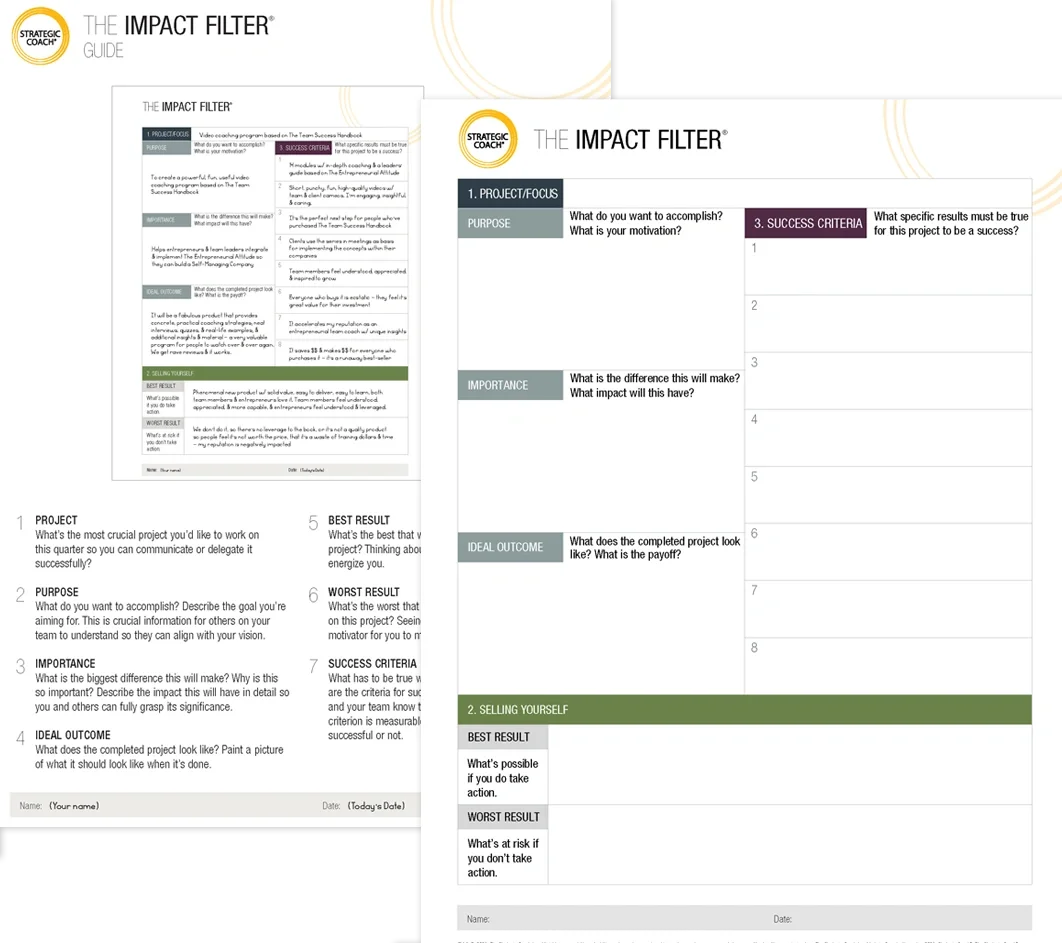
And so I feel like the time from idea to seeing something that you can play with or, by the way, seed living has shrunk to being, you know, in an hour or two, you can now build something that works the way you envisioned it, even if you're handing off something much more complete and thorough to somebody else to implement. So I feel like there's freedom now that you didn't have before in being able to take your ideas further. It's not just throwing it out. If you use your example of your Impact Filter, it's not just defining success and failure and the success criteria and then saying, now go do it. You're actually able to use that criteria to build something. And I think that's a big unlock. You can get a lot further as a visionary entrepreneur with AI tools than you ever could before.
Dan Sullivan: I found an example because, you know, I do a lot of podcasts, but the one with Peter Diamandis is really interesting. I had a discussion with him and he really got interested in the idea. I said, I'm trying to find a historical precedent, something that happened in the past that is resonant with what's happening with AI. And I got it. There's a great book. It's called The History of Money: A Story of Humanity. He was a central banker in Ireland. His name is David McWilliams. And terrific book. And he's a great storyteller. Part of the reason is storytelling is really a great advantage. If you're a good storyteller with AI, you have an extra …
Steve Krein: What did you say his name was?
Dan Sullivan: David McWilliams, M-C-W-I-L-L.
Steve Krein: Got it.
Dan Sullivan: And he says money is our central technology. He says if you really want to know what improvement, and he said, I can go back 5,000 years to the Middle East. There was a city called Sumer 5,000 years ago. And he showed a story of a beer maker. He's the first human that's actually recorded anywhere in human history 5,000 years ago. His name is Kazim or something like that. And he had just taken a loan of barley. And it was a two-and-a-half-year loan. And he was paying 33 percent per year. And he thought it was a real deal, you know. And it's put in clay and everything. And they found the story. But he was borrowing money—a lot of barley, because barley was actually the currency. That's what they did. You know, a day's work is worth a bushel of barley. They had to find some constant. Apparently he was a good beer maker, because at 33 percent interest, apparently he thought it was a good deal, or it was the only deal.
So I got really interested in his book, but he talks about the revolution, the cognitive revolution that happened, and it started in Sicily, as far as he can see, European entrepreneurs were dealing with Arab entrepreneurs and the Arabs had inherited zero, the whole concept of zero. You had nine numbers and you had zero. And he said this is one of the most revolutionary things that ever happened because they were still using Roman numerals and trying to do fast division and multiplication with Roman numerals. You know, it's a six-week job to get an answer. And he said they noticed these merchants that came from North Africa or the Eastern Mediterranean, and he said they could sit there in their head and they could just immediately, good deal, bad deal, I'll go for that, I won't go for that. And within about five years, the Sicilians had 10,000 children, students, actually learning how to do zero. The big thing is it was a cognitive revolution, and this is really what I think AI is. It's you having a different relationship with your brain.
Steve Krein: Well, I don't know if any of this came from your book. You're thinking around on your podcast with Shannon, you were talking about subjective versus objective and what is true about what AI can do and not do and what humans can do and not do. Does that tie to any of the history of money thinking or is that a different thread? I found that very interesting.
Dan Sullivan: Yeah, he goes into double entry bookkeeping. He goes into compound interest. You know, he said these are fundamentally cognitive breakthroughs. The thing I think is interesting about it, from my standpoint, you know, being who I am and Strategic Coach is that anything that gets me thinking in a new way or a different way is really a big deal, because you don't have ambition at 82 unless you're excited about the way that you can go about your thinking.
Steve Krein: Are you finding anybody at your age even close to thinking about or leveraging AI the way you are?
Dan Sullivan: No. I brought up the subject of medical science, you know, that my sense is the thing that we do most with David Hasse is plasma transfer. We have two IVs, one out of this arm, another one going back into this arm. The blood goes out, it gets put through a centrifuge, the plasma is taken out, and new albumin is put in. David Hasse is pretty cutting edge. And he's got really, really long studies of people using plasma exchange where it stops dementia and it starts repairing dementia. Then he said it has to do with having clean blood. And he says blood slows down when it gets thick. And if you can constantly renew the youngness of your blood, he says, the oxygen gets to the brain faster. And he says a lot of people slow down because their brains aren't as fast. The blood going through their brain, it's just slowing down. It's thick blood.
Steve Krein: I feel like it's the, I just changed my water filter under the sink. There's two different filters, but one of them you don't have to change until like two years and it starts to blink and you know you have to do it. I'm bringing this up because what you just described made me immediately think of, we were very used to a slower drip out of the filter faucet and it was slow, by the way, over time, but we didn't realize what it used to be, so I changed it last night and it's literally like a fire hose now.
Dan Sullivan: Yeah, it's the exact analogy. It's hard to tell because Babs and I are doing a lot of different things, but I think the stem cell, the brain stem cell that we're doing in Buenos Aires with the scientist, his name is Moviglia, and he's going through the FDA in Washington. He's gotten his green card. He's starting to get patents for his process that he's been developing over 45 years, and now he's got some real connections in the U.S. that probably in about two years what we're doing in Buenos Aires will be available in the United States. So my air miles, I won't get as many air miles, but I can do it.
Steve Krein: Where's that going to be, Dan?
Dan Sullivan: It's under wraps right now, because it's not a done deal yet.
Steve Krein: Yeah, that's great. That's going to be a big breakthrough.
Dan Sullivan: But he's about 75. He says, I'm into the best zone of my scientific research right now. And he's got issues like a lot of people do. But the thing that I notice is, my level of excitement about what I'm doing, this is your, for me, this is your 52 since I became a coach. And the stuff that I'm thinking of right now, and the patterns and the insights I'm seeing, I've never had them like I have right now. But I wouldn't be if I hadn't done all the medical work over the last 10 or 20 years. And now, if you're clear how you'd like to be at an even older age, like I'm now bouncing off 100 and all my planning, it's 18 years from now. And I said, you know, I need to be improving every quarter, appear to pull this off. And so there's this excitement of what you're actually doing, but the fact that AI is now such a big part of the medical profession. So, you know, when I brought out My Plan For Living To 156, the book, I was in my forties when I did that. And people say, yeah, we'll just see how you are when you're 70. And then they saw me how I am when I'm 70. Now they're seeing how I am with their 80. And they say, you know, I'm starting to take that seriously, this stuff.
Steve Krein: You know, what's interesting is how few of the tools, techniques, breakthroughs were even around, forgetting about when you were in your fortie. Like, if you just think about AI coming along three or four years ago, and perhaps if there wasn't AI, you wouldn't have this cognitive upgrade that you're getting that matches the medical upgrade that you're getting related to the medicine and the stem cells and all these things. And I'm just wondering, how much more ambitious are you as a result of now having AI combined with everything you're doing, then the analog capabilities you had just a couple of years ago, or even, you know, as you described before, Claude, there seems to be cognitive upgrades now on a weekly or monthly basis through these tools as they race to kind of beat each other. But I can't imagine the excitement and the freedom that comes from it now having those capabilities at 82.
Dan Sullivan: Yeah, it's very profound. And Babs is doing it too. So as a couple, we're, Babs is improving, you know, I mean, we have a division of labor; she runs the company and I'm responsible for what's on stage. We've been at it now for 37 years. But you know, what we're doing today far surpasses what we were doing 10 years ago.
Steve Krein: Have you had to adjust or accelerate any of your goals or thinking around what's possible in the shorter term? You know, even when you think about the kind of quarterly books you're putting out and some of the things that you're doing and thinking about, what's been the biggest change in terms of what, besides the speed going from three weeks to three hours in developing your quarterly book?
Dan Sullivan: Yeah, I think the biggest thing is we had CoachCon again this year, so we did it in Orlando in June, and we had Angus Fletcher as our first speaker. He's really on to something. He's a professor at Ohio State University, but he has essentially his whole faculty as his ideas. They gave him a big building. His big thing is that what you do with your past determines what you're going to be able to do with your future. You know, that's his central theme. And he says you got to be telling yourself a better and better and more integrated story about who you have been in order to have the capability to be better, you know, and he works with special forces. He's like a guy that they brought in from outside to get special forces, because special forces, Green Berets, Delta Force, all the different SAS in Great Britain, that they're put into chaotic situations where they have to make good decisions with very little information. And I said, that kind of sounds like entrepreneurism to me.
But he said the big thing is that every Special Forces person has to have a story about who they've been up until now, because it's their story that enables them to make really fast decisions. And it's not a story they share in common with other people. It's just their story. And if I'm in a dangerous situation and I have very little time, I have very, very little resources, how do I make a good decision? And it's not logical. It's just that you've handled these type of situations in your past, and your brain is fast enough that once you identify the situation that you're in right now, you make a decision. And his whole thing about it is, he said, we've been taken over with a way of thinking that was started by the Greeks 2,500 years ago, where it has to make logical sense. And he says, these situations don't make logical sense at all. And he said, but you instinctively know from your grasp of who you've been up until now, this is the way you're going to go. And it's instantaneous.
And he said, logic is for arguments. Storytelling is for action. You have to perform action. So what's the best story? And that's what I'm noticing, you know, with all the medical work that we're doing is people say, we do this or we do that. And I said, that one's a lot better. And they say, well, why is it a lot better? I said, it feels a lot better. There's more energy. Yeah, but does it make logical sense? And I said, I'm not having an argument. I'm trying to create a successful action. And I think entrepreneurism is about what's the successful action that you have to take.
Steve Krein: Circling back to the subjective-objective view of things, I was just thinking about the feeling you just described, subjective. How do you think that plays into, like, is there an unlock when people embrace that difference with their use of AI? And is there a blurring some people are doing of where they're thinking about their thinking merges with AI thinking? Do you see that being a big unlock, or is that more just an observation?
Dan Sullivan: No, I think it's a big unlock. And some stories that I've heard about what Anthropic is doing sort of indicates to me that the main goal for a lot of the AI pioneers, you know, the people who are doing the technological work, is that they realize that the human brain doesn't operate like a computer. Ray Kurzweil believes, well, it's all just computing. And at a certain point, the machines are going to be faster than the brain. But more and more, I think they're realizing that the brain is not a computer. It's not an information processor. It's a meaning maker.
Steve Krein: But you are offloading a bunch of things that you just don't have to think about anymore. You were describing simple math or things that you just don't have to think about. Once you learn it, two and two is four. Does it free us up to be more creative? Does it, you know, how the real unlock and across your community, what do you see the gap being between those that are the furthest along with it and those that are the least?
Dan Sullivan: They say yes or no really fast. Yes, we're going to do this, or no, we're not going to do it. And they're not doing three months of analysis why that should be true. Elon Musk is probably pretty good at this. And that a fast decision that immediately is the wrong decision is better than not making the decision at all.
Steve Krein: Yeah, which, by the way, comes full circle back to how we started the conversation around failure, which is if you're not afraid of it. And I think his first principles, thinking and philosophy, which he's very forward about in every decision he makes and articulating why he's questioning things that have been what was thought to be common sense or common knowledge about the way rockets are built or not reusable or all those things. He cheered when things blew up. He cheered when things didn't work. And I think you're saying there's quicker decisions. Do you think there is also a more open to failure kind of shift happening because you can turn that failure into a positive lesson and takeaway quicker?
Dan Sullivan: Yeah, I think that failure is just part of the creative process. Basically, he's seen it.
Steve Krein: Accepted.
Dan Sullivan: Yeah, it's seen as a unified process where if it doesn't fail, you probably haven't tested it enough. Let's switch the partner. You had a view, probably you were 10 years into the Program when you came up with the idea, you know, that you would create basically a global community of entrepreneurial business founders who are in the areas of medicine, you know, and that was it. But a lot of it just depended upon government funding, you know, in various countries, and all of a sudden the world changed, partially because of a political change of who's in charge of the money and everything like that. So it's almost like a paradigm. You had a paradigm. Government's always going to be spending money. The big thing is to link up the right funding sources with the right researchers. But it can be interrupted where the money is not available because they aren't sure which direction that they're going in. And that directly affects you.
Steve Krein: My very oversimplified view of health care now is it's predictably unpredictable. Predictably unpredictable on how long things are gonna take to reach the patients, the families, the people that are impacted by the most. There’s so much regulatory and other political molasses that I have to get through that. It's funny, I kind of equated to when you're using AI and you're sitting there waiting for the response, it now shows you all the things it's doing. And Fable 5, which is a fascinating new model to use, by the time this comes out, obviously more people will have used it, but also maybe it'll be past even Fable 5, you start to look at and go, I can be doing other things while I'm waiting for that to happen, and I feel that in health care. We planted a lot of seeds, we invested in hundreds of companies, but there's no predicting how long things take to get to commercialization, to scale, to exit, to any of the things. And so what else can you do while that's running?
And so what's interesting is, rather than being frustrated by it, I've learned to accept it and build it into the plan, right? So as an entrepreneur in health care, I think you're up against things that have no ability to control. Other industries outside of health care, there's entrepreneurs building and executing and getting commercialization scale on a different timeline. So I look at it as now a piece of what I'm doing, not the only thing I'm doing, but regardless, I think the capabilities that we now have as entrepreneurs in 2026 when we're recording this is not only never been seen before, but it's at a level that you can take—and I think over the next five years, by the way, in health care as well, over the next 5 to 10 years, you're going to be able to see things and get things done that were never possible before. And so I think the roles are being rewritten in a lot of ways because of what's possible with AI.
Dan Sullivan: Yeah, I spent a lot of time reading historical fiction, and there's this British writer by the name of Andrew Wareham, who I don't think really started writing his stories until he was about 60 years old. He'll take a section of British history, a lot of it is around the sailing days, the great golden age of sailing before metal ships. First of all, they were wooden ships. They were wind-powered. But he never goes to paper with any of his books. They go strictly to digital. So he doesn't wait around. I mean, we had the new book, The Greater Game, which came out in May, and we have the Casting Not Hiring coming out with Jeff. Book publishing is the last of the great 19th century industries because they have very, very slow processes. But I only write books to get people to sign up for the Program. I mean, the money that you get for writing a book, it's, you know, it's just change. That's why the first three books, we didn't take any money at all. We just wanted to reward the writer who actually did the writing so that he would write them fast. But the big thing is that, just going back to the point that you're talking to, you now have wisdom where you didn't have wisdom before.
Steve Krein: Yeah, where you're surfacing it more.
Dan Sullivan: Yeah, and the big thing is that I'm working with a writer who's only written one book in his life, but I've written 62. And I just realized how you create a book and how you go along and who you have to have on the team. I just know the time frame that you could do it, someone who's only written one book or maybe no book at all. Ben Hardy had never written a book before we started. He was a graduate student at Clemson, you know, he was just getting his PhD. But he was a blog writer. He wrote on Medium. He was the top Medium writer. I just said, you know, the editors at the publisher will get to our manuscript when they get to their manuscript. They're doing 60 books this year, year one of 60, and you've got to take a ticket and stand in line. But I think that there's a sense that I think smart people are going to get smarter, and I think that non-smart people aren't going to improve at all as we go along with AI. I think there's a great divide that's already happening with AI, very unequal. It's creating an enormous inequality, and it doesn't correspond to who used to have the highest status. It's the people who can develop thoughts and get them into action the fastest and in the best possible way.
Steve Krein: Yeah, so I want to come full circle to something that you shared at least 25 years ago. And I know it was not even in my worldview in my twenties or thirties, which was the retirement track tool that you used to do as part of the original first couple of years of the Program. And I remember my mind being blown, you know, at that age, hearing about not retiring and the idea of a mindset shift or a mind shift that occurs when you flip that script from how you define retirement. I thought that would be a nice way to end this episode, because the way you used to define the retirement trick, and by the way, you were also a lot younger, so I can't imagine your perspective of how you define retirement now, how you've seen your peers probably a decade or two ago retire. How does AI change your thinking about the retirement trick?
Dan Sullivan: Well, first of all, I think that technology is on my side, and I think that time is on my side. Because I'm in far better physical shape, just according to the tests, at 82 than I was at 62. You know, we do a complete bank of tests, top to bottom, three times a year with David Hasse. I was there about three weeks ago in Nashville, and they took out 42 vials of blood, and they went off to 10 different labs around the country, and then we get a big bank. And if we even look to when we started this process in 2022, it's four years right about now. I'm just better, you know, by all the standard tests. So my sense is that four years from now, the tests are going to even be better. The big thing is you die because you didn't test. Really, I'm at the point now where I say the people who die didn't get tested or they got tested too late. So you got to be doing the test all the time, more so when you're in your eighties, because cells don't develop at the same speed. They reproduce 50 times every cell in your body, and they haven't solved that issue yet.
But staying on top of it is really, really important. People said, don't you think you're going to die? I said, I am going to die, but I'm going to die on stage. In other words, I'm going to be in the middle of what I'm doing. I'm not going to retire and go to the departure lounge and spend 15 years in the departure lounge waiting to die. I'm just going to push it. And Elon Musk, I think he's very insightful on more levels than technology. But he says, you know, I'm not for this living forever. He says, people should die. First of all, they get a sense of urgency of making an impact while they're alive. He says, that's one thing that death does for us. But going back to the retirement conversation that you were talking about, I said, there's two things that you want to retire from. You want to retire from activities that you don't like doing. You want to retire from people that you don't like hanging around with. I said, just make a clean sweep of getting rid of everything you don't like doing, and then just only have people that you like around you, and that's retirement.
Steve Krein: The way you defined retirement was also impactful because I think the idea of what do you do, I do think what you could do as an entrepreneur in your sixties or seventies before has now changed because of AI. But can you describe how you define retirement or what retirement means, the definition? How it plays into people's mindset about not only going through it, but after.
Dan Sullivan: Yeah, well, there's two things. They retire racehorses and they retire battleships. What it means is you're taken out of use. You know, I can't wait ‘till 15 years from now when I get to be taken out of use. You know, it just doesn't seem to me a compelling offer. Yeah, I mean, you look younger. You've been watching me. I've been watching you. And you seem a lot younger than, let's say, four or five years ago.
Steve Krein: Oh, yeah. I feel like I absolutely have the energy, excitement, and ambition that probably surpasses what I had when I was 25. And I feel more capable, not just because I know how to use the technology, but I see very quickly the multiplier physically, mentally, spiritually. The retirement trick and its impact on me when I was in my thirties, as an example, I think is now playing out. Like the things I did 20, 30 years ago playing out now, I feel the same way about what I'm laying now for a couple of decades from now. But every day I wake up and I can't wait to sit down. Interestingly enough, it used to be collaborating with other people was the unlock for a lot of things that I was ideating on or envisioning or wanting to do. I find now I can do a lot more alone with AI and get things a lot further along before you bring in collaborators. And that's exciting. It feels very empowering. And I think it impacts not just how I think, but how I feel.
Dan Sullivan: Probably you get some feedback from your family and friends on who you are. You know, what I notice is that, you know, it's just an analogy, but you can't be a performer on the field and be a spectator in the stands at the same time.
Steve Krein: Yeah. Yeah, there was a movie, a Robert De Niro movie, maybe it was 5 or 10 years ago, and I think it was called like The Intern or something. Robert De Niro was a very successful businessman and had retired and became an intern at this company.
Dan Sullivan: Oh yeah, I saw that movie.
Steve Krein: Yeah, it was funny, but it actually was the retirement trick playing out, right? It was like, here was this vibrant, very successful, he might've been a business owner or an entrepreneur, I forget what he did before that, but you kind of saw he was lost. I remember he was watching all the buzz. And I think the movie would be different today if he kind of did. I think AI has invigorated it. A generation of entrepreneurs have been in the game for a long time. To have a future much bigger than their past seems not only possible, but inevitable now.
Dan Sullivan: Yeah. And you can really see it. My feeling is, basically operating in three countries, so we operate in the U.S., Canada, and the UK, that the U.S. is really going into warp drive. I can just feel the country going into warp drive right now. And I think it has a lot to do with, I think the best way to be an American is to be an entrepreneur, because everything in the Declaration of Independence, the Constitution, everything favors people who are doing new stuff. And my sense is that Guy Karp, K-A-R-P, who's the CEO of Palantir, you know, I mean, Peter Thiel was, you know, one of the founders, but he said, I don't have any deep research on this, but I've got anecdotal research that AI favors blue-collar workers over people who are over-educated, and the only thing they know how to do is to call a meeting to schedule some more meetings.
Steve Krein: I used to say it was the greatest time in history to be an entrepreneur 20 years ago. I think this is the greatest time. I mean, entrepreneurship is being democratized. And I think in some ways the gig workers of like, you know, Instacart and Uber and all that stuff's been one layer, but the knowledge worker who now doesn't need to find a company to work for. I think they become independently free to bring their unique abilities to organizations and companies and others. And I think the collaboration is now going to happen at the individual level, not just at the company level. It's incredibly exciting, but I think you're right. The overeducated or even those that only operate and they knew how to play the political game in a company are going to be out of luck pretty soon.
Dan Sullivan: Recent political thing is socialism. And who you look at in your city, you have the mayor and then you have the three nominees for the congressional districts in New York. And what do they have in common is that they actually come from wealth. And the other thing is that they've had an enormous amount of education, but not much experience in the marketplace. You've got to be useful. You've got to be continually useful to other people. You've got to know which way the wind's blowing in terms of where the market is. I think the market is really the decider of what gets paid for and what doesn't get paid for. And it doesn't matter what your status is and what people told you. It doesn't matter how much debt you've gone to get educated. You're going to come out and you're going to catch the escalator to the top. There's no walking the stairs if you have a master's degree and everything.
Steve Krein: No, that's not the way it works anymore. Dan, as we wrap up, what's your biggest insight from this conversation? What was your biggest takeaway? What role changes as a result of having this conversation?
Dan Sullivan: I think the big thing is, don't think about your job. Think about your role that other people find valuable. In other words, what is your role as a person? What do you bring to the table that makes life easier for other people and they're able to make greater progress because they have you in their life? And that seems to me, if you're designing how you can make money in the marketplace, that's a good place to start. Just find out what they want and can you either connect them or can you actually create something for them that makes their life better and easier.
Steve Krein: Yeah, mine was early on in the conversation and maybe even a little bit before we got on the conversation talking about the harmony of failure and breakthrough success and how they're actually not against each other. They actually harmoniously go together and your biggest breakthroughs come from your biggest failures and the embracing of that. And I know we touched on it early on in the session, but that really you got to develop a nervous system.
Dan Sullivan: That's okay with that. Yeah.
Steve Krein: Always enjoy the conversation, Dan.
Related Content
The Impact Filter®
Dan Sullivan’s #1 Thinking Tool
Are you tired of feeling overwhelmed by your goals? The Impact Filter is a powerful planning tool that can help you find clarity and focus. It’s a thinking process that filters out everything except the impact you want to have, and it’s the same tool that Dan Sullivan uses in every meeting.