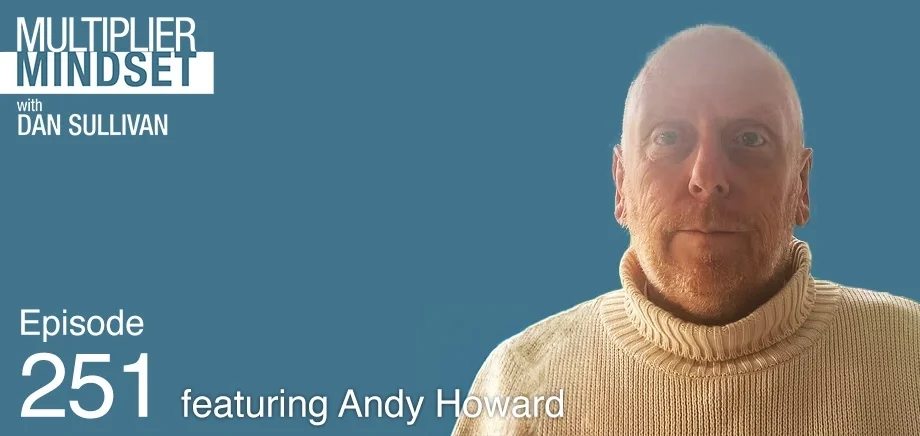
Not Being Normal Is Your Biggest Advantage, with Andy Howard
June 10, 2026
Hosted By
 Dan Sullivan
Andy Howard always knew he didn’t think like everyone else, and school confirmed it. Today, he runs Karuna Impact, a niche property business that converts underused commercial buildings into homes and channels a third of its profits to fight child bed poverty. Discover how Strategic Coach® helped Andy transform discomfort and loss into clarity, confidence, and a powerful freedom of purpose.
Here’s some of what you’ll learn in this episode:
- Why Andy’s entrepreneurial mind didn’t fit formal education.
- What Andy started doing after school that finally felt energizing.
- How a neglected niche in property became a huge growth opportunity.
- How Andy has gained confidence and clarity through Strategic Coach.
- What sparked Andy’s renewed sense of purpose as an entrepreneur.
Show Notes:
Many successful entrepreneurs don’t thrive in school, so they use their own experience as their real education.
Most coaching programs focus on goals and tactics; Strategic Coach focuses on expanding your freedom.
Freedom isn’t handed to you—you earn it through the entrepreneurial journey.
To be free in any area of life, you first need freedom over your time.
As you grow your personal freedom, you naturally create greater value for others.
For many entrepreneurs, work loses its energy once it feels routine.
Big opportunities often live in niches that most people overlook.
Social impact and company profitability aren’t mutually exclusive; a well-designed business can achieve both.
Strategic Coach thinking tools help you get crystal clear on your vision and the people needed to achieve it.
Every Program Coach is an entrepreneur, so they coach from real-world experience, not theory.
Finding a community of like-minded entrepreneurs makes it easier to take risks and pursue bigger freedoms.
Clarifying your freedom of purpose gives you the motivation to keep growing long after you’ve hit your initial goals.
Resources:
The 4 C’s Formula by Dan Sullivan
Who Not How by Dan Sullivan with Dr. Benjamin Hardy
The 4 Freedoms That Motivate Successful Entrepreneurs
Everything Is Created Backward by Dan Sullivan
Episode Transcript
Dan Sullivan: Hi, this is Dan Sullivan. I'd like to welcome you to the Multiplier Mindset podcast. Hi everybody, it's Dan Sullivan and we're here at the Strategic Coach and this is our Multiplier Mindset. Really great interview with Andy Howard and Andy has a very specialized entrepreneurial niche. He takes commercial buildings and turns them into residential buildings with the ultimate purpose of finally for lots and lots of children, thousands of children, they actually have their own bed, they actually have their own home, and he makes a living doing it, and he's a successful entrepreneur. Right at the beginning of the interview, he talks about the fact that he didn't get much out of the school system, and the school system didn't get much out of him. And that seems to be a tremendous characteristic of the entrepreneurs that we have in Strategic Coach. And personally, over the last 50 years, I've coached 7,000 entrepreneurs, so I've got a pretty good feel of the type of creature who decides to be an entrepreneur. And Andy checks all the boxes. That is, they want to use their own experience as their educational system.
And I remember when I was 20 years old, first time I went to the UK, 1964, I was taking a train ride from London up to Scotland. And I kept a diary, and in the diary I said, you know, I'm actually an educator. This is 20 years old. I'm actually an educator, but I want to create a system and I want to create a structure where really creative and adventurous people can use their own experience as the lessons of their educational system, which means that they will never stop learning and their educational system will go on for the rest of their life. And it took me about another 10 years before I could get the structure, so then at 30 I actually started coaching entrepreneurs. The type of experience that Andy talks about of really doing it on his own, you know, he's learning, he's getting a handle where in the marketplace is unique skills. He's a 10 Quick Start. That's a profiling system we have. I'm a 10 Quick Start. So I grasp what Andy is talking about.
But the big thing about Coach is that there's lots of coaching programs out there, but they more or less just talk about what are your goals and what are the tactics of getting your goals. But for Strategic Coach, it's really about freedom. And that is that starting as a child, there's this desire for freedom that the normal childhood, going through school and being taught and everything else, doesn't give them the freedom that they actually want. And what they understand is that in order to be free in any way in your life, you have to have freedom over your time. And what that requires is that you have freedom of money so that you can buy back your time. Freedom doesn't come free. You got to earn your freedom. You got to pay for your freedom. And that's where the entrepreneurial journey becomes necessary. You've got to do something unique, have your own niche in the marketplace, and you get paid in an unusual way. But what you're doing is freeing yourself up to take on bigger and better collaborative relationships with other entrepreneurs. And your purpose is to create enormous value out in the marketplace.
And so I see totally the picture of where Andy's going. And I met him for the first time two or three months ago. He was on one of our 10x Connector calls. And I said, everything he's talking about, I can see him doing this for the next 50 years and getting better and better at it. And that's the beautiful thing about the entrepreneurial life. It gets richer. It gets more multi-dimensional. It becomes more impactful. It creates greater and greater value. And as long as you stay with increasing your own personal freedom, you'll be creating enormous value for other people.
Andy Howard: So I'm Andy Howard. I'm in my second year of Coach. I've just joined the 10x Program. So I did The Signature Program for the first year and moved into the 10x. I own a company called Karuna Impact and so what that does is it converts commercial buildings to residential in the UK currently and then it diverts a third of its profits to charities that help to eradicate child bed poverty in the UK, and it's also starting to train young people about small-scale property development. So I did The Signature Program for a year and then I'm about two or three months into my first 10x year. I think I identified as a child that I thought differently from other people and I didn't really fit into the school system. I fit in at school, I had friends and usual school stuff, but I just didn't fit into formal education. So I was quite a naughty child because I was bored a lot. And so whenever we went into lessons, I was looking for shortcuts, and they wanted granularity, and that wasn't how I thought. And so my mind would drift off to other things, other ideas, other things that I should or shouldn't be doing.
And so I think I knew early on that I didn't want to do what everybody else did. And I would find pathways to do things. I would always simplify everything. I still do it now, and I would do it as a child. That's okay, but not everybody gets it. And so, you know, I left school at 16 because it was probably best for the school and for me. And so I went into a number of jobs that I just didn't like. They were just jobs, right? I didn't like them. And it was only when I started to do stuff for myself and started to think for myself and put my ideas into place and take on little, what I would call side hustles, while I still had a main job, that I began to enjoy myself. And everybody else carried on their education. I left school at 16 and just, you know, it wasn't the place for me. And I think the school were pleased too. It felt like the right thing, but I didn't know if it was the right thing because everybody else had jobs. And so actually I began to think, is it me? And well, I suppose in some respects it was me, but I just didn't work like everybody else did.
Like I said, when I left school, I just took on a succession of jobs that I didn't enjoy. They weren't suitable for me. I probably wasn't suitable for them. And then I started doing odd jobs for other people that they didn't want to do. I just started to see opportunities. And they could be really menial things, right? Just people paying me to do stuff for them. And then some years ago, I set up a recruitment company, a construction recruitment company with some partners. And I enjoyed that. I really enjoyed that. I enjoyed the start of that, but I didn't enjoy as it grew. And that's very difficult. You need to find the right partners. That's not a criticism of the people I partnered with, but I like the excitement of the new ideas. Where I become less comfortable is when it becomes very normal, and my attention goes off to other things. And so, during the course of that process, I thought, I'm going to go away and teach myself about property development, because I'd always been interested in it.
And so, I went away and I thought, I need to focus on something. Where's the niche? You know, property development is a huge industry. Where's the niche? Where can I make myself different? And that's where I came across converting commercial buildings to residential. And lots of people turn their nose up at that marketplace, you know, and that's why I like it. Because, you know, it's a niche. It is a niche. It's not everybody's thing. But that's why people leave it alone. And that's why there's huge opportunity in it. You know, there are lots now, there are lots of commercial buildings that are underutilized. And so there's huge scope for the growth of this business.
So it didn't even start off accidentally. It started off with me carrying out small jobs for other people. I then started a company. Then I got bored with that. And so then I went into property development. And to some extent, it still didn't satisfy me. And that's why I moved the business to be an impact business. I wanted to impact other people positively, too. But I wanted to combine that with a business. And I thought that the idea of social impact and company profitability are not mutually exclusive. And again, when I started doing this, people have said to me, are you mad? But actually, actually, now I had the courage to launch it. And that came through Strategic Coach, really, giving me the confidence to do that. That's not a plug for a Strategic Coach. It just did. I just jumped and did it. It's the best thing I've ever done. Honestly, it's the best thing I've ever done. Just to see the interest that people have in this business now is incredible. And we only launched it last year.
Even yesterday, somebody who runs the world's biggest bed poverty charity contacted me, and I had a Zoom call with him yesterday. It's amazing how many people are coming out of the woodwork, and all these new potential collaborations. I see the potential impact growth in this as exponential, exponential. You know, to do that, it has to be profitable. To make the impact, it has to be profitable. But I'm so pleased I did it, because it's just given me a really renewed sense of purpose. This partly comes back to how I always thought I thought differently from other people. I looked into Strategic Coach. I thought, that feels like my group of people. And so why is that giving me confidence? Because I walked into a room full of people, and even when we do the 10x calls with Dan online, they're from all sorts of industries, all sorts of capabilities. And there's some big people in that room. There's some very successful, very thought-provoking people in that room. And so once I'd settled in and realized that actually being in that room was a good thing and a comfortable place, you know, those people thought like I did, that's what gave me the confidence.
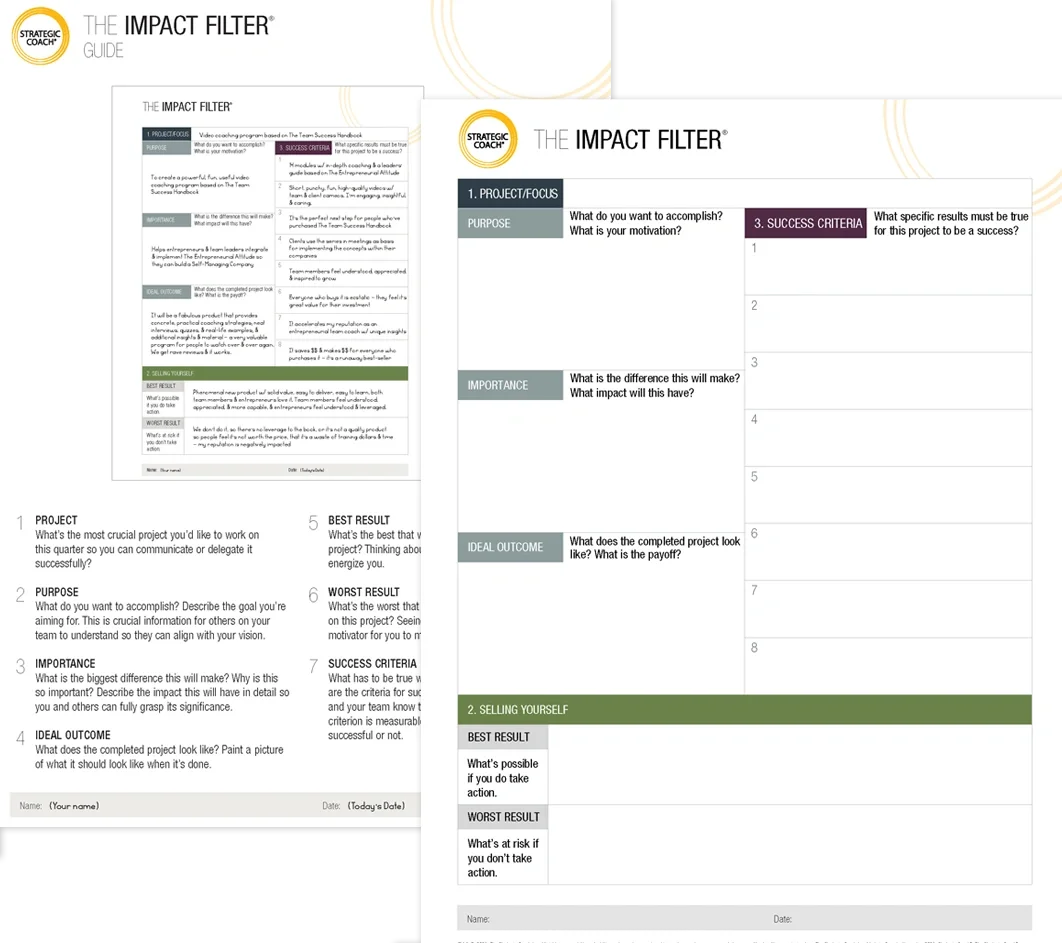
And I started to look at some of the tools, and I've always had an aversion to administration. At admin, I just, I can't do it. I think I'm a 2 Follow Through and a 10 Quick Start on my Kolbe, right? So admin-related things cause me problems. But when I got to grips with some of those tools— they're actually creative thinking tools—and where I initially viewed them as, you know, more paperwork, they're not. They're not. They really force me to sit down and to look at my vision, to look at who's involved in it. I think as well, you know, things like The Impact Filter help me to communicate to others what I'm thinking, rather than just shooting from the hip and expecting everybody to understand it. You know, I always struggle with showing vulnerability. And I think that what Coach has taught me is that it's okay to be vulnerable. And I think that when you can start to drop that mask of invincibility and show vulnerability and tell people that I don't know, but somebody else might do, I found that's been the biggest confidence booster that I've had. Because it doesn't feel nice doing that, and it doesn't feel nice to somebody who naturally doesn't do that. And then it's clarity.
I know Coach talks about The 4 C's, you know, the Commitment, Courage, Capability, and Confidence. But the thing it's given me behind that is the fifth C, and that's clarity. You know, it's really helped to slow my 10 Quick Start brain down to just, you know, just to a pace where it's doable, because otherwise I'm going off at all sorts of different angles. That clarity and confidence, I think, are the two things that are allowing me to look at collaborations now as well. And so now I'm clearer on my thinking. I'm far more confident in talking to other people about how we could work together to expand our impact. So it has given me confidence, but it's given me clarity. Slowing my brain down is a good thing sometimes. Discuss that with a network and, you know, I found Coach should not be prescriptive, you know, it's not someone gives you a load of facts and you're going to take facts. It's absolutely about what you just said. It's engaging with your tribe, and you know they'll show their vulnerabilities with it, and people have said that I'll help you. We'll do this. I can help you do that. And it’s been great.
You know, one of the first things, and I still remember this, one of the first things when I walked into my first Signature Program, there was a guy sitting across the table to me and he just said to me, what can I do to help you? Just generally, I hadn't even told him what I do. He said, what can I do to help you? And I was quite taken aback. But actually, when you look at it, that's the whole ethos of this. There are people in there willing and very able to humor you, to give you a platform to talk and to share their fears with you. And I think once people start to do that, you become, I'm not going to use the word comfortable, but you're comfortable with your emotions. And that's a good thing, because that's real strength, in my opinion. What's possible is that the scale of what I'm doing is exponential. If my business helps one child get a bed, there are nearly 900,000 kids in the UK without beds. I could 900,000x my impact just by doing this. That, to me, is on a scale that I could never have imagined. I would never have had the confidence to do. I'm now talking to people in the U.S. and Canada about potentially replicating the model there.
And I think, as well, it's the, you know, that whole 10x growth piece is not thinking linearly. You will never get to where you want to go by just doing more and more work yourself. And that was never my thing anyway. But this collaborative, this Who, these people … I'm looking at collaborations, and there will be collaborations, I'm sure, that I don't even know yet. You know, I don't even know some of the people or some of the things I need to collaborate on. But I'm absolutely confident that I will find them. I think for me, I knew the idea was a decent idea, because I talked to other people and said to people, what do you think of this? And agreed, some people said you must be mad to do that, or you won't get the scale, or you won't get the traction. I think for me, it was the fearlessness of doing it. It was the discomfort of sitting there, and it doesn't pay to listen to everybody, does it? Not entirely. It was that kind of discomfort that I thought, oh my God, if I do this, I've got to launch this, I've got to tell people, and I've got to expose myself to challenge to people saying all sorts of things about it, that some might be nice, some might not.
But it was the pushing through that, I won't call it fear, I'll call it discomfort, of thinking, should I do this? And then there just came a day that I just thought, you know, I'm just going to do it. I'm just going to do it. What's the worst that would happen? I also felt the discomfort of doing it would push me on, you know, it would push me on to another level. I'm alright being uncomfortable. I'm at my worst when I'm comfortable, if that makes sense. I'm comfortable being uncomfortable. And that goes back to the school thing, right? If I didn't have enough to do, I would find something to do that generally wasn't the best thing to do. But pushing through that discomfort, if anyone is listening to this and thinks, I don't want to try something because it's going to be uncomfortable, unless you do it, you will never get out the other side of it. You will never have the experiences. And it's not necessarily about the goal. For me, it's about the journey, the change that I go through by putting myself through uncomfortable situations. You know, it doesn't always feel good at the time, right? It doesn't always feel good at the time. But it does afterwards.
And I journal every day three things. I think Dan said there's three wins every day, three for tomorrow. They may not be the same things. When I look back and I do a 90-day review constantly of those three wins, the change in me, even in the time scale that I've been doing it, has been phenomenal. And I recognize achievements now. You know, you forget about some of the things you do, whether that's a new confidence, competence, whether it's more clarity on something in action that you took as a result of some of the obstacles you face now, whether those obstacles were actual obstacles or obstacles in your head. The challenge is to take the action afterwards, and that feels so much better for doing it, but it feels a bit rough at the time.
What triggered me doing this was the worst thing that's ever happened to me and the best thing. I did this because I promised my mom I was going to do it and my mom became really ill last year and my mom died, and so I promised my mom I would do this. And so the worst thing that ever happened in my life actually drove me to think, do you know what? I was going to do this anyway, but I promised my mum I was going to do it. That sounds really simple, right? But that act in itself, you know, losing my mum, that's the worst thing that happened, isn't it? But the best thing that happened was then I did it. And so I now see that I can impact the lives of thousands and thousands of kids who will probably never know me. So it's that idea of planting the tree, a shade you never sit under kind of thing.
So the best thing that happened is that I started to realize the positive impacts that these actions could have on other people and these could be life-changing. And so the emotional connection to doing something like that, notwithstanding the fact we do property development, you know, that's kind of what we do. But the increase in the why I do it. My freedom of purpose has grown beyond anything I could imagine. Beyond anything I could imagine. The best thing that's happened is I recognize how my freedom of purpose has expanded. Why is it important to me? Because I'm playing on a bigger stage. It's that. I'm playing on a bigger stage. We talk about the freedoms, and whichever freedom is more important to you, and I know they're holistic, but some of those freedoms may be more important to you than others. It's the freedom it gives me, and I realize when I look around at the people around me, I'm playing on a bigger stage, and that pulls you forward. It makes it uncomfortable, too. It makes it uncomfortable. If you can get comfortable with being uncomfortable, then to me, that's where the money is.
And if you're entrepreneurial, I couldn't think of anywhere better. You know, they should be asking themselves a question first. Do they really want to expand themselves or not? And I think, you know, lots of people dream about putting themselves through these situations and, you know, will I expand? But the difference between the people that think about it and the people that do it, that's why somebody should do this. If you're really committed to exponential growth in terms of yourself and whatever industry or your role within that industry, then absolutely do it. If you're committed to making those changes. It's the people and the coaches, right? Everybody is so welcoming. Everybody's so keen to hear your story. Everybody's keen to share their stories. And for me, it's been the … comfort sounds like the wrong word, but it has been the comfort of being able to do that in an environment. And the coaches, you know, and nobody's asked me to say this, but the coaches are great. Dan's great too, but the coaches that we go and spend the time with, they're brilliant. They're absolutely brilliant. And they're entrepreneurs themselves. If you're ever going to take advice about entrepreneurship, take it from an entrepreneur, not a book.
For me, it's the journey home afterwards. On the journey home, I'm buzzing. I'm full of ideas. It's great. It's great. It's stimulating, if you're an entrepreneur. This idea of collaboration and the exponential growth, every time I do the 10x course and Dan does The Triple Play, I get anxiety, because I sit there and I think, oh my God, what am I meant to be doing? But actually, when I do that and then go back and review it, it has forced me to collaborate, which forces me to expose my vulnerability continually. So tell him that, because that is the thing that really opens my mind up when we do that. It really is, even though I find it really uncomfortable. It's a dawning of realisation, that tool, and every time I do it, I think, oh no, we're going to do this again. And every time, I come up with a slightly different answer, and it's genius is actually in its simplicity, isn't it? I was going to say, it's so future focused, it feeds into my 10 Quick Start, right? So, I mean, it's great, it's great. The best place is either connect with me on LinkedIn, Andy Howard, or at www.karunaimpact.com, K-A-R-U-N-A.
Related Content

The Impact Filter®
Dan Sullivan’s #1 Thinking Tool
Are you tired of feeling overwhelmed by your goals? The Impact Filter is a powerful planning tool that can help you find clarity and focus. It’s a thinking process that filters out everything except the impact you want to have, and it’s the same tool that Dan Sullivan uses in every meeting.